What blending is, and the order that works
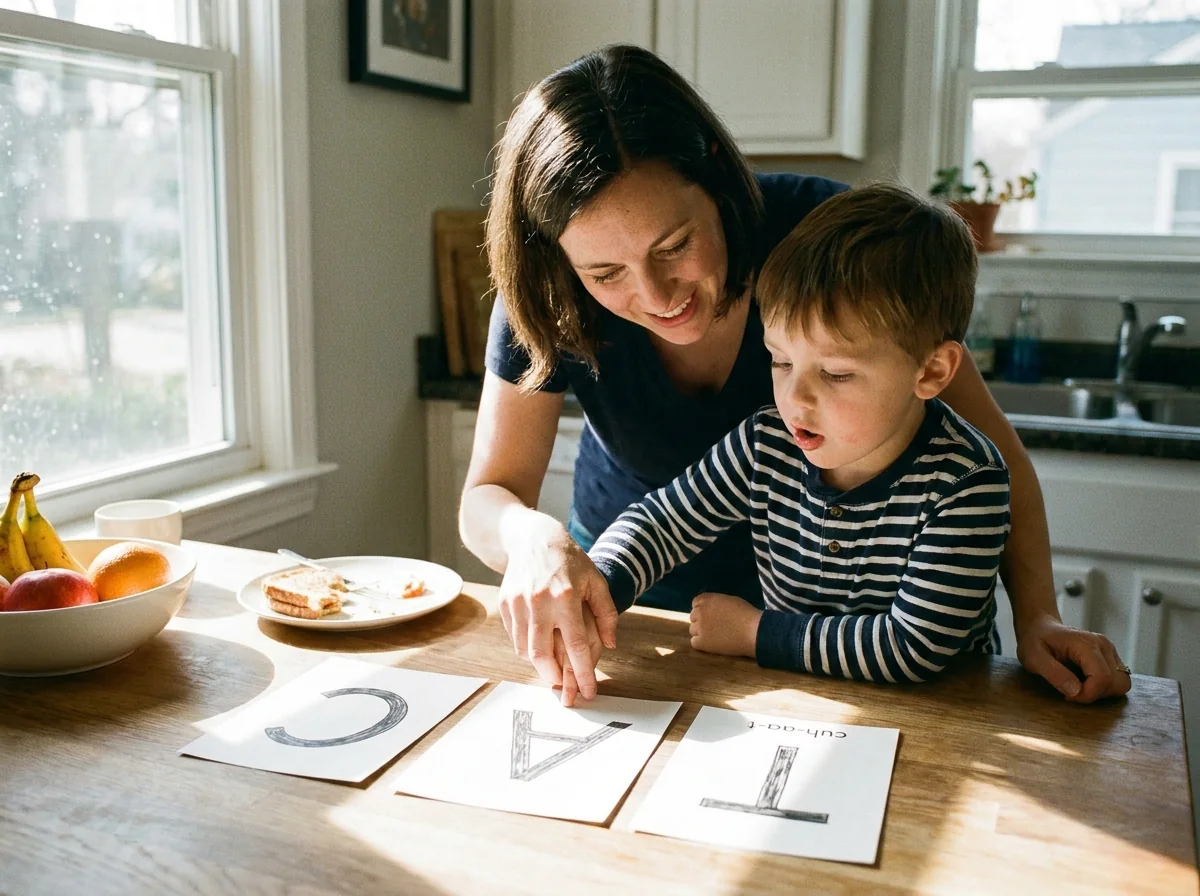
Blending is pushing separate sounds together to make a word: /s/ /u/ /n/ becomes "sun". It is the skill that turns letter sounds into reading, and it is the step where many children get stuck, because knowing the sounds and joining them are two different things.
The order that works for most children, at home or in a classroom:
- Oral blending (ages 4 to 5): you say the sounds, your child says the word. No letters yet.
- Blending with letters (ages 5 to 6): your child looks at the letters, says each sound and blends them.
- CVC words (consonant-vowel-consonant, like cat and mop), then words with four or five sounds.
Blending and segmenting are among the best-supported practices in early reading: the National Reading Panel found that phonemic awareness instruction, especially blending and segmenting, improves both reading and spelling (NICHD, National Reading Panel), and the Institute of Education Sciences' foundational skills guide puts blending at the center of its phonics recommendation (IES What Works Clearinghouse). In most US schools oral blending starts in pre-K and print blending is a kindergarten goal; in England it is Reception. If your child is 4, start with the games below and leave the letters for later.
Start with oral blending (no letters yet)
Oral blending is blending by ear. You say a word in pieces and your child works out what you said. Because there is nothing to look at, all of the attention goes into the sounds.
Move through these levels in order:
| Level | You say | Child says |
|---|---|---|
| Compound words | "cup ... cake" | cupcake |
| Syllables | "ta ... ble" | table |
| Onset and rime | "s ... un" | sun |
| First sound split | "m ... ap" | map |
| Every sound | "f ... i ... sh" | fish |
Work the games into the day rather than sitting down for them. "Can you touch your n-o-se?" "Time to put on your c-oa-t." "I spy, with my little eye, a d-o-g." Most 4-year-olds pick up the first three levels in a few weeks; blending every single sound usually clicks between 4½ and 5½.
The script to use from day one, all the way through print blending, is say it slow, say it fast: you stretch the word ("mmmaaap"), then say it at normal speed ("map"), and your child copies both. Later, your child does the stretching.
Choose the right first words: continuous sounds
Some sounds can be held as long as you have breath: mmm, sss, fff, lll, rrr, nnn and all the vowels. These are continuous sounds. Others stop the moment you make them: b, d, g, k, p, t. These are stop sounds, and children tend to add a vowel to make them audible ("buh", "tuh"), and "buh-a-tuh" never quite blends into "bat".
So the first words you blend should start with a continuous sound, and ideally end with one too:
- m: mat, man, map, mom, mud, mop
- s: sat, sun, sad, sit, sap
- f: fan, fin, fun, fit, fog
- l: lap, lip, lot, log, leg
- r: rat, run, rag, rip, rod
- n: nap, net, nut, nod, nip
Then add words that end with a stop sound (mat, sit, rug), then words that start with one (bat, dog, pig). By then a clipped "b" at the front is manageable.
Two things make this work. First, say every sound purely, with no "uh" on the end: "mmm" not "muh", and a short, clipped "t". Second, make sure the letter sounds you are using are instant; if your child has to think about what s says, the first sound is gone from memory before the last one arrives. Our guide to how to teach letter sounds covers pure sounds, and the letter recognition activities help if the letters themselves are still shaky.
Successive blending: the technique that works for most kids
There are two ways to blend a word in print. Final blending says all the sounds first, then the word: "/m/ /a/ /t/ ... mat". It asks a 5-year-old to hold three sounds in memory, and many cannot yet. Successive blending (sometimes called cumulative or continuous blending) adds one sound at a time and never lets go:
- Point to m. "mmm"
- Slide to a, without stopping the voice. "mmmaaa"
- Slide to t. "mmmaaat"
- Say it fast. "mat"
Nothing has to be remembered, because the child is always saying the whole word so far. Teach it with your finger sliding under the letters, then your child's finger, then no finger. For a child who runs out of breath or gets lost, use two-sound words first (am, at, in, up, on, if) and add the third sound when those are easy.
If your child blends "mmmaaat" correctly and then says "mop", they are guessing from the first sound: cover any picture and ask for "say it slow" again.
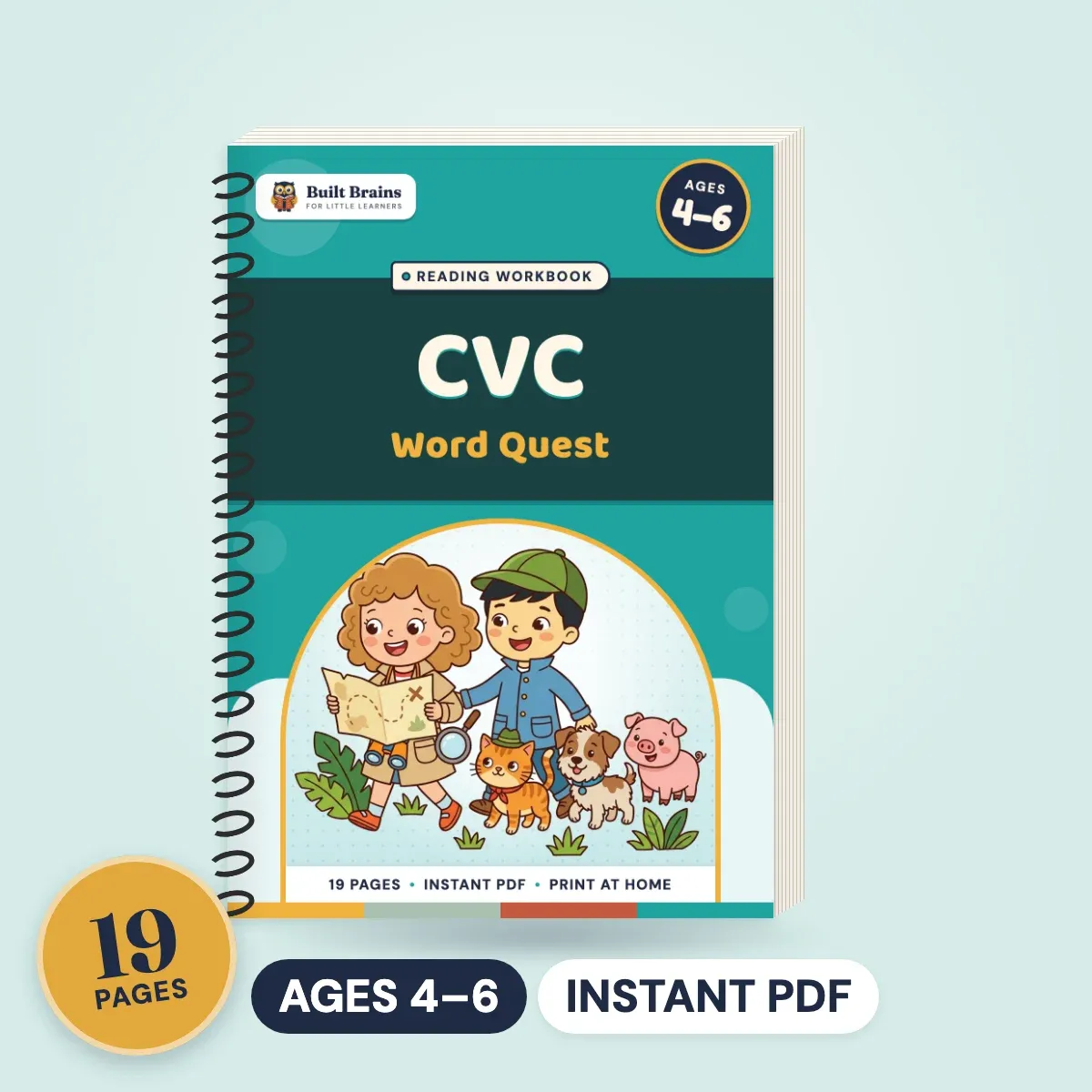
CVC Word Quest is built around this routine: say each picture slowly, write one sound per box, then trace, read and find the words, over 19 pages for ages 4 to 6. For word lists sorted by vowel, see the CVC words list.
15 blending games for 4, 5 and 6-year-olds
Mix oral games (1 to 7) with print games (8 to 15). Three minutes of one game a day is enough.
- Robot talk. You are a robot who speaks in sounds: "Pass the c-u-p." Your child translates. Swap roles once they can.
- Touch your b-a-ck. Body parts and clothes: n-o-se, ch-i-n, h-a-t, s-o-ck.
- Sound I spy. "I spy a m-u-g." Start with things on the table.
- Slinky stretch. Stretch a slinky while stretching the word; let it snap back as you say it fast.
- Arm slide. Shoulder for the first sound, elbow for the middle, wrist for the last, then swipe down the arm to say the word.
- Mystery bag. Small toys in a bag; you say the sounds, your child pulls out the right one: p-i-g, c-a-r, b-u-s.
- Blend and eat. Say the sounds of a snack ("gr-a-pe"); the correct blend wins the grape.
- Drive the word. A toy car drives under the letters of a word on card; the engine noise is the stretched word.
- Hop the sounds. Three letter cards on the floor; hop on each saying its sound, then jump to the end saying the word.
- Sound boxes. Three boxes on paper; push a counter into one box per sound, then slide a finger under all three to blend.
- Word ladders. With magnetic letters, change one letter at a time: mat, sat, sit, sip, sap. Blend each new word.
- Pop-up letters. Reveal three letter cards one at a time; the voice holds each sound until the next card appears.
- Blend and match. Six picture cards, six word cards; blend each word and put it on its picture.
- Silly sentences. "The c-a-t s-a-t on the m-a-t." You read the sight words, your child blends the CVC words.
- Alien names. Blend made-up words like "zop" and "fim" for alien toys. It proves your child is blending rather than remembering.
The Florida Center for Reading Research publishes free printable versions of several of these, sorted by grade (FCRR Student Center Activities), and Reading Rockets has a short classroom guide to blending and segmenting games (Reading Rockets).
When a child can't blend yet: three checks
If you have been trying for a few weeks and the sounds still do not turn into words, run these checks in order. Each one points to a different fix.
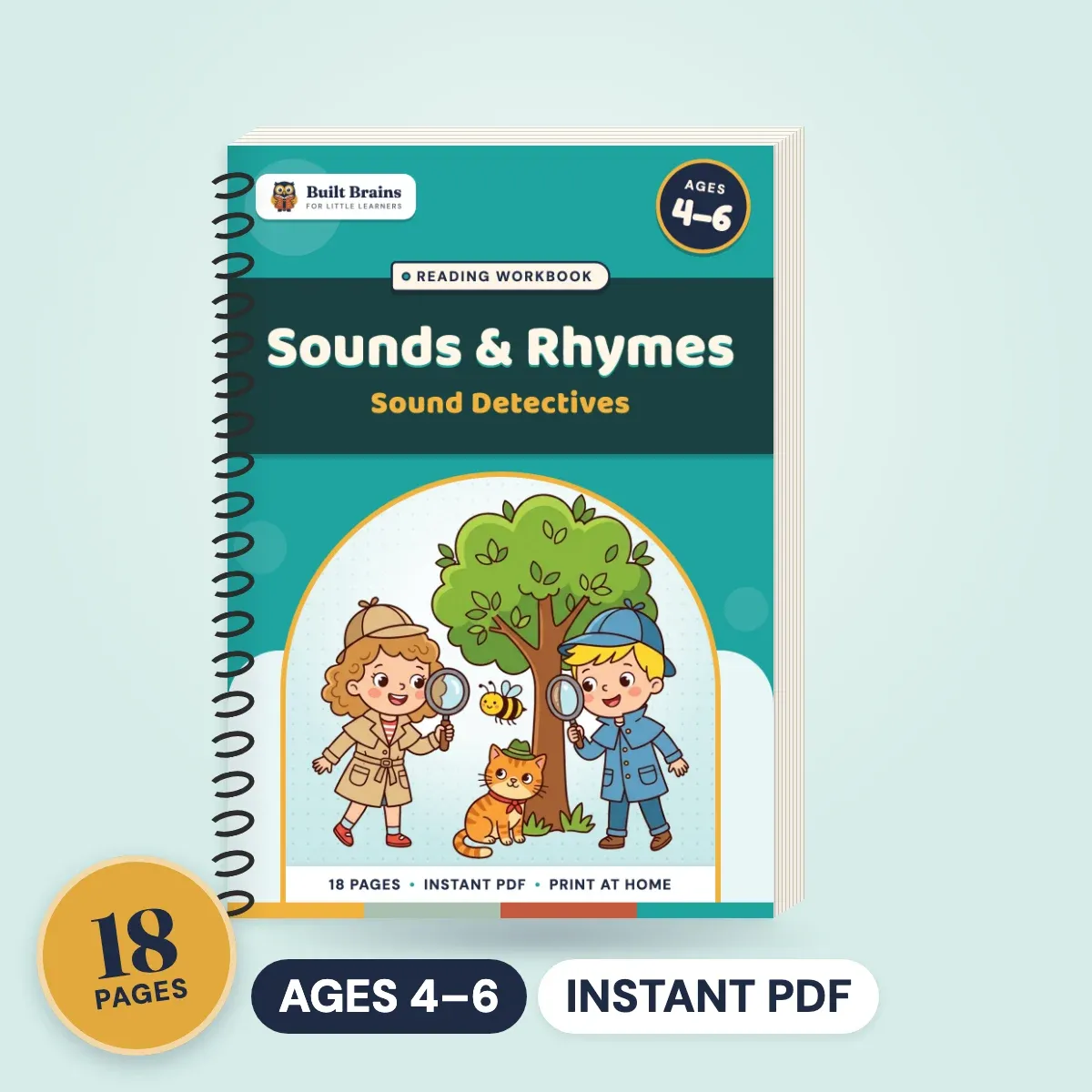
Check 1: Can they blend by ear? Say "What am I saying: s-u-n?" with no letters. If not, the problem is phonemic awareness, not letters, and the fix is two or three weeks of oral blending, rhyming and beginning-sound games. Rhyming activities and the Sound Detectives: Sounds & Rhymes book (beginning sounds, rhyme matching and sounding out simple words, ages 4 to 6) are the place to start.
Check 2: Are the letter sounds instant? Show five letters, one at a time. If any sound takes more than a second, or comes out as "muh", practice those five letters until they are automatic before blending with them. Blending with slow sounds is like doing math with numbers you have to look up.
Check 3: Is the method overloading memory? If your child says "/m/ /a/ /t/" and then "tam", or just stares, switch to successive blending, use two-sound words, and shorten sessions to three minutes.
One more common snag: a child who gets the first and last sound but drops the middle one needs vowel practice, a, e, i, o, u on their own with a key picture for each.
Most 5-year-olds getting daily, calm practice start blending within a couple of months. If your child is 6½ or older, has had steady teaching and still cannot blend two or three sounds, talk to their teacher about a reading screen; early help works best.
After CVC words: what comes next
Once your child can blend most CVC words at a steady pace (a word every two or three seconds, not perfectly), they are reading. Next steps, roughly in order:
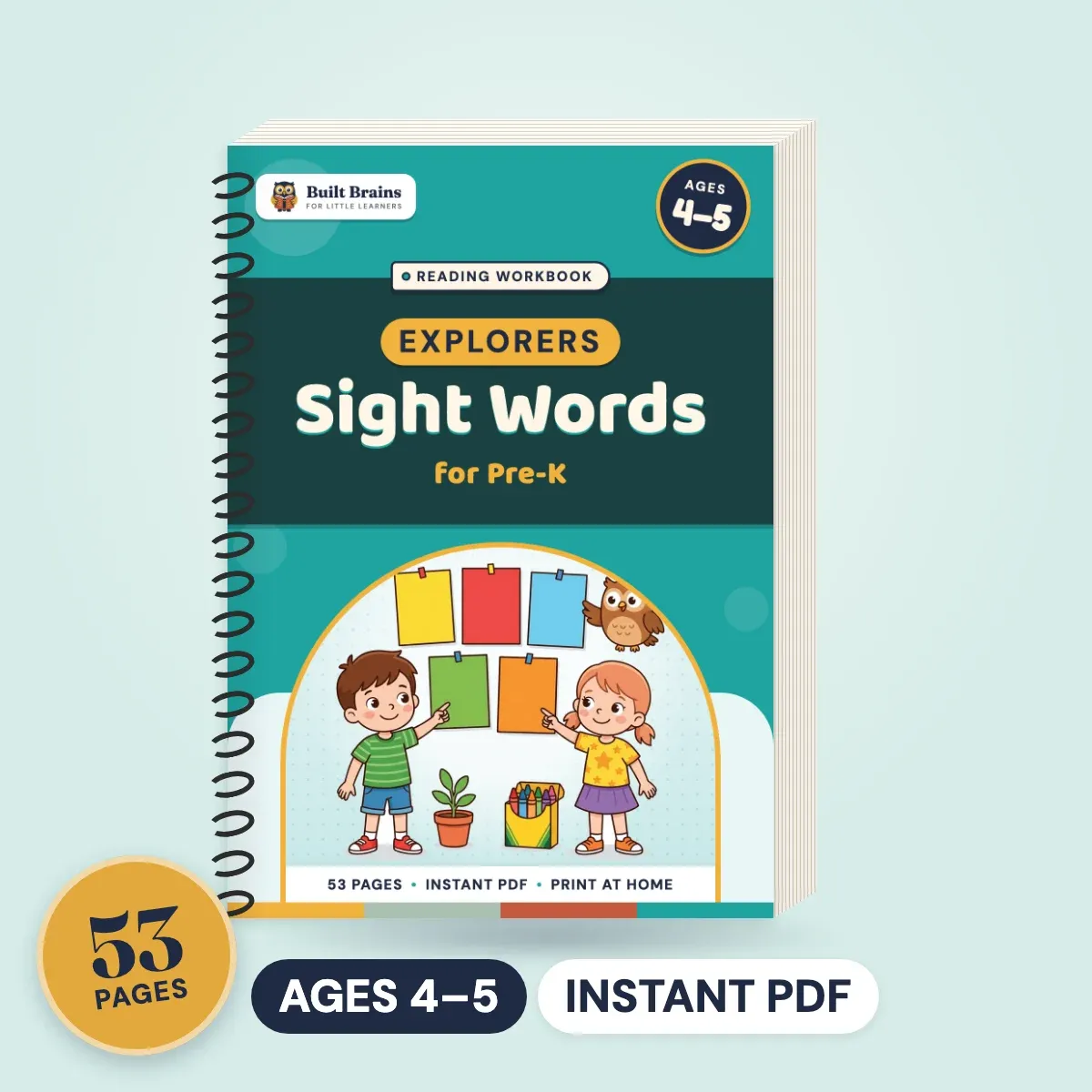
- Sight words alongside. A small set of words learned by heart lets your child read real sentences: "I see a cat." Sight Word Explorers: Pre-K covers the 40 pre-primer words with one page each, for ages 4 to 5; see the pre-K sight words list.
- Short decodable sentences and books made only of CVC words and the sight words your child knows.
- Consonant blends (fl, st, mp), where every letter keeps its sound: flag, stop, lamp. Blend them the same successive way, just with four sounds.
- Digraphs (sh, ch, th, ck), where two letters make one new sound.
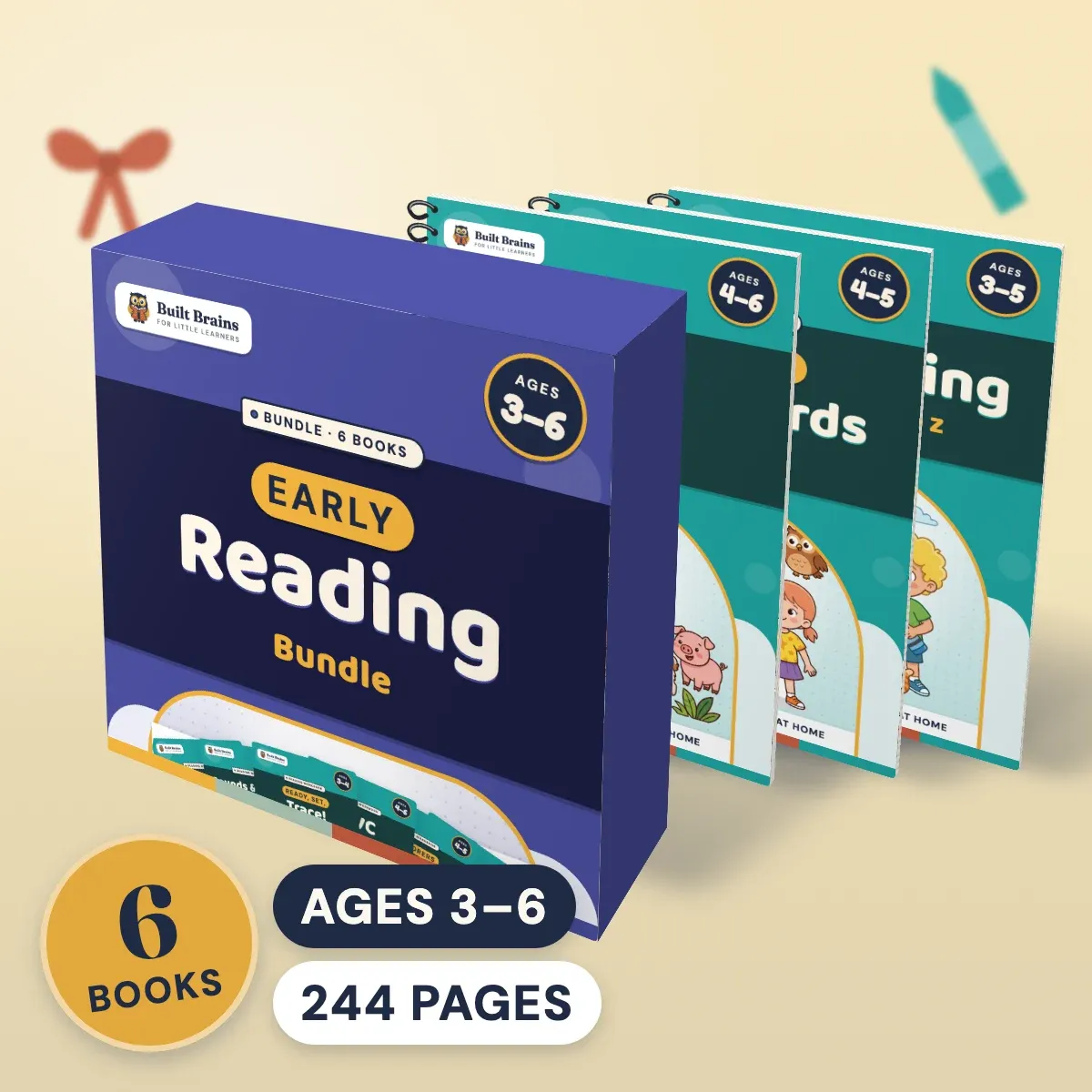
For the whole sequence in one place, the Early Reading Bundle puts the path in order for ages 3 to 6: pre-writing lines, the alphabet, beginning sounds and rhymes, CVC words and 92 sight words, 244 pages in all. For how blending fits into a kindergarten year, see what to teach in kindergarten at home.
Sources
- NICHD – National Reading Panel: the panel's finding that teaching phonemic awareness, especially blending and segmenting, improves children's reading and spelling.
- IES What Works Clearinghouse – Foundational Skills to Support Reading for Understanding in Kindergarten Through 3rd Grade: the recommendation to teach phonemic awareness and to blend letter sounds into words.
- Reading Rockets – Blending and Segmenting Games: classroom games for oral and print blending.
- Florida Center for Reading Research – Student Center Activities: free printable phonological awareness and phonics activities by grade.
Questions parents ask
Most children can blend by ear (hearing "c-a-t" and saying "cat") between 4 and 5, and blend printed CVC words during kindergarten, at 5 to 6. Children who start later catch up quickly with daily practice. If a child is 6½ or older and still cannot blend two or three sounds after steady teaching, ask their teacher about a reading screen.
Oral blending is blending without letters: an adult says a word in separate sounds, "m-a-p", and the child says the whole word, "map". It comes before blending in print because it isolates the listening skill. Games like "touch your n-o-se" and sound I spy are oral blending, and most 4-year-olds can learn it in a few weeks.
Start with continuous sounds that can be stretched out: m, s, f, l, r, n and the short vowels. Words like mat, sun, fan and lip let a child hold the first sound while moving to the next. Stop sounds such as b, d, p and t are harder to blend at the start of a word, so add them a little later.
Usually because three separate sounds are too much to hold in memory at once, or because the sounds have an "uh" attached ("buh-a-tuh"). Switch to successive blending, where the child stretches "mmmaaat" without stopping, use pure sounds, and start with two-sound words like "at" and "up". Guessing a different word often means they are reading only the first letter.
Successive blending means adding one sound at a time without a pause: "mmm", then "mmmaaa", then "mmmaaat", then "mat". Because the child is always saying the whole word so far, nothing has to be remembered. It is easier for most beginners than saying all three sounds separately and then trying to put them together.
With five minutes of calm daily practice, many 5-year-olds go from blending by ear to reading simple CVC words in one to three months. Some children click in a week; others need a term. Progress is faster when the letter sounds are already automatic, so if blending stalls, spend a week on sounds and come back.
Reviewed by
Early Childhood Educator & Curriculum Specialist
Maya Caldwell, M.Ed., is a veteran kindergarten teacher and instructional coach who specializes in structured literacy and purposeful play. With over a decade of classroom experience, she designs hands-on, inclusive learning environments that turn emerging readers into confident lifelong learners.
More about Maya →