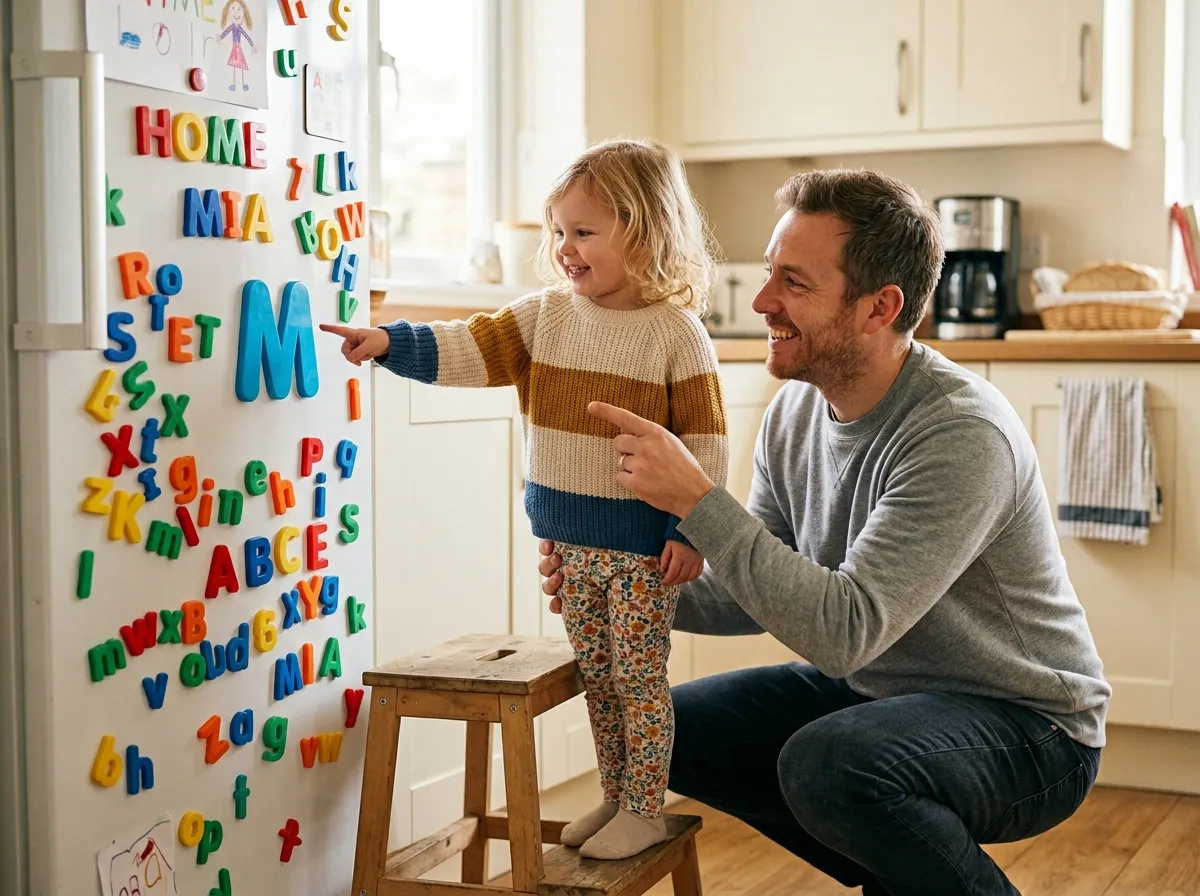
What is letter recognition (and how is it different from letter sounds)?
Letter recognition is your child's ability to look at a letter and know which one it is. It has three layers, and children usually get them in this order:
- Matching: finding two letters that are the same (put the B with the B).
- Pointing: you say "Where is the S?" and your child points to it.
- Naming: you point to a letter and your child tells you "S."
Letter sounds are a separate skill: knowing that S says /sss/ as in sun. Both matter. Knowing letter names gives children a way to talk about print ("your name starts with an M"), and the US National Early Literacy Panel found that alphabet knowledge in the preschool years is one of the strongest early predictors of later reading. But it is the sound that lets a child read a word. So once a letter is familiar, attach its sound straight away. Our guide on how to teach letter sounds covers that next step.
Letter recognition age: what is typical?
Children learn letters at very different speeds, and early exposure matters more than age. Treat these as rough guides, not deadlines:
| Age | What many children can do |
|---|---|
| 2 to 3 | Sing an alphabet song, notice letters, point to a letter in their own name |
| 3 to 4 | Recognize several letters, often the ones in their name and family names |
| 4 to 5 | Name many capital letters and a growing number of lowercase ones, know some letter sounds |
| 5 to 6 | Work toward all 26 letters in both forms by the end of kindergarten |
For reference, the CDC's milestone checklist for 5 year olds includes naming some letters when you point to them, and the Head Start early learning framework describes children at the end of preschool naming around 18 capital and 15 lowercase letters. US kindergarten standards then aim for all capital and lowercase letters by the end of the kindergarten year.
If your child is heading into kindergarten and recognizes almost no letters despite regular, playful practice, or has trouble with speech or hearing, mention it to your pediatrician or their teacher. Usually the answer is simply more exposure, but it is worth asking.
Which letters should you teach first?
Start with your child's name
Your child's name is the most motivating word in the world to them. Teach its letters first, starting with the first letter. A child called Maya will learn M faster than any other letter because it is her letter. Then move to family names: Mom, Dad, siblings, the dog. For writing the name, see how to teach a child to write their name.
Then letters that make lots of words
After name letters, teach the letters that are most useful for early reading. Many phonics programs start with s, a, t, p, i, n, then m, d, g, o, c, k. These build dozens of simple words quickly. There is no need to go A to Z in order.
Keep look-alikes apart
Do not teach b and d in the same week, or p and q, or m and w. Let one become rock-solid before introducing its twin.
Uppercase or lowercase first? Our recommendation
This is a long-running debate. Capitals are simpler shapes and easier to tell apart, which is why toddlers often learn them first. But nearly all the text in picture books is lowercase, and that is what your child will read.
Our recommendation: introduce each letter as a pair ("Big M, little m") from the start. Let capitals be the easy win for 3 year olds, and put most of your practice time into lowercase from around age 4. Waiting until all 26 capitals are mastered before showing lowercase only slows reading down.
30 hands-on letter recognition activities
Pick two or three for the week and repeat them. Young children learn through repetition, and a game they already know takes no explaining.
Multisensory activities (touch it, build it)
- Play-dough letters. Roll snakes and bend them into the letter. Say its name each time you finish one.
- Salt tray tracing. Pour salt or sugar into a baking tray and trace letters with one finger. Shake to erase.
- Shaving cream writing. Spray on the table and draw letters. It wipes clean in seconds.
- Sandpaper letters. Cut letters from sandpaper, glue them to card, and have your child trace them with two fingers while saying the name.
- Letter in a bag. Seal hair gel in a zip bag, tape it down, and trace letters through the plastic.
- Build with loose parts. Make letters from buttons, pasta, blocks or Lego on a printed letter.
- Rainbow tracing. Trace one big letter three times in three different crayons.
- Dot-sticker letters. Cover a large outline letter with round stickers. Great for fine motor skills too.
- Mystery letter feel. Put a magnetic letter in a sock. Your child feels it and guesses.
Games (quick and playful)
- Letter swat. Write letters on sticky notes on the wall. Call one out; your child swats it with a clean fly swatter.
- Go fish. Clip paper clips to letter cards and "fish" with a magnet on a string. Name each catch.
- Letter memory. Six pairs of cards face down: capital and lowercase pairs once your child is ready.
- Feed the monster. Cut a mouth in a tissue box. "The monster is hungry for R." Your child posts the R.
- Letter bingo. A 3 by 3 grid of letters, with cereal pieces as counters.
- Which one is missing? Line up four magnetic letters, your child closes their eyes, you remove one.
- Letter parking lot. Write letters in "parking spaces" on paper. Call a letter; your child drives a toy car into the right space.
Movement activities (for wiggly kids)
- Letter hopscotch. Chalk letters on the sidewalk. Call one and your child jumps to it.
- Body letters. Make letters with your bodies: arms up for Y, lying flat for I, two of you for X.
- Letter toss. Tape letters to the floor and toss a beanbag. Name the letter it lands on.
- Sticky-note hunt. Hide 5 letters around a room. Your child finds them and brings them back.
- Flashlight find. In a dim room, shine a flashlight on letters taped to the wall. Your child names what lights up.
Name-based activities
- Name puzzle. Write your child's name on a card strip, cut it into letters and rebuild it.
- Name hunt. Find the letters of their name in a magazine and cut or circle them.
- Who has my letter? Look for your child's first letter in family and friends' names.
- Name on everything. Label their cup, chair and hook with their name so they see it daily.
Print in the world (letters are everywhere)
- Cereal box hunt. "How many O's can you find on this box?"
- Store sign spotting. On a walk or drive, look for one letter on signs.
- Grocery list helper. Show them the first letter of each item: "Milk starts with M."
- Mail sort. Find letters on envelopes and junk mail before it goes in the recycling.
- Letter of the day. Choose one letter each morning and look for it all day. Our morning warm-up pages include a letter of the day to trace.

Ages 3–5 · 60 pages
ABC Tracing Adventure: A to ZLearn every letter the right way — trace, find, color
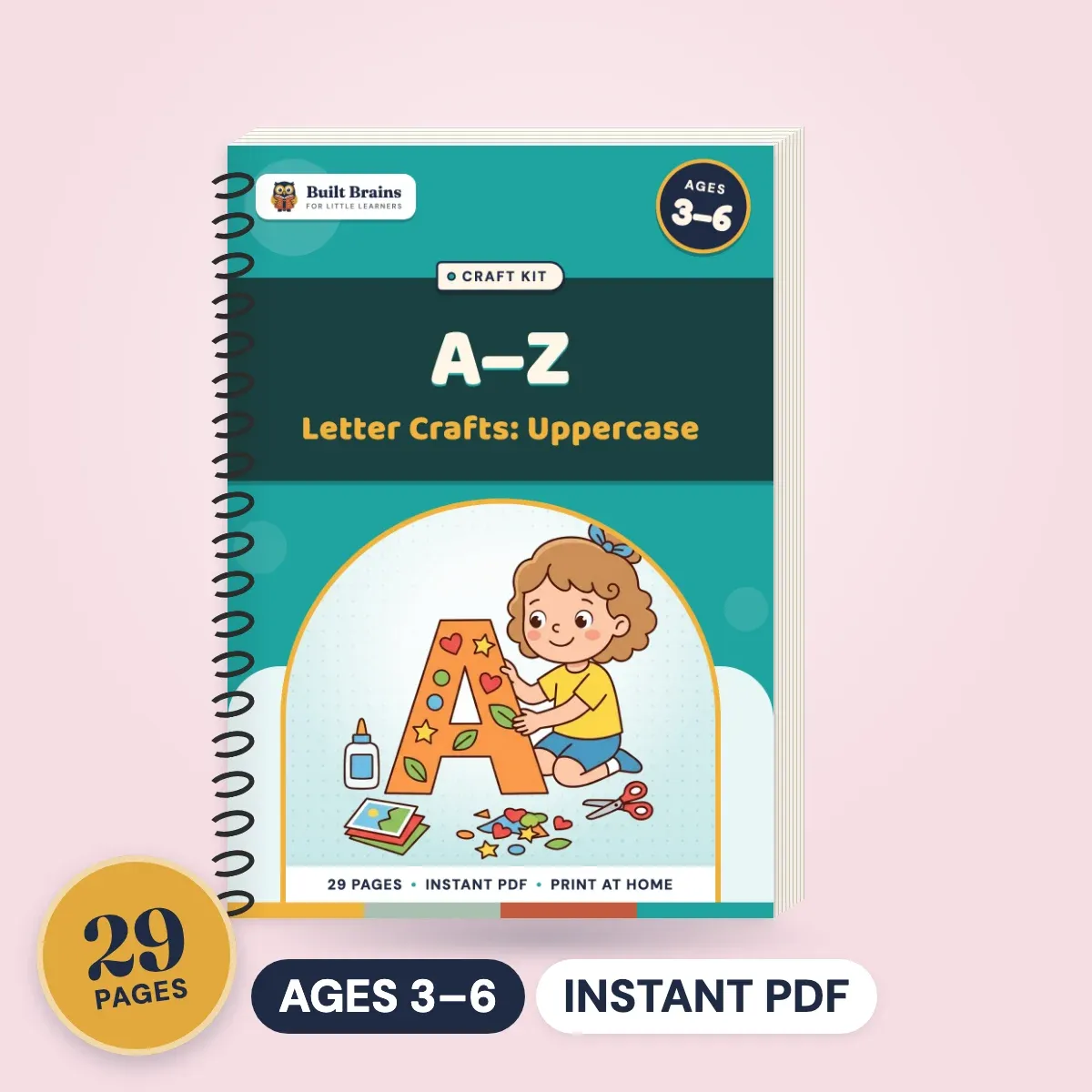
Ages 3–6 · 29 pages
A–Z Letter Crafts: UppercaseColor, cut and paste a craft for every capital letter
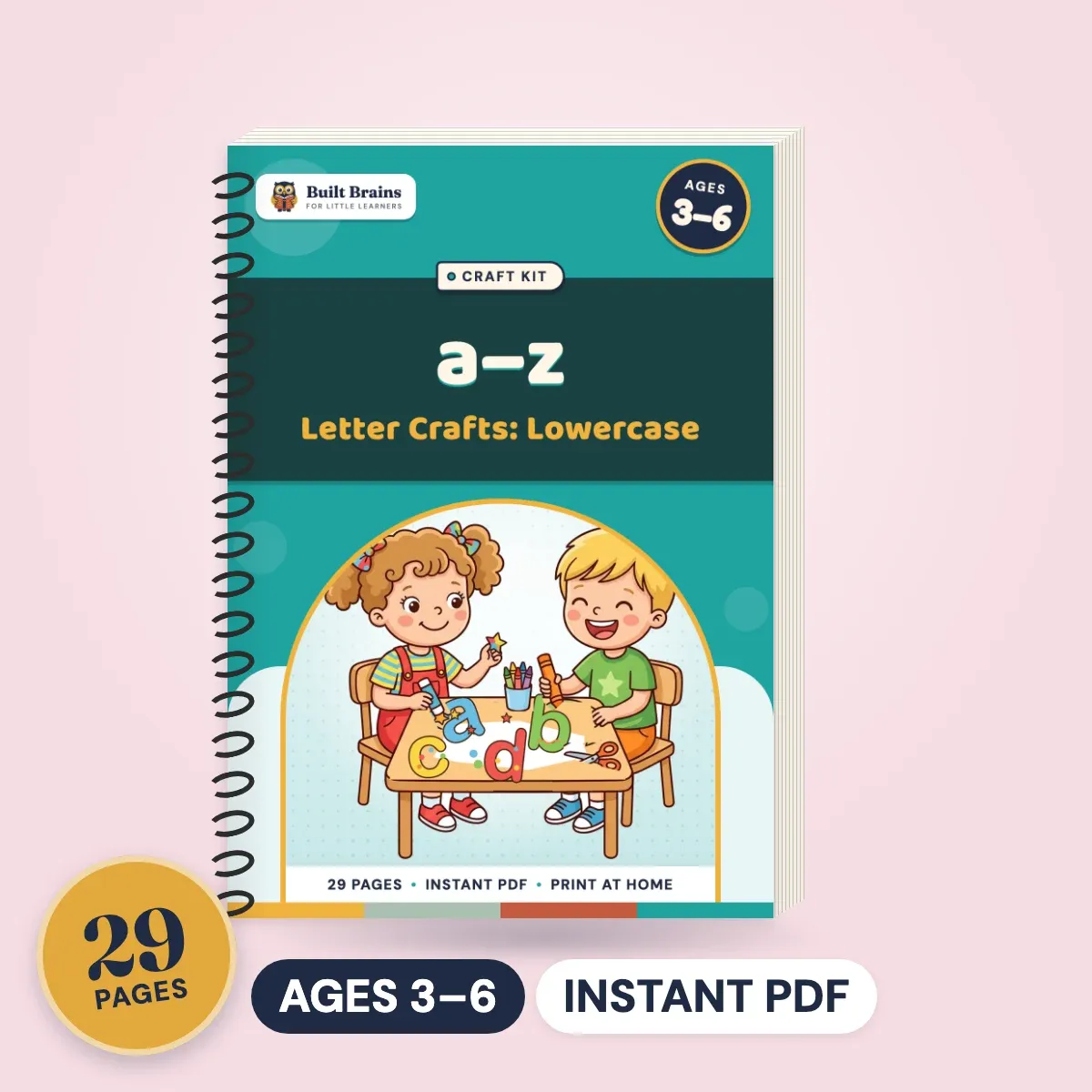
Ages 3–6 · 29 pages
a–z Letter Crafts: LowercaseColor, cut and paste a craft for every small letter
How to teach letter recognition: a simple weekly routine
Short and often beats long and occasional. Aim for 5 to 10 minutes a day, plus the letter spotting that happens naturally.
- Monday: meet the letter. Show the capital and lowercase form. Say its name and sound. Trace it big with a finger, then color a large letter. The ABC Tracing Adventure gives every letter a big letter to color with its picture and step-by-step tracing.
- Tuesday: build it. Play-dough, salt tray or loose parts.
- Wednesday: craft it. Make a letter craft: color a giant letter and glue on pictures that start with it. The uppercase letter crafts and lowercase letter crafts are made for this.
- Thursday: play a game. Letter swat, go fish or feed the monster, mixing the new letter with old ones.
- Friday: hunt it. A letter hunt in a book, on a cereal box or around the house, then a quick check of what stuck.
Each day, start with 1 minute of review: hold up 3 or 4 known letters and let your child name them fast. Success first, new learning second. If you want every week planned for you, the Complete Preschool Curriculum at Home follows this rhythm across 36 weeks.
What if my child confuses b and d?
Almost every young child mixes up b and d at some point, and plenty still do it at 6 or 7. They are the same shape flipped, and until now your child's brain has learned that a flipped object is the same thing (a cup is a cup whichever way it faces). Letters are the first thing where direction changes the meaning.
What helps
- Teach them weeks apart. Master b fully before d appears.
- Give one anchor. The easiest: d starts like c. Draw a c, add a tall line, and you have d. Since c comes before d in the alphabet, it is easy to remember.
- Use the "bed" picture. Write the word bed and draw a bed over it: the b and d make the headboard and footboard.
- Say the stroke. For b: "Line down, back up, round." For d: "Round like c, then line up and down." Forming letters the same way every time helps the eyes remember.
- Sort them. Mix b and d cards and sort into two piles, checking each one with your anchor.
What does not help
Drilling the pair together over and over, or making a big deal of mistakes. Stay calm and point back to the anchor. If reversals continue past about age 7 alongside real difficulty learning to read, talk to their teacher.
Common mistakes to avoid
- Teaching A to Z in order. Name letters and useful letters first get children reading sooner.
- Only teaching capitals. Your child will meet lowercase in every book.
- Quizzing instead of playing. Rapid-fire flash cards turn a game into a test. Mix new letters with easy ones.
- Long sessions. Stop after 10 minutes, ideally while your child still wants more.
- Stopping at the name. Once a letter is known, add the sound. That is the bridge to reading.
Letter recognition worksheets vs hands-on play
Hands-on games should do most of the work, especially for 3 year olds. Printable pages earn their place as the calm, sit-down part of the routine: a big letter to color, a letter to trace, a letter hunt to circle. They also give you a record of what your child has covered. The best mix for most preschoolers is one or two hands-on activities and one printable page a day, then out to play.
Questions parents ask
Children vary a lot. Many 3 year olds know a few letters, often the ones in their own name. By around 5, most children can name a good number of letters, and US kindergarten standards aim for all 26 capital and lowercase letters by the end of kindergarten. If your child is 5 and knows almost none, mention it to their teacher or pediatrician.
Teach them as pairs. Capitals are easier to tell apart, so many children learn them first, and that is fine. But most of the print in books is lowercase, so show both forms from the start and give lowercase letters the extra practice, especially from age 4 onward.
For most preschoolers, one or two new letters a week works well, with quick review of the ones they already know every day. If your child picks letters up fast, go faster. If they are mixing letters up, slow down and spend more time on review games rather than adding new letters.
Yes. Mixing up b and d, p and q, and writing letters backward is very common in young children and often continues until around age 7. On its own it is not a sign of dyslexia. Teach the two letters at different times and give your child one simple trick to tell them apart.
Letter recognition means knowing a letter by sight and naming it: that is a B. Letter sounds means knowing the sound it makes, /b/ as in ball. Children need both for reading. Many families teach the name and sound together, but it is the sound that lets a child read words.