
Is a curriculum appropriate for toddlers?
Yes, as long as you treat it as a plan for play rather than a school day. Two and three year olds learn by touching, moving, talking and copying you. The CDC's developmental milestone checklists for this age focus on language, play, movement and self-help, not on letters or worksheets. So a good toddler curriculum looks like this:
- About 10 minutes a day, often less, at a time your child is fresh.
- One theme a week (farm animals, the color red, rain) that gives you songs, books and things to look for.
- One hands-on activity, like dot-dabbing, stickers, sorting, play-dough or matching.
- No pressure. If your child walks away, the lesson is over. Try again tomorrow.
The rest of the day is the real curriculum: reading aloud, chatting while you cook, outdoor play and naps.
What's inside Tiny Steps Toddler Curriculum
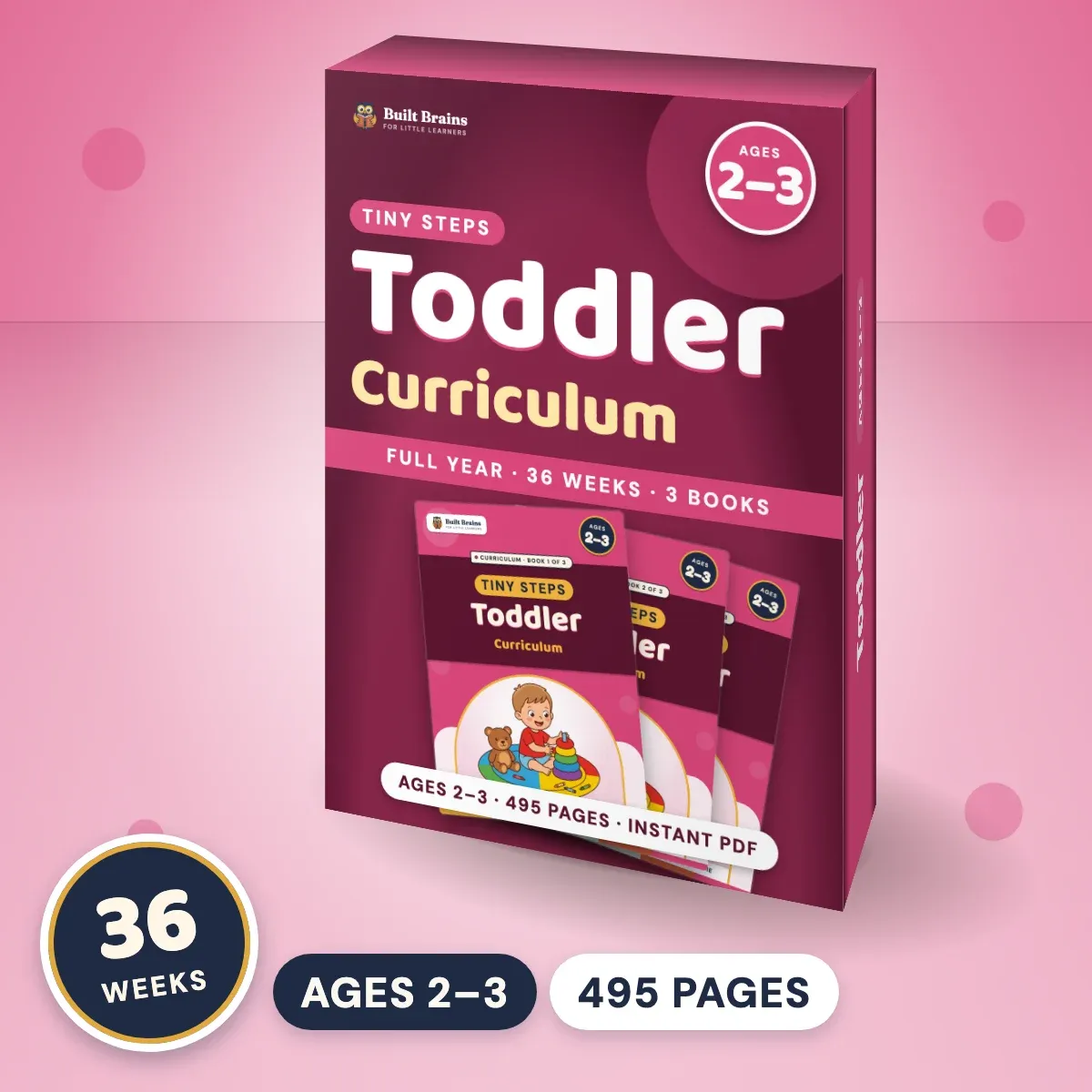
Tiny Steps Toddler Curriculum is a gentle first year for 2 and 3 year olds, ten playful minutes at a time. Every one of its 36 weeks has a color, a shape, a number and a theme, with big simple pages to color, dot-dab, trace, match and count to 5, plus first-word picture cards. It comes in three printable books (weeks 1–12, 13–24, 25–36) plus an 18-page Parents' Guide, 495 pages in all, including 24 coloring pages, 24 tracing pages, 24 big pictures to color and trace, and 12 each of pencil-control, big-and-small, matching, counting and cut-out card pages.
It is an instant PDF, black and white, prints on US Letter or A4, and has a 14-day money-back guarantee.
What a toddler curriculum should (and shouldn't) include
Include
- Language: naming things, first-word cards, songs, nursery rhymes, stories.
- Colors and shapes: one at a time, found in real life ("Find something red!").
- Early counting: counting to 3, then 5, by touching real objects.
- Fine motor: scribbling, dot markers, stickers, tearing paper, play-dough, posting jar lids or large pom-poms into a slot cut in a box.
- Big movement: dancing, jumping, ball games, animal walks.
- Matching and sorting: socks, blocks by color, big and small.
- Independence: washing hands, putting toys in a basket, carrying a cup.
Skip
- Long worksheet sessions or anything that needs your child to sit for more than a few minutes.
- Flashcard drilling of letters. Letter interest often appears later, and pushing early tends to backfire.
- Screens as the main "teacher." The AAP advises very limited, shared screen time at this age (our screen time for toddlers guide explains more).
12 months of toddler curriculum themes
Here is a year of themes with a color and shape focus and simple weekly ideas. Start in any month. Each theme can run for a week or stretch over a whole month if your child loves it.
| Month | Theme | Color and shape | Weekly ideas |
|---|---|---|---|
| September | All about me | Red, circle | Body parts song, handprint art, mirror faces, family photo book |
| October | Fall and leaves | Orange, triangle | Leaf hunt, crunch walk, pumpkin counting, color sorting |
| November | Farm animals | Brown, square | Animal sounds game, toy farm sort, egg carton counting |
| December | Lights and cozy things | Yellow, star | Flashlight hunt, wrapping-paper scrunch, star stickers |
| January | Snow and winter | White, oval | Ice painting, sock matching, mitten pairs, snowball (pom-pom) toss |
| February | Feelings and friends | Pink, heart | Feelings faces, sharing games, heart stickers, hug count |
| March | Weather | Gray, rectangle | Rain sounds, cloud cotton balls, puddle jumping, umbrella color sort |
| April | Bugs and gardens | Green, circle review | Bug hunt with a magnifier, planting a seed, ladybug spots to 5 |
| May | Vehicles | Blue, rectangle review | Car ramp races, sorting cars by color, "red means stop" game |
| June | Ocean | Blue, oval review | Water play, fish counting, big and small sea animals |
| July | Summer and sun | Yellow review, circle | Ice cube painting, sun hats, sprinkler play, picnic sort |
| August | Toys and home | Purple, square review | Toy box sort, "put away" race, tea party counting |
Want ideas for older siblings too? Our preschool themes by month list pairs well with this one.
A sample toddler week (10 minutes a day)
Here is the farm week, laid out the way it might really happen.
- Monday: meet the theme. Read a farm picture book. Ask, "What does the cow say?" Make the sounds together. Color a big cow page with chunky crayons.
- Tuesday: the color. Brown is the color this week. Go on a brown hunt: a teddy, a shoe, a wooden spoon. Dot-dab a brown horse.
- Wednesday: the number. The number is 2. Count 2 toy pigs into a box. Clap 2 times. Trace a big 2 with a finger.
- Thursday: the shape. Square. Find squares on a window, a block, a cracker. Stick square stickers in a row.
- Friday: play. Set up a toy farm with blocks for fences. Talk while your child plays: "The sheep is going into the barn."
That is it. Five to ten minutes, then on with the day.

Toddler curriculum ideas you can do without printing anything
Not every day needs a page. These work with things you already have.
Color ideas
- Sort laundry by color. Say, "Blue sock! Can you find another blue one?"
- Color-of-the-day snack: red apple slices, red pepper strips.
Shape ideas
- Cut toast into circles, squares and triangles.
- Shape hunt on a walk: round wheels, square windows.
Counting ideas
- Count stairs as you climb them.
- Count spoons as you set the table, up to 3, then 5.
Animal and season ideas
- Animal walks: hop like a frog, stomp like an elephant.
- Collect three leaves, three sticks and three stones and lay them out together.
For more, see learning activities for toddlers, sensory bin ideas and our screen-free activities for toddlers.
How to run toddler "school" so it actually works
- Pick your moment. After breakfast or after a nap, never when hungry or tired.
- Sit side by side, not across the table. It feels like play, not a test.
- Show, then hand over. Do the first dot yourself, then pass the marker.
- Narrate, don't quiz. "You colored the pig brown" beats "What color is that?"
- Repeat. Toddlers love the same book and the same game many times. Repetition is how they learn.
When it isn't working
- Your child walks off: let them. Try a movement version of the same idea later.
- Your child scribbles over everything: that is good pencil practice. Scribbling comes before shapes and letters.
- Your child only wants one theme: stay with it. A month of dinosaurs teaches as much as a month of variety.
- You are worried about speech or development: talk to your pediatrician or health visitor. Asking early is always reasonable.
Free toddler curriculum vs a printable plan
You do not need to spend money to teach a toddler. Books from the library, songs, household objects and the theme list above make a full year. If you'd like a few pages to try, start with our free printable book.
A printed plan helps if you want a color, shape, number and theme already chosen for every week, with matching pages ready to go. It may not suit you if you prefer a completely paper-free approach or don't have a printer.
Start your toddler curriculum this week
Choose a theme from the table, gather three books and a box of chunky crayons, and try 10 minutes tomorrow morning. Browse more for this age on the toddler page.
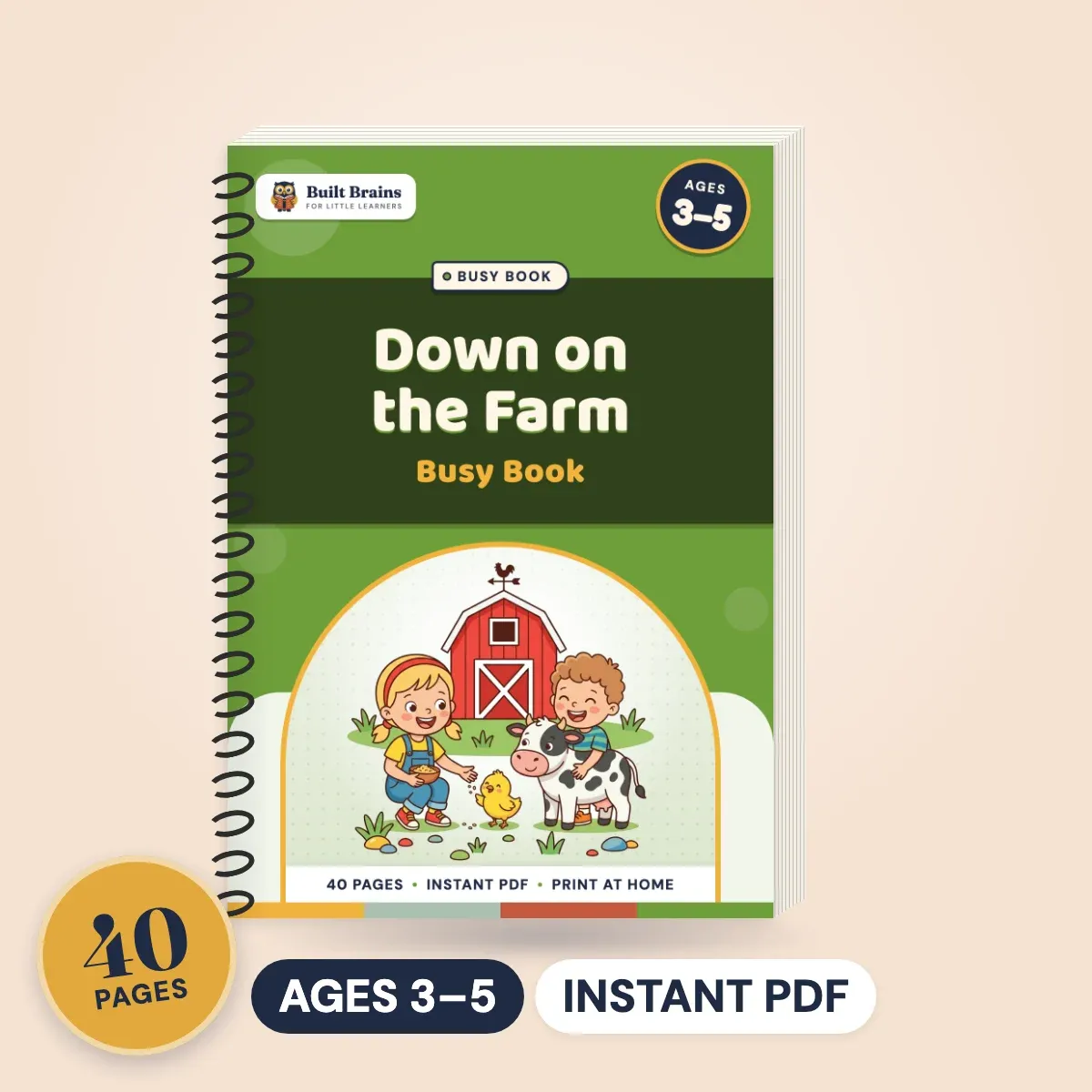
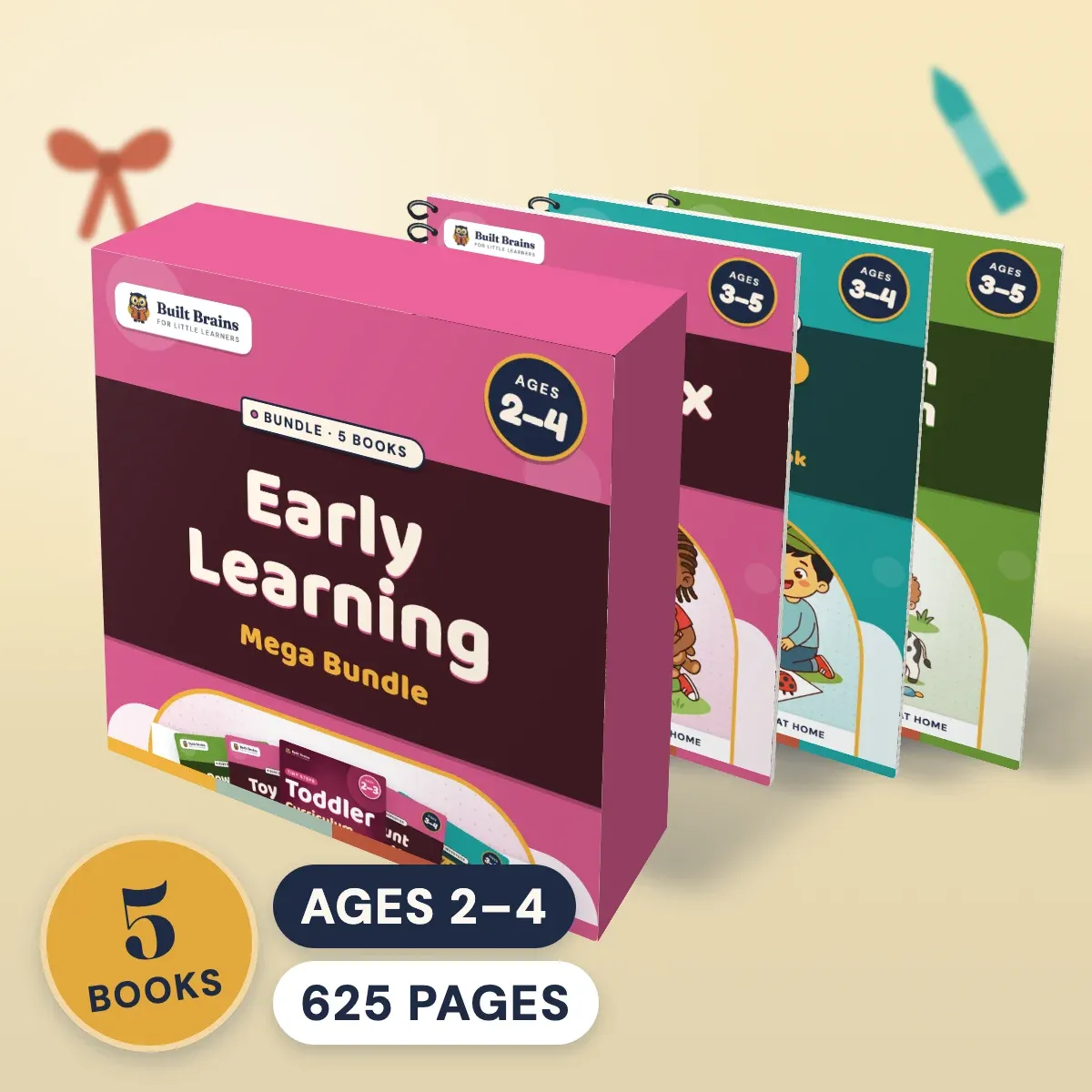
If you want every week planned, Tiny Steps gives you 36 weeks of colors, shapes, numbers and themes. The Early Learning Mega Bundle includes it along with the Down on the Farm and Toy Box busy books, Count With Me! 1 to 10 and the Ready, Set, Trace! pre-writing book, for ages 2 to 4.
Questions parents ask
No. Toddlers learn mainly through play, conversation, books and everyday routines, and those matter far more than any worksheet. A toddler curriculum is useful for parents who want a simple plan and fresh ideas each week. Keep it to about 10 minutes, follow your child's interest, and drop it on days when it is not working.
Mostly talking, moving and doing things for themselves: new words and short phrases, pointing to pictures in books, running and climbing, stacking blocks, scribbling, and helping with simple tasks. Colors, shapes and counting to three or five come gradually through play. Children vary widely, and the CDC's milestone checklists are a useful guide to share with your pediatrician.
About 5 to 10 minutes of a guided activity is plenty for most 2 year olds, and 10 to 15 minutes for many 3 year olds. Stop when your child loses interest, even if you only managed two minutes. Short, happy moments repeated most days build more learning than long sessions that end in tears.
Themes from a toddler's own world work best: colors, shapes, my body, my family, animals, farm, food, vehicles, weather, seasons, bugs, the ocean and bedtime. Pick one per week or two, read books about it, sing songs, do one simple craft and look for it on walks. Familiar themes give children words they can use every day.
Around age 2 is a common time to try a gentle routine, when many children enjoy short table activities like coloring and stickers. If your child shows no interest, wait a few months and keep reading and playing. There is no benefit to starting early, and nothing is lost by waiting.