Why a space theme works for preschoolers
Space is one of the few themes that grips a 3-year-old and a 5-year-old equally. The little one wants to count down and blast off; the older one wants to know why the Moon changes shape. Both practice sequencing (3, 2, 1), size words (giant Jupiter, tiny Mercury), new vocabulary (orbit, crater, astronaut) and the first real science question: "How do we know?"
Keep the facts few and true: say "the Sun is a star" and "eight planets," and check anything else on NASA's Space Place before you pass it on. Hands-on pretend play of this kind is what NAEYC recommends for building language and problem-solving in the early years.
Run it like any theme: one or two 10-to-20-minute activities a day, the same books all week, and a basket of props (flashlight, foil, a ball, a toy rocket) left out. How that fits into a morning is in our preschool at home schedule.
Space literacy and math activities
Literacy
- S is for star, R is for rocket. Trace the letters in a tray of salt with a finger, then with a pencil "rocket."
- Countdown words. Write 10 to 1 on paper stars; your child reads each number aloud before "Blast off!"
- Planet name clap. Clap the syllables: Mars (1), Sat-urn (2), Ju-pi-ter (3). Which is longest?
- Space word cards. Match pictures to words (sun, moon, star, rocket) and, at 4 and 5, trace the word.
- Astronaut log. Each day your child draws one thing a pretend astronaut saw and dictates a sentence for you to write.
- Moon rhymes. Moon, spoon, soon, balloon. Finish the rhyme: "The cow jumped over the ___."
- Act out the book. After "Roaring Rockets," build a chair rocket and retell the launch, flight and splashdown in order.
Math
- Count the planets. Line up eight balls or paper circles from the Sun outward and count them. Which is first? Last?
- Star cups. Number eight cups 1 to 8 and drop in the right number of star stickers or pasta stars.
- Rocket number line. Tape numbers 1 to 10 up a doorframe. A paper rocket "flies" up as your child counts, then back down.
- Big planet, small planet. Sort pictures or balls: Jupiter and Saturn are giants, Mercury and Mars are small. Say "bigger" and "smaller" aloud.
- Shape moons. Cut a circle, a half circle and a thin crescent from yellow paper. Name the shapes and match them to Moon pictures.
- Rocket subtraction (ages 4–5). Five rockets on the launch pad, two blast off. How many are left?
- Star patterns. Yellow star, white star, yellow star. What comes next? Make it harder with three colors.
Number practice past 10: see our number tracing 1–20 guide.
Space science and sensory activities
- Day and night with a lamp. Darken the room, switch on a lamp (the Sun) and slowly turn a ball or your child (Earth). The lit side is day, the dark side is night, and one full turn is one day.
- A year around the Sun. Walk a slow circle around the lamp while turning; the whole lap is one year. Then add a small ball as the Moon circling Earth.
- Moon phases with cookies. Twist apart sandwich cookies and scrape the filling into a full Moon, a half Moon and a crescent, then eat the experiment.
- Flashlight Moon. Shine a flashlight on a ball in a dark room and walk around it. The lit part you can see changes, which is why the Moon looks different each week.
- Crater drop. Fill a tray with flour, dust cocoa on top, and drop marbles from different heights. Which makes the biggest crater?
- Fizzing planets. Baking-soda balls with a drop of food coloring; squirt with vinegar to "explode" into color.
- Moon sand. Eight cups of flour to one cup of oil makes moldable "moon sand" for footprints and rover tracks.
- Star gazing. On a clear night, go out for ten minutes to find the Moon and the brightest stars. Stars twinkle; planets usually do not.
Simple true space facts for ages 3–5
- The Sun is a star, the closest one to Earth, which is why it looks so big and bright (NASA Space Place).
- Eight planets go around the Sun: Mercury, Venus, Earth, Mars, Jupiter, Saturn, Uranus and Neptune (NASA Science). Earth is third.
- Earth spins once a day, giving day and night, and travels around the Sun once a year.
- The Moon makes no light of its own; we see sunlight bouncing off it, and it seems to change shape as it circles Earth about once a month.
- Jupiter is the biggest planet, Mercury the smallest, and Saturn has the brightest rings.
- Mars looks red because its dust is rusty.
- Twelve people have walked on the Moon, all between 1969 and 1972.
Space art, fine motor, movement and outdoor activities
Art and fine motor
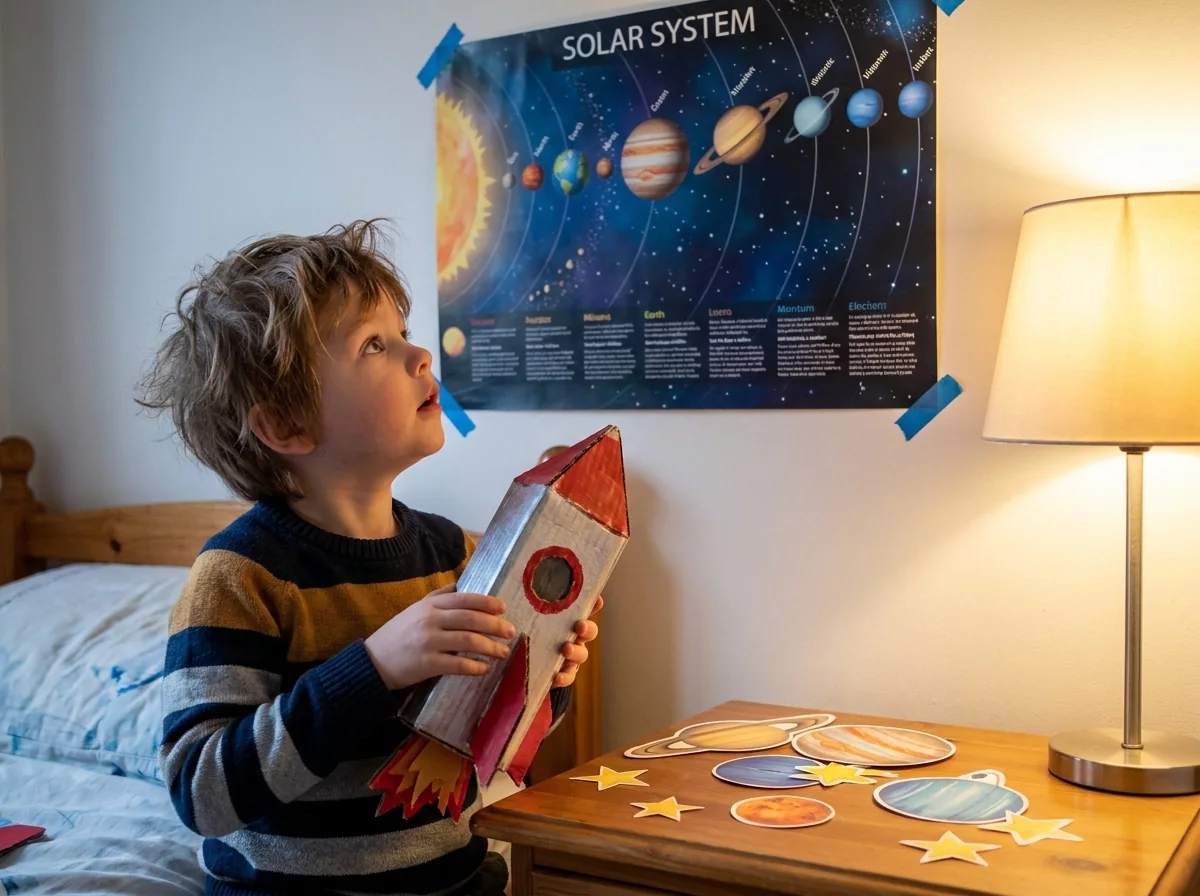
- Tube rocket. Paper-towel tube, paper cone, card fins, tissue flames: the craft every space theme needs.
- Paper-plate planets. Paint eight plates in planet colors (Earth blue and green, Mars red, Jupiter striped) and hang them in order.
- Foil Moon. Press a sheet of foil over a plate and dent craters with a spoon handle.
- Constellation pictures. Star stickers on black paper, joined with a white crayon. Name each shape, as ancient sky-watchers did.
- Salt-painting galaxy. Glue swirls on black paper, sprinkle salt, drop on watered-down paint and watch it travel.
- Space mazes and dot-to-dots. Help the rocket reach the Moon; join the dots to find a planet.
- Cut, fold and stand. Stand-up paper rockets and astronauts for a tabletop mission (our busy book ideas cover storing cut-and-fold pages).
Movement and songs
- Rocket launch. Crouch small, count down from 10 together, and blast off with a jump.
- Moon walk. Slow, bouncy, giant steps across the room, as if you weigh almost nothing.
- "Zoom, Zoom, Zoom, We're Going to the Moon." The classic action rhyme.
- Planet freeze. Spin like Earth until the music stops, then freeze in orbit.
- Meteor dodge. Gently roll soft balls across the floor while your child jumps over the "meteors."
Outdoors
- Shadow clock. Trace your child's shadow with chalk in the morning and again after lunch. The Sun seems to move because Earth is turning.
- Moon diary. Look at the Moon every evening for a week and draw its shape on a strip of paper. By Friday the change is obvious.
Sample 5-day space plan for preschool
| Day | Morning (15–20 min) | Afternoon (10–15 min) | Book |
|---|---|---|---|
| Mon | Countdown words + rocket number line | Tube rocket craft | Roaring Rockets |
| Tue | Day and night with a lamp | Moon walk + "Zoom, Zoom, Zoom" | Papa, Please Get the Moon for Me |
| Wed | Count the planets + planet sizes | Paper-plate planets | There's No Place Like Space! |
| Thu | Space word cards | Crater drop | Mousetronaut |
| Fri | Space mazes and coloring | Star gazing after dinner | How to Catch a Star |
Start the Moon diary on Monday evening. For a second week, swap in the moon-phase cookies, fizzing planets, constellation pictures and shadow clock.
Space picture books for preschoolers
- There's No Place Like Space! by Tish Rabe (The Cat in the Hat's Learning Library). The planets in rhyme; look for the updated edition with eight planets.
- Roaring Rockets by Tony Mitton and Ant Parker. Launch to landing in simple rhyme; best at 3.
- Papa, Please Get the Moon for Me by Eric Carle. A fold-out story that shows the Moon shrinking and growing.
- Mousetronaut by Mark Kelly. A small mouse saves a mission, by a real astronaut.
- How to Catch a Star by Oliver Jeffers. Gentle, funny, and a talk-starter about how far away stars are.
- The Darkest Dark by Chris Hadfield. For the child who is scared of the dark and loves space.
- Mae Among the Stars by Roda Ahmed. The story of Mae Jemison for ages 4 and 5.
What to print for a space theme
Three books cover most of the activities above:
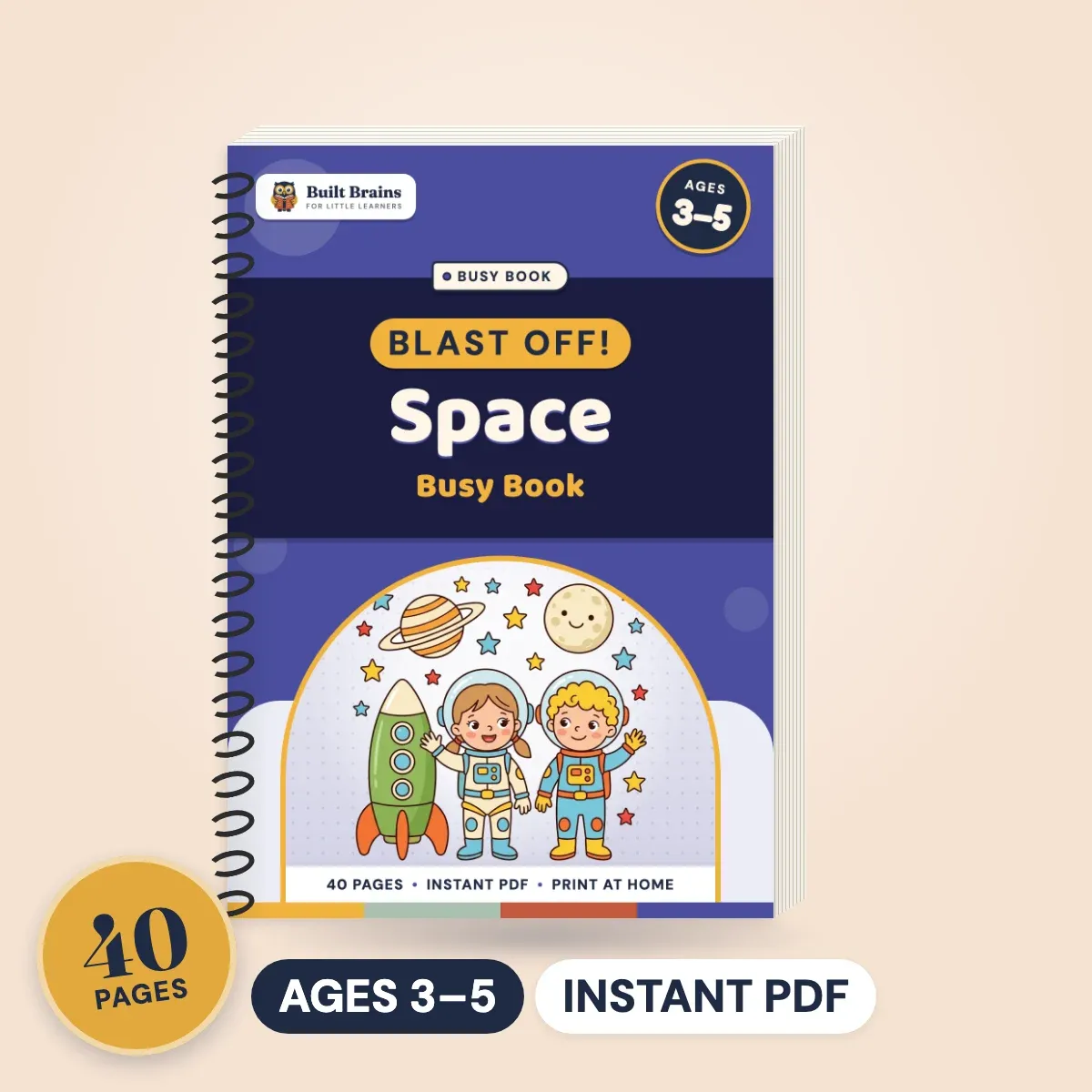
- Blast Off! Space Busy Book (ages 3–5, 40 pages): rockets, planets, astronauts and a friendly alien across coloring, tracing, mazes, dot-to-dots, counting, patterns and word cards.
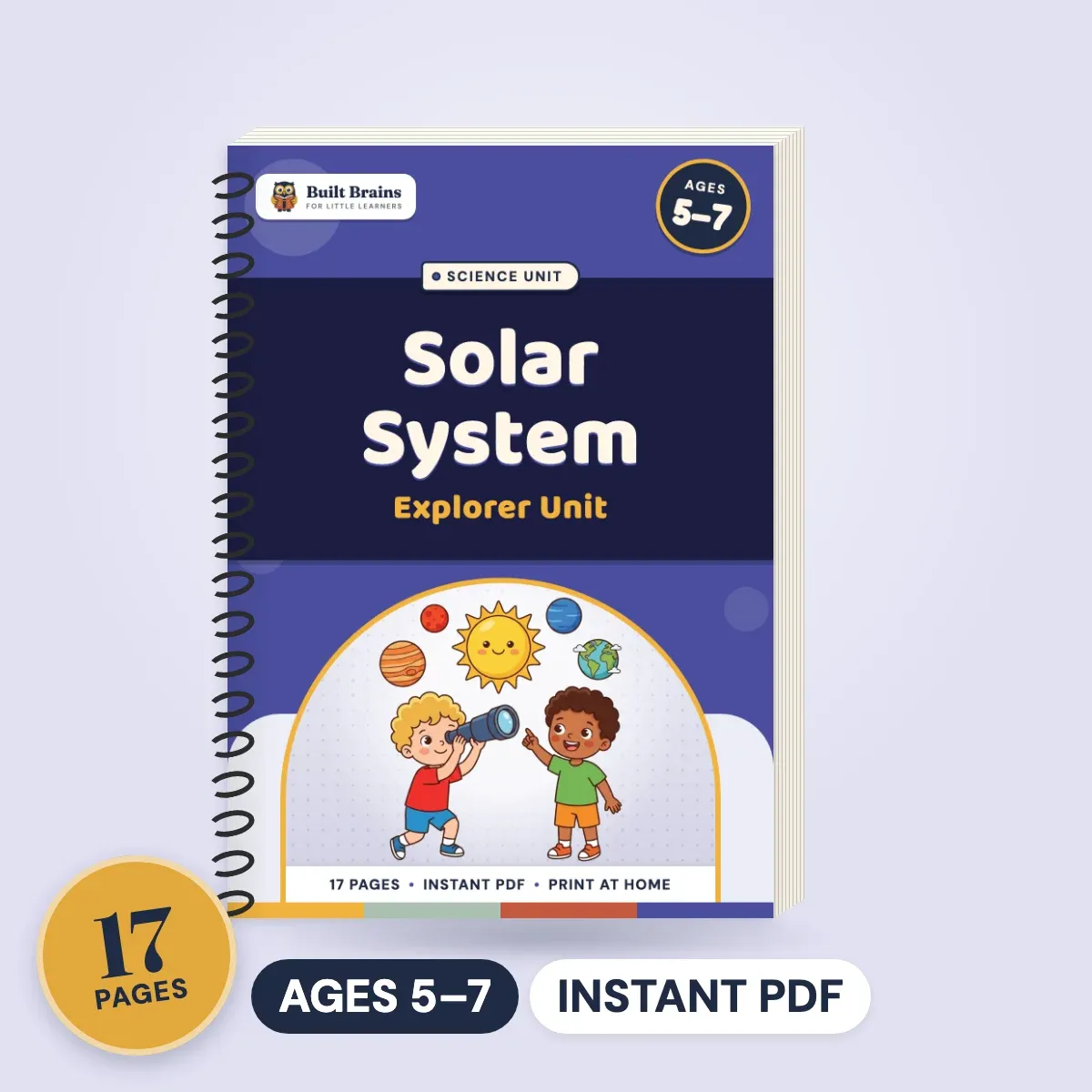
- Solar System Explorer Unit (ages 5–7, 17 pages): read-aloud facts about the Sun, the Moon and the planets, then tracing, counting, mazes and a word search. Read the fact pages to any preschooler; save the written work for 5.
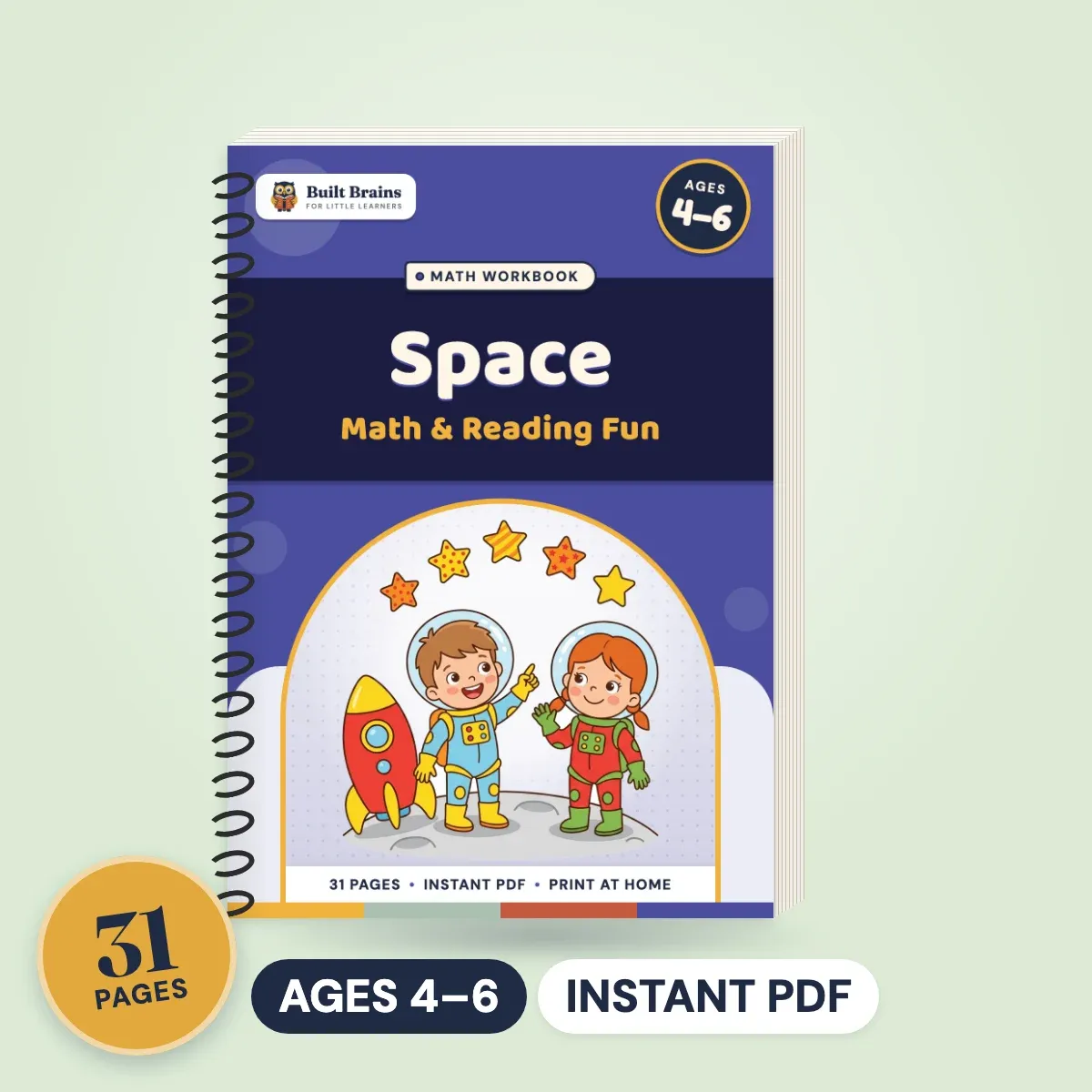
- Space Math & Reading Fun (ages 4–6, 31 pages): counting rockets and stars to 20, adding and taking away planets, tracing and reading space words.
Also worth having:
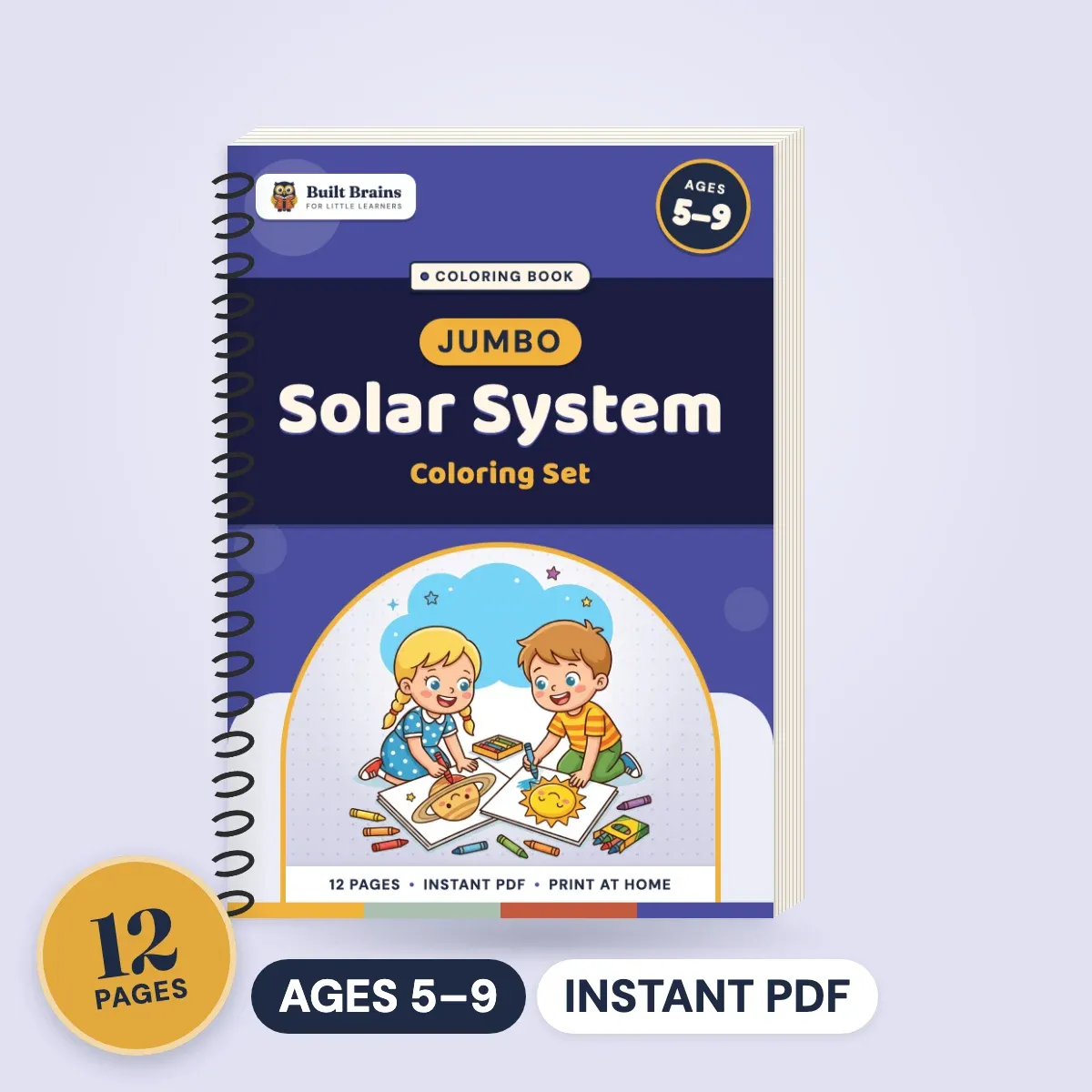
- Jumbo Solar System Coloring Set (ages 5–9): the Sun and all eight planets, one big page each with a fact, to color and hang in order (activities 8 and 24).
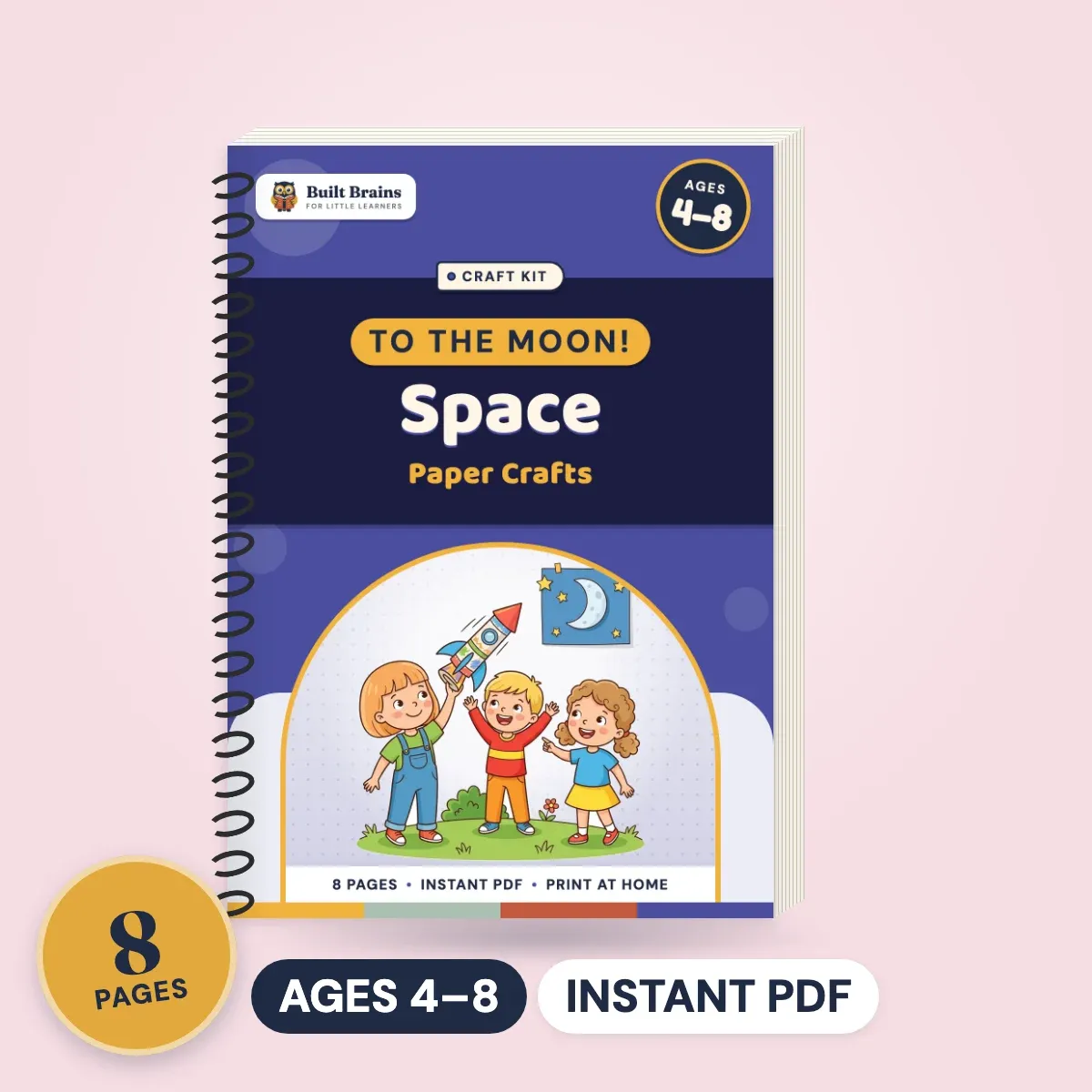
- To the Moon! Space Paper Crafts (ages 4–8): 12 stand-up rockets, astronauts and planets to color, cut and fold (activity 29).
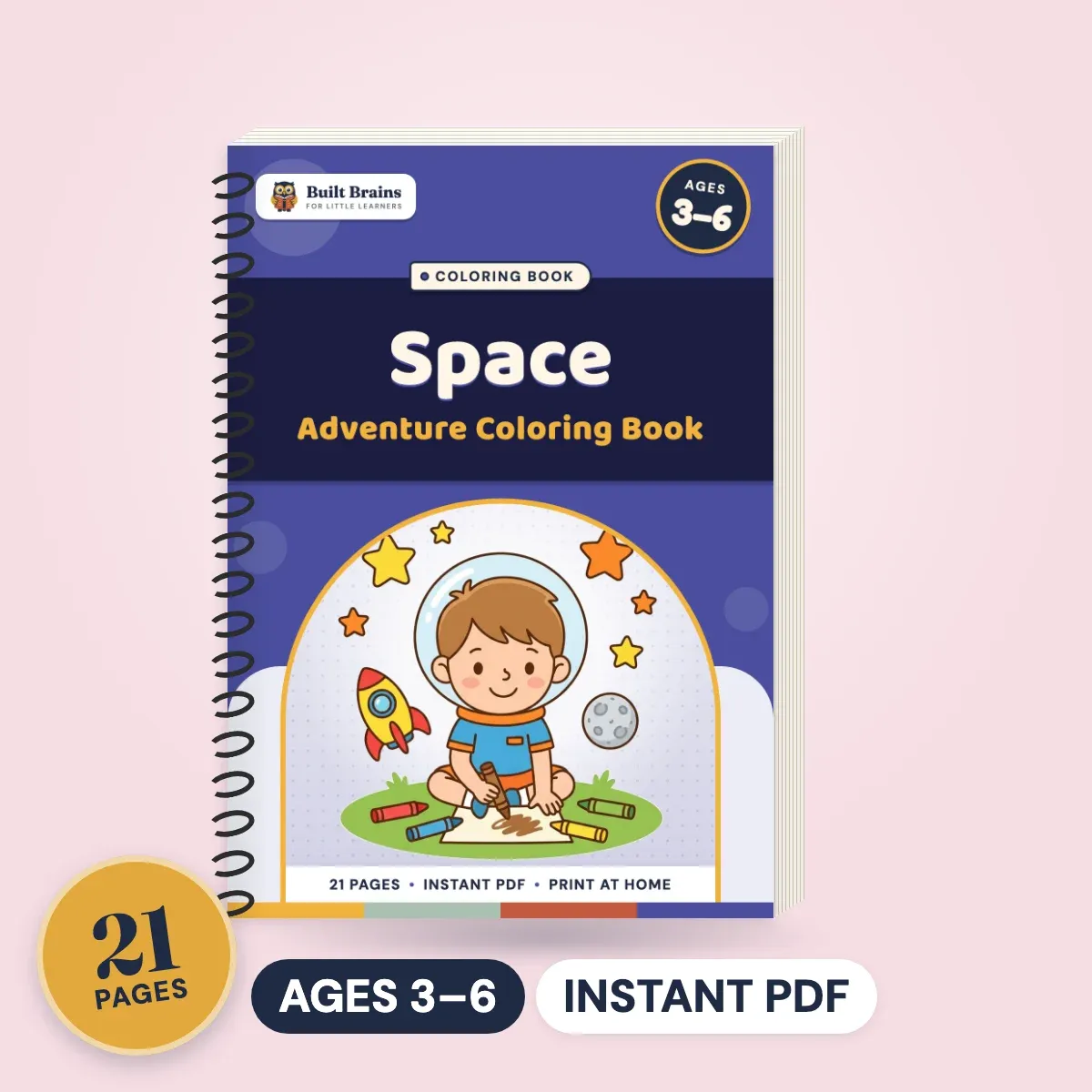
- Space Adventure Coloring Book (ages 3–6): big, simple space scenes with thick lines.
- Night Sky & Constellations Pack and Moon Phases & Eclipse Crafts (both ages 5–9): constellations to connect, a moon-phase wheel and eclipse diagrams for a 5-year-old who wants more.
Keep the planet lineup on the wall afterward; children go on naming them for months, and the coloring pages make good quiet-time activities once the rockets are put away.
Sources
- NASA Space Place – All About the Sun: the Sun is a star, the closest one to Earth, explained at a child's level.
- NASA Science – Planets: the eight planets in order, their sizes and Pluto's status as a dwarf planet.
- NASA Space Place – Our Solar System: kid-level explainers on the Moon's phases, day and night and the planets.
- NAEYC – 10 Things Every Parent Should Know About Play: why pretend and active play drive early language and problem-solving.
Questions parents ask
Keep to what they can see and act out: the Sun is a star that gives us light and heat, Earth is the planet we live on, the Moon goes around Earth and seems to change shape through the month, and eight planets go around the Sun. Add a few planet names, what astronauts do and how a rocket counts down. Skip distances and temperatures for now.
Use bodies. Put a lamp (the Sun) in the middle of the room, hold a ball (Earth) and walk a slow circle around it while turning the ball. The turn makes day and night; the whole circle takes a year. Then add a smaller ball (the Moon) circling the Earth. Follow with a picture book and a planet lineup to color.
Not anymore, by the official definition. Since 2006 astronomers have classed Pluto as a dwarf planet, so there are eight planets: Mercury, Venus, Earth, Mars, Jupiter, Saturn, Uranus and Neptune. For a preschooler, "Pluto is a small, icy world past Neptune" is enough and avoids unlearning it later.
A paper-towel-tube rocket is the quickest: wrap the tube in paper, add a cone made from a paper semicircle, glue on fins and tissue-paper flames, then count down and launch. Paper-plate planets, a foil Moon with craters pressed in by a spoon and a black-paper constellation picture with star stickers are all 10-minute makes.
One to two weeks. Space has more content than most themes (Sun, Moon, planets, stars, rockets, astronauts), so two weeks with one or two short activities a day is comfortable for ages 4 and 5. For a 3-year-old, keep it to a week of rockets, the Moon and coloring, and revisit the planets next year.

Reviewed by
Early Years SENCo (Special Educational Needs Coordinator)
Ben Mitchell is an Early Years SENCo specializing in early identification and inclusive classroom strategies for neurodivergent children.
More about B. Mitchell →