What goes into a kindergarten homeschool lesson plan
A kindergarten lesson plan at home is much simpler than a classroom plan. Each day needs a few short, focused pieces and plenty of time around them:
- Phonics (10–15 minutes): letter names, sounds, then blending sounds into words.
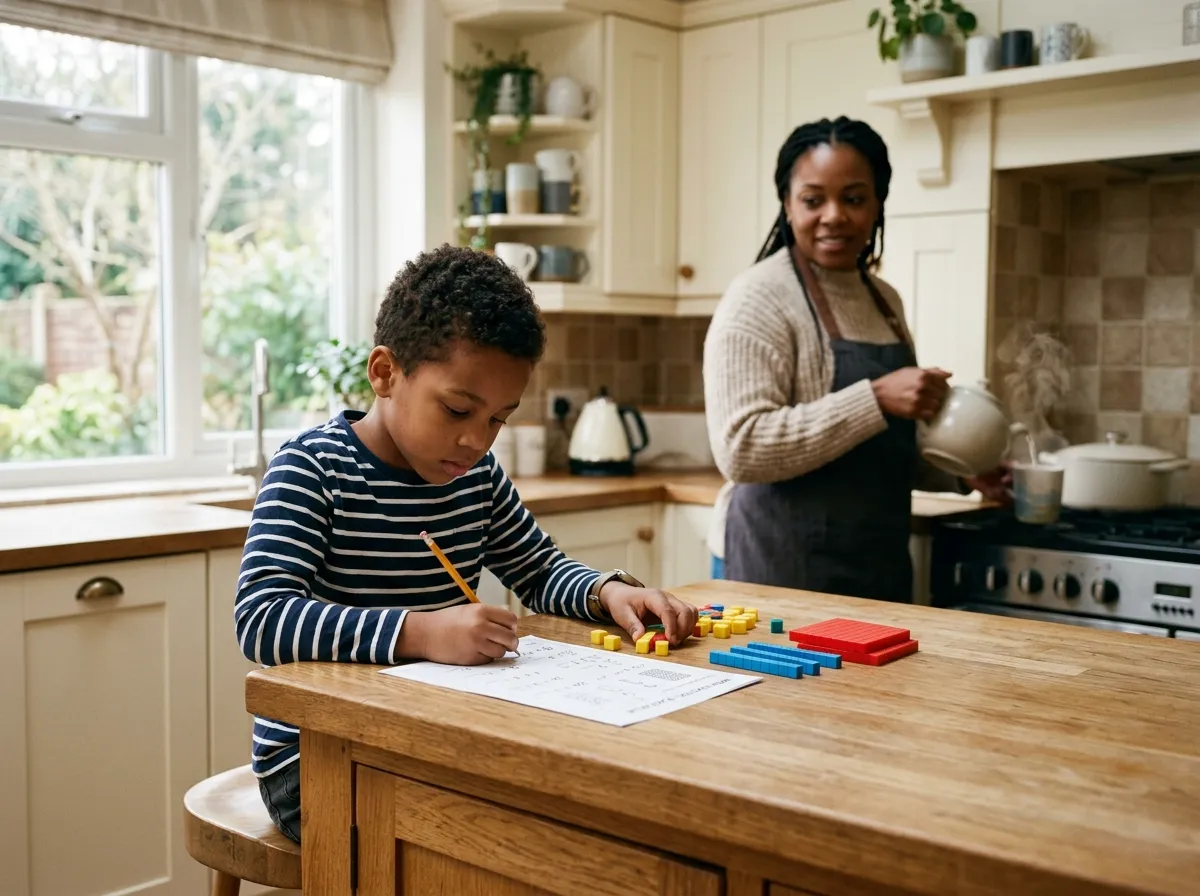
- Math (10–15 minutes): real objects first, then a short page.
- Writing (5–10 minutes): letter formation, then drawing and labeling.
- Read-aloud (15–20 minutes): picture books, ideally tied to the week's theme.
- Theme (10–15 minutes, two or three days a week): a simple science or social studies topic.
- Play: blocks, pretend play, outdoors, crafts. Not a filler: this is where a lot of the learning sticks.
That adds up to about 30 to 45 minutes of focused work. For how many hours suit each grade, see how many hours a day to homeschool, and for what kindergartners should learn across the year, see what to teach in kindergarten at home.
The standards most US schools follow expect kindergartners to learn letter sounds, read common high-frequency words and begin reading simple text (Common Core, Reading: Foundational Skills K), while kindergarten math centers on whole numbers and on describing shapes (Common Core, Kindergarten Math). The plan below starts there.
Sample kindergarten lesson plan: Week 1
Week 1 focus: letters Aa to Ff, sight words I and a, counting and writing 1 to 5, and the theme All About Me. The focus is the same as Week 1 of our kindergarten curriculum, laid out here as a full free week so you can try the approach before deciding anything.
| Day | Phonics | Math | Writing | Read-aloud | Theme | Play |
|---|---|---|---|---|---|---|
| Monday | Meet Aa, Bb, Cc: say each sound, find things that start with it | Count 1 to 3 with spoons or blocks | Trace Aa, Bb, Cc | A picture book about yourself or your name | Make an "All About Me" page: name, age, favorite color | Free play with blocks |
| Tuesday | Meet Dd, Ee, Ff; beginning-sound hunt for all six letters | Count 4 and 5 with snacks; match to dots | Trace Dd, Ee, Ff | A book about feelings | Mirror drawing: draw your face | Pretend play |
| Wednesday | Sight words I and a: read, find in a book, build with letter tiles | Write 1 to 5; show each with fingers | Write your first name | A book about families | Measure your height with a string | Outdoor time |
| Thursday | Letter hunt: find Aa to Ff in books, signs and food packets | Count and sort small toys into groups of 1 to 5 | Draw your family, label with a first letter | A favorite from the shelf | Handprint and footprint art | Playdough letters |
| Friday | Review all six letters and sounds; read "I see a ___" sentences together | Number hunt 1 to 5 around the house | Finish "I am ___" with a drawing | Re-read the week's favorite | Share the All About Me page with someone | Library trip or nature walk |
How to teach each block
- Phonics: Say the sound, not just the letter name ("Bb says /b/, like ball"). Hold up real objects that start with that sound. Stop while your child is still interested.
- Math: Always count real things first: spoons, crackers, toy cars. Then do one short page. Ask "How do you know?" after every count.
- Writing: Watch the starting point and direction rather than neatness. A few careful letters beat a full page of rushed ones. The alphabet tracing tips guide covers letter formation.
- Read-aloud: Point to the words as you read, pause to ask what might happen next, and let your child find the week's letters on the page.
- Theme and play: Keep these light. The goal is curiosity and conversation.
How to plan a 36-week kindergarten year
Public schools in most states run about 180 days a year (NCES), which is 36 five-day weeks. Planning in 36 weeks gives you a clear path with natural breaks for holidays. You don't need every week written out in August; you need the order.
A simple year map
| Weeks | Phonics and reading | Math |
|---|---|---|
| 1–9 | Letters Aa to Zz, then -at, -an, -ap, -ag, -ad, -it, -ig words | Count and write 1 to 10, more and fewer, shapes, teen numbers |
| 10–18 | More short vowel word families (short i, o, u), CVC review | Counting to 30 and 50, adding and taking away within 5, measuring |
| 19–27 | Short e words, digraphs sh, ch, th, wh, -ck, l-, r- and s-blends | Taking away within 10, counting to 100 by tens, hundred chart, ways to make 10 |
| 28–36 | Ending blends, silent e (a_e, i_e, o_e, u_e), review | Making 10, sorting and graphing, patterns, adding and subtracting to 10 |
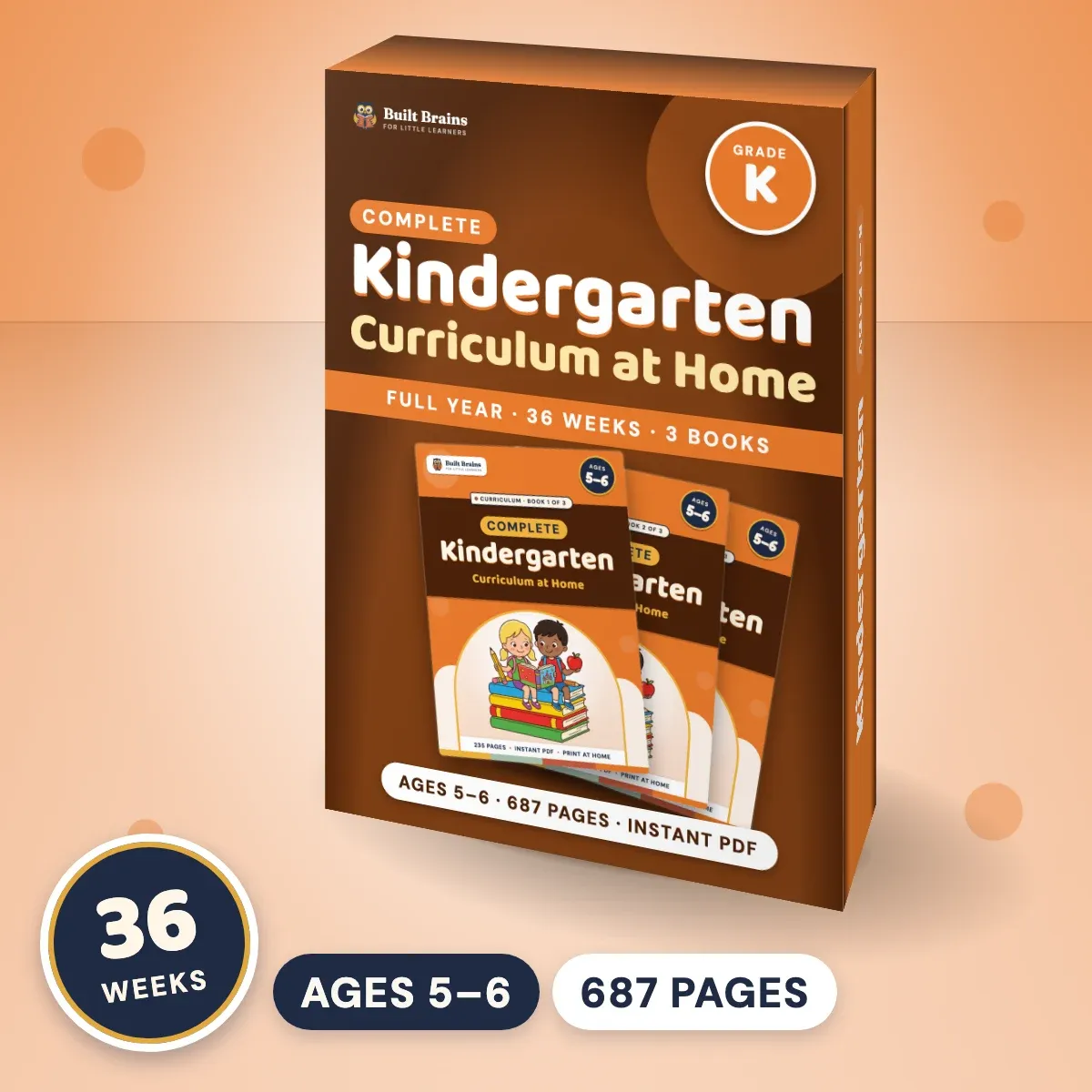
This is the sequence our Complete Kindergarten Curriculum at Home follows, with a new theme every week (from All About Me and Community Helpers in the fall to Dinosaurs, Plants & Spring and Space later in the year) and more than 70 sight words along the way.
Planning steps
- Mark your calendar: start date, holidays, and any breaks. Count 36 teaching weeks.
- Set the order for phonics and math using a map like the one above.
- Choose a theme per week, loosely matched to the season.
- Plan two weeks at a time. Gather library books and objects on the weekend.
- Review every few weeks. Build in a catch-up week each term.
For materials to gather before Week 1, use the homeschool kindergarten supply list.
A simple weekly lesson plan template
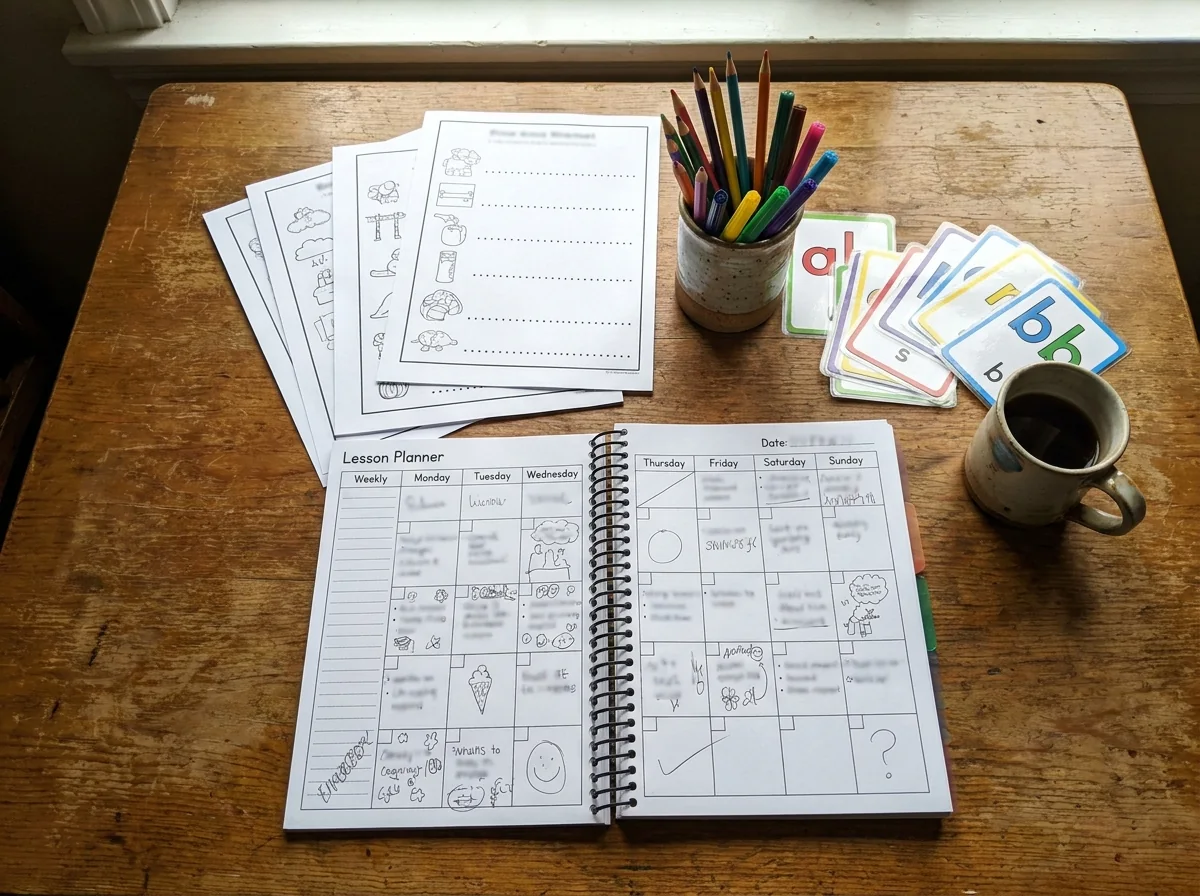
You can draw this on one sheet of paper or a whiteboard:
- Top of the page: week number, dates, letter or phonics pattern, sight words, math focus, theme.
- Grid: five columns (Monday to Friday) and six rows (phonics, math, writing, read-aloud, theme, play).
- Each box: one short line, such as "Count 4 and 5 with snacks." If it needs more than one line, it is probably too long for a five year old.
- Bottom of the page: books to borrow, things to gather, and a "Notes" line for what to repeat next week.
Fill in the top row first, then the boxes, then the notes on Friday. Keep finished sheets in a folder; together with a few work samples, they make a simple record of your year, which some states ask for.
How to adapt kindergarten lesson plans for your child
If your child is ready for more
- Move faster through letter review weeks and spend extra time on blending and reading short sentences.
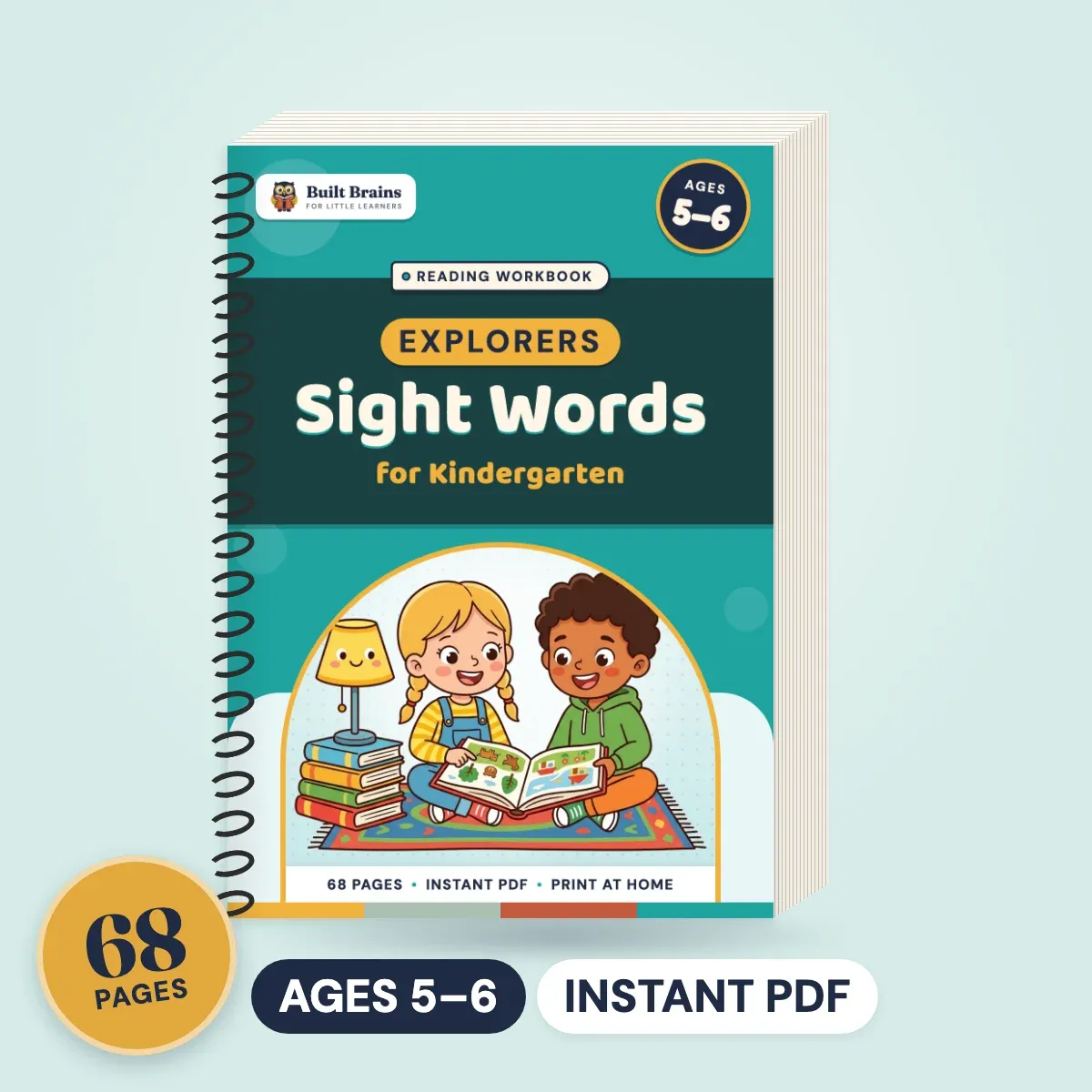
- Add a sight word practice book like Sight Word Explorers: Kindergarten, with a page for each of 52 primer words.
- Swap a math page for a real-world challenge: setting the table for six, sharing snacks fairly.
If your child needs more time
- Repeat a week with new books and games before moving on.
- Shorten each block to five minutes and add more movement.
- Go back to listening games: rhyming, clapping syllables, "I spy something that starts with /m/."
Children develop at different rates, and a slower start is common. If you're unsure whether your child is ready for kindergarten work at all, the kindergarten readiness checklist can help.
If mornings are hard
A daily warm-up page gives a calm, predictable start. Good Morning! Kindergarten Warm-Ups has 180 pages, one per school day, that follow the same plan week by week. The kindergarten morning work guide has more ideas.
State rules and record keeping
Homeschool requirements are set by each state. Some ask for notice of intent, set subjects, days or hours, or require records or testing; others ask for very little. Check your state on the HSLDA homeschool law map before you start. Weekly lesson plan sheets plus a small portfolio of dated work are a simple way to keep records either way. If you're still choosing materials, see printable vs boxed homeschool curriculum and how to homeschool kindergarten.
 Best valueSave $32
6 books · 1043 pages
The Complete Kindergarten BundleCurriculum, warm-ups, sight words and enrichment
Ages 5–6 · 185 pages
Good Morning! Kindergarten Warm-Ups180 daily pages: phonics, sight words and math
Sources
- Common Core State Standards – Kindergarten: Reading Foundational Skills: letter sounds, high-frequency words and early reading expected in kindergarten.
- Common Core State Standards – Kindergarten Math: Introduction: kindergarten math focuses on whole numbers and on describing shapes and space.
- HSLDA – Homeschool Laws by State: state-by-state homeschool requirements, including notice, subjects and records.
- NCES – Number of instructional days and hours in the school year, by state: most states set a public school year of about 180 days.
Questions parents ask
Each day needs a short phonics lesson, a hands-on math lesson, a few minutes of handwriting or drawing and writing, a read-aloud, and time for play. Across the week, add a science or social studies theme and one review day. Keep each piece to 10 or 15 minutes so the whole plan fits in under an hour.
Count out 36 weeks, which matches a typical 180-day school year. Map phonics in order (letters, short-vowel word families, digraphs, blends, silent e) and math in order (counting, numbers to 20, adding and taking away within 10, counting to 100). Pick a theme for each week, then plan the details only a week or two ahead.
Yes. The sample Week 1 in this article is free to use as written, and the template section shows how to build your own weeks from library books and household objects. A free plan works well for a trial week. For a full year, a planned curriculum saves hours of weekly preparation.
Adjust the pace, not the order. If your child already knows the letters, move quickly through review weeks. If a skill is shaky, repeat the week with new books and games before moving on. Children develop at different rates in kindergarten, and steady progress matters more than the calendar.
Friday works well for most families: a review page, a fun theme activity and a library trip or nature walk. Ending the week on something your child can already do builds confidence, and it gives you a clear moment to note what to repeat the following week.

Reviewed by
Early Childhood Educator & Curriculum Specialist
Maya Caldwell, M.Ed., is a veteran kindergarten teacher and instructional coach who specializes in structured literacy and purposeful play. With over a decade of classroom experience, she designs hands-on, inclusive learning environments that turn emerging readers into confident lifelong learners.
More about Maya →