What is the best 2nd grade homeschool curriculum?
The best 2nd grade homeschool curriculum gives your child real things to read every week, keeps building spelling through phonics patterns, and covers the big second-grade math jumps: regrouping, numbers to 1,000, time, money and early multiplication. It should fit into about an hour a day without you planning every lesson yourself.
A complete second-grade year should include:
- Reading to learn: a true story or nonfiction article each week, with questions about main idea, details and cause and effect.
- Spelling and phonics: 10 or so words a week built on one pattern, such as silent letters, vowel teams, prefixes or suffixes.
- Grammar: nouns and verbs in more depth, adjectives and adverbs, contractions, quotation marks, combining sentences.
- Writing: friendly letters, paragraphs, and short opinion and narrative pieces.
- Math: adding and subtracting to 1,000 with regrouping, place value, time to five minutes, money, arrays, measurement, data and fractions.
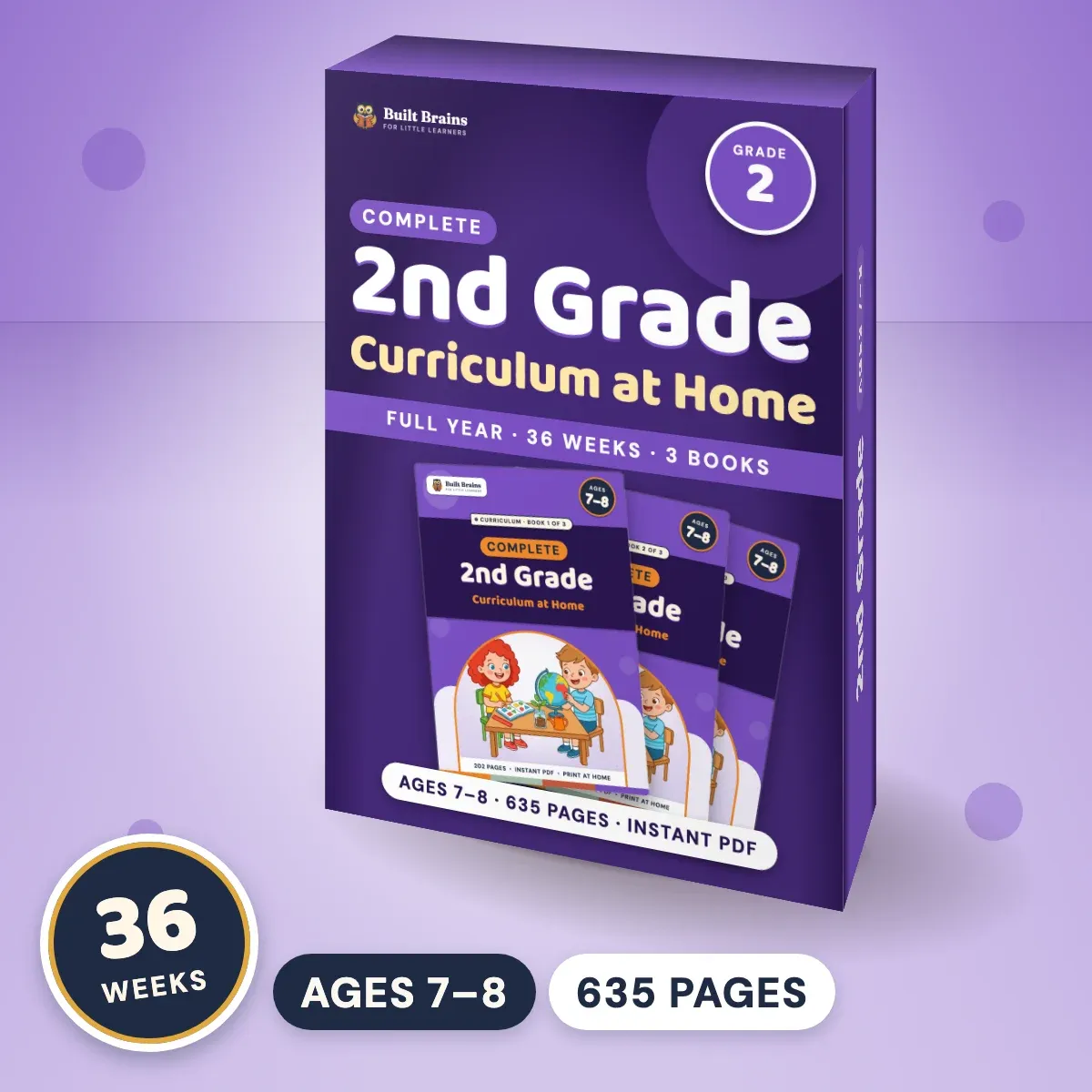
Our option is the 2nd Grade at Home Curriculum, a secular, print-at-home year. From the product details:
- 36 weekly plans, 635 pages: three printable books of 12 weeks each plus a 19-page Parents' Guide.
- A new true story or nonfiction article every week with comprehension questions.
- A 10-word spelling list built on one pattern, a phonics sort, practice and a spelling check.
- Grammar mini-lessons, sight words and writing prompts.
- Second-grade math from regrouping and place value to time, money, arrays and fractions.
It is an instant PDF download, black and white, prints on US Letter or A4, and comes with a 14-day money-back guarantee.
What do 2nd graders learn? The second-grade scope
US state standards for second grade are broadly similar. Use this as a guide to the year, not a test, since children develop at different speeds.
| Subject | What most second graders work on |
|---|---|
| Reading | Reading longer stories and nonfiction, finding the main idea, comparing two texts, reading aloud with expression |
| Phonics and spelling | Long vowel spellings (ai, ay, igh, oa), r-controlled vowels, silent letters, -dge and -tch, prefixes and suffixes, homophones, two-syllable words |
| Grammar | Collective and irregular plural nouns, irregular past tense verbs, adverbs, contractions, possessives, quotation marks |
| Writing | A paragraph with a topic sentence, a friendly letter, a short story with a beginning, middle and end |
| Math | Adding and subtracting within 100 fluently, within 1,000 with regrouping, place value to 1,000, time to five minutes, coins and dollars, measuring length, bar graphs, arrays and equal groups, halves, thirds and quarters |
| Science and social studies | Weather and water, plants and life cycles, animals and habitats, the Earth and moon, maps, communities, national symbols |
The big change from first grade is that reading becomes a tool for learning about the world. Your child reads about how clouds make rain or how a seed grows, then answers questions using details from the text. If your child is still working through first-grade patterns like silent e and vowel teams, it is fine to start there and move up. Our 1st grade homeschool curriculum guide covers that year.
How many hours a day is 2nd grade homeschool?
Most second graders do well with about one to two hours of focused work, including:
- Reading and comprehension: 20 to 30 minutes
- Spelling and phonics: 10 to 15 minutes
- Grammar and writing: 15 minutes
- Math: 20 to 30 minutes
- Independent reading: 15 to 20 minutes, often in the afternoon
Our curriculum plans for 45 minutes to an hour a day. Many families split it: reading and spelling after breakfast, math after a break outside.
A sample week of 2nd grade homeschool
Here is Week 13 from our second-grade curriculum. The pattern is silent letters (kn, wr, mb, gn), the grammar skill is adjectives that compare, the math is money with quarters and dollars, and the theme is Winter.
- Monday, spelling and phonics: Read the list together: knock, knife, kneel, wrist, wreck, wrinkle, thumb, climb, comb, gnat. Sort the words by their silent letter. Ask, "Which letter do we write but not say?"
- Tuesday, grammar and sight words: Mini-lesson on -er and -est (cold, colder, coldest). Practice the sight words use, very and wash.
- Wednesday, math: Money with quarters and dollars. Count real coins first, set up a pretend shop with price tags, then do the pages and word problems.
- Thursday, read: "Snowflake Science," a short nonfiction article about how snowflakes form and the farmer who first photographed them. Read it twice, then answer the questions.
- Friday, write and review: A writing prompt, the spelling check (you say each word in a sentence, your child writes it) and the Winter theme page.
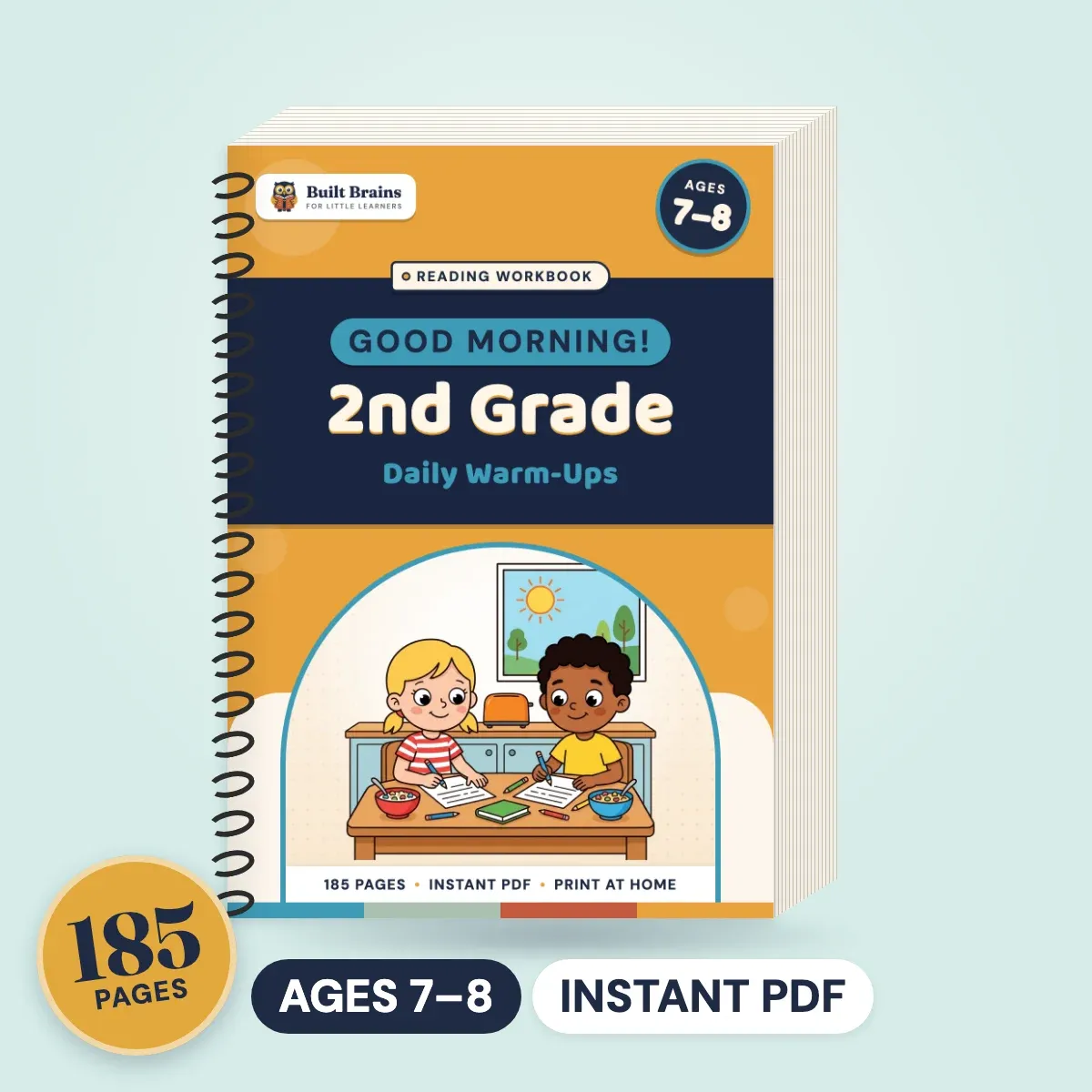
Each plan day has one main focus. If you want a little math and writing every day, add a five-minute morning page. The 2nd Grade Warm-Ups give 52 daily pages with a word of the day, a fix-it sentence, two-digit math of the day, place value practice and a quick write.
How to choose a 2nd grade homeschool curriculum
Have a sample week open and work through these questions.
Is there enough real reading?
Look for a new passage every week, with both stories and nonfiction. Questions should ask "how do you know?" and "what is the main idea?", not only facts you can copy from the first line.
Is spelling built on patterns?
A weekly list on one pattern, with a sort and a check, works far better than a list of unrelated words. Second grade is when spelling patterns like -dge, -tch, silent letters and suffixes start to matter. Our 2nd grade spelling words guide goes deeper.
Does the math cover regrouping and place value to 1,000?
This is the hardest second-grade math jump. Check that the program teaches it with drawings or base-ten blocks before the written method, and gives plenty of practice.
How much will you need to prep?
Open-and-go programs need a few minutes of reading the plan. Others need weekend planning and gathering books. Be honest about your time.
Secular, neutral or faith-based?
Read a few sample passages and the science topics. In second grade, nonfiction reading touches science and history more often, so it is worth checking the tone matches your family.
Do you need a separate spelling program?
Most complete curricula include spelling. Add a separate program if your child finds spelling hard and needs more practice each week, or if you want more vocabulary work.
 New
NewAges 7–8 · 635 pages
Complete 2nd Grade Curriculum at Home36 weeks of reading, spelling, grammar, writing and math — planned for you
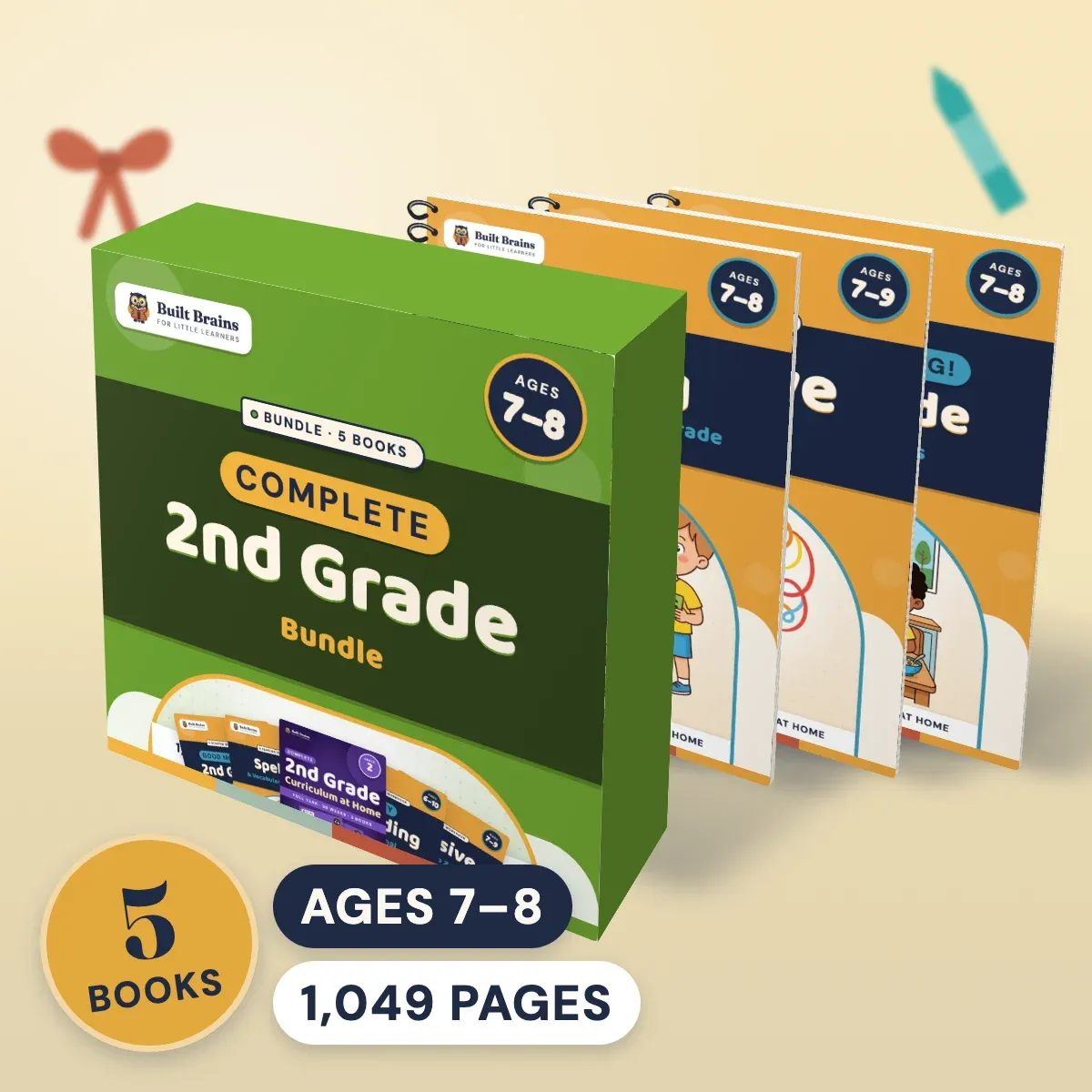 Save $27
5 books · 1049 pages
The Complete 2nd Grade BundleCurriculum, warm-ups, spelling, journal and cursive
Ages 7–8 · 183 pages
Spelling & Vocabulary: 2nd Grade36 weekly lists with sorts, practice, vocabulary and checks
Types of 2nd grade homeschool curriculum
- All-in-one printable: reading, spelling, grammar, writing and math with weekly plans. Low cost, little prep, you print as you go.
- Boxed: physical workbooks and readers. No printing needed, higher cost.
- Literature-based: a booklist at the heart, with language arts and math often separate. Rich reading, more planning and book gathering.
- Online: lessons on a screen, often self-checking. Low prep, more screen time.
- Mix and match: separate programs for each subject. Flexible, but you coordinate it all.
Want to try the printable style first? Try our free printable book and see how your child takes to it. It is written for younger children, but it shows the paper, style and print quality.
Our option: the Built Brains 2nd Grade at Home Curriculum
Since this is our blog, here is our second-grade year described plainly.
The 2nd Grade at Home Curriculum is a 36-week printable year for ages 7 to 8. Weekly reading passages include true stories and nonfiction such as "How Clouds Make Rain," "Johnny Appleseed," "The Coral Reef," "Our Moon" and "Sleep: Your Body's Recharge," each with comprehension questions. Spelling moves from long vowel review through r-controlled vowels, silent letters, prefixes, suffixes, homophones and multisyllable words. Math covers regrouping to 1,000, place value, time to five minutes, money, measuring, data, fractions, and arrays and equal groups leading into first multiplication facts. There is no religious instruction.
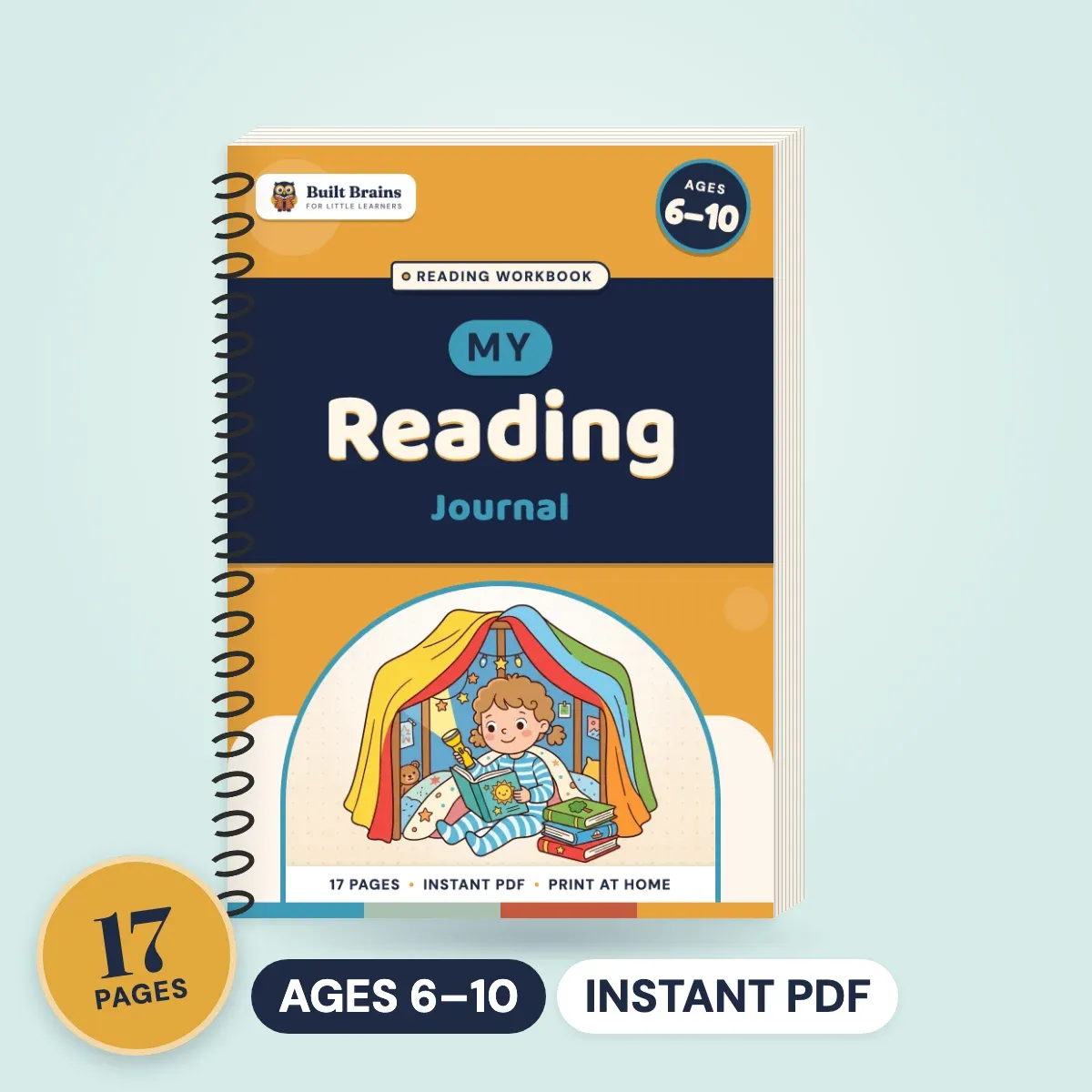
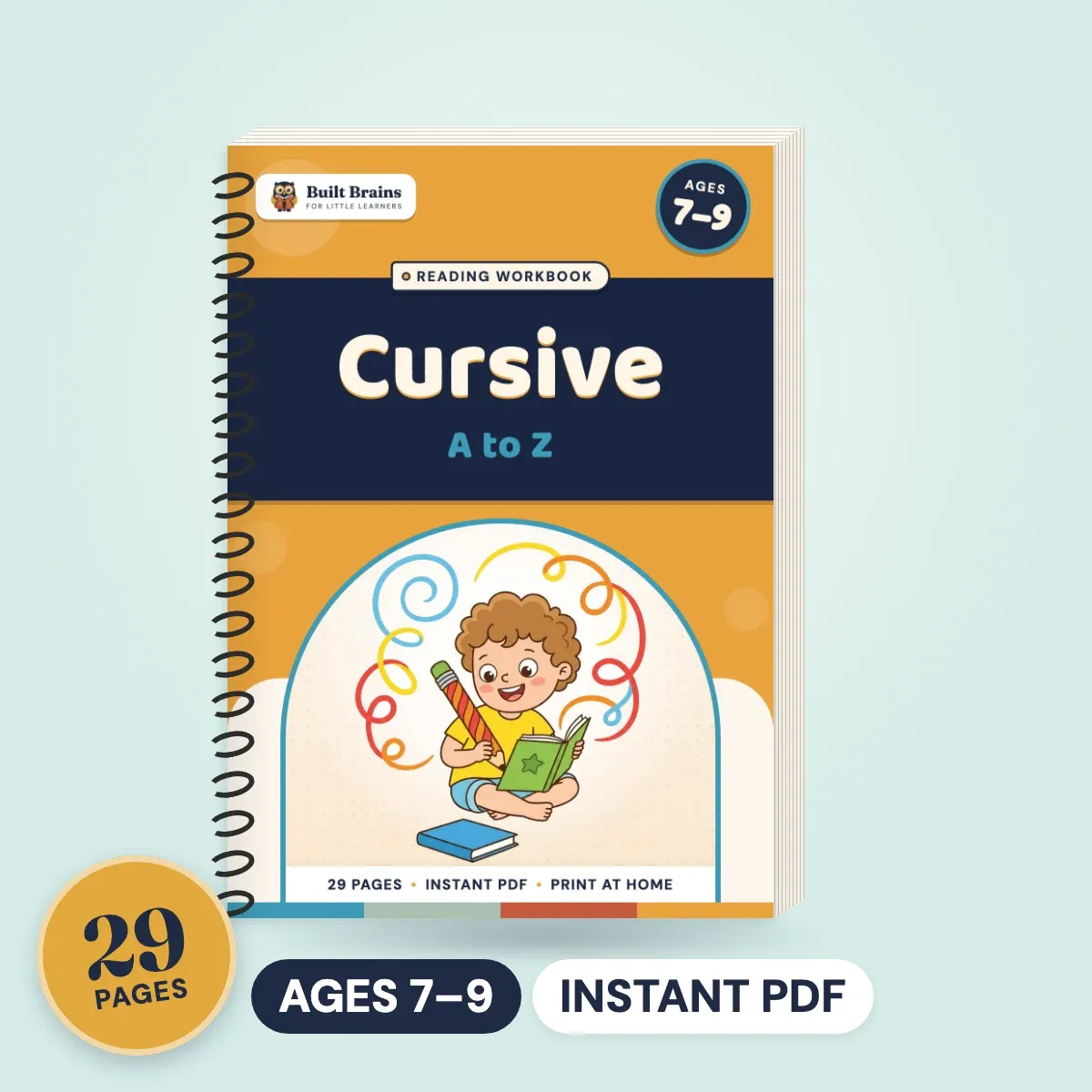
The Complete 2nd Grade Bundle adds the 2nd Grade Warm-Ups, the full Spelling & Vocabulary: 2nd Grade program (36 weekly lists, each with a word sort, practice page, word-detective vocabulary and a Friday check), My Reading Journal and Cursive A to Z. That is 899 pages for the whole year.
It may suit you if you want a secular, open-and-go second-grade year in one place, you are comfortable printing a week at a time, and your child is reading simple passages already.
It may not suit you if:
- You want a word-for-word script for every lesson.
- Your child is still decoding short-vowel and silent e words slowly. Start with first-grade work instead.
- Reading or writing is a real struggle. A specialist program, and a conversation with your pediatrician or a reading specialist, may help more than any general curriculum.
- You want physical readers, manipulatives or a screen-based program.
- You want full science and history courses. Our themes are reading-based, so you would add library books, experiments or a separate program.
Common 2nd grade homeschool mistakes
- Stopping read-alouds because they can read now. Keep reading longer, harder books to them. It builds vocabulary and listening comprehension.
- Rushing regrouping. If borrowing in subtraction is confusing, go back to bundles of ten and drawings for a week.
- Marking every error in writing. Choose one thing to fix per piece, like capitals or the week's spelling pattern.
- Making spelling only memorization. Sorting words by pattern is what makes spelling transfer to new words.
- Too much independent work too soon. Second graders can work alone for short stretches, but still need you close by.
- Skipping handwriting. Neat, comfortable writing makes everything else easier. Many families start cursive this year.
How to start 2nd grade homeschool
- Check your state's homeschool rules and record-keeping requirements.
- Spend a few days checking where your child is: can they read a short passage aloud, write three sentences, add two-digit numbers?
- Pick one core curriculum and print the first week only.
- Set up a basket with pencils, an eraser, a ruler, coins, a clock with hands and a whiteboard.
- Keep a monthly sample of reading, writing and math for your portfolio.
If you want second grade planned for the whole year, secular and printable, the 2nd Grade at Home Curriculum covers reading, spelling, grammar, writing and math in 36 open-and-go weeks.
See more for this age on our second grade page.
Questions parents ask
Most second graders finish the year reading short chapter books and nonfiction with growing fluency, finding the main idea, spelling common vowel patterns, writing a paragraph with a beginning, middle and end, adding and subtracting within 100 with ease and within 1,000 with regrouping, and telling time to five minutes. Children vary, so watch for steady progress.
About one to two hours of focused lessons a day suits most second graders, split between reading, spelling, writing and math. Add independent reading, read-alouds, outdoor play and projects around that. Two shorter sessions often work better than one long one at this age.
The core is reading and comprehension, spelling and phonics, grammar, writing and math. Science and social studies are often taught through nonfiction reading and projects. Many families add handwriting, often starting cursive, plus art, music and physical activity, which can be simple and low-cost.
Yes. Second-grade phonics covers harder patterns: vowel teams, r-controlled vowels, silent letters, prefixes, suffixes and multisyllable words. These patterns help children decode longer words in nonfiction and spell more accurately. A good second-grade curriculum ties weekly spelling lists to one pattern at a time.
Yes, there are secular options in every style: printable, boxed, literature-based and online. Check the sample reading passages and science topics to confirm there is no religious instruction. Built Brains curricula, including our 2nd grade year, are secular and faith-neutral.