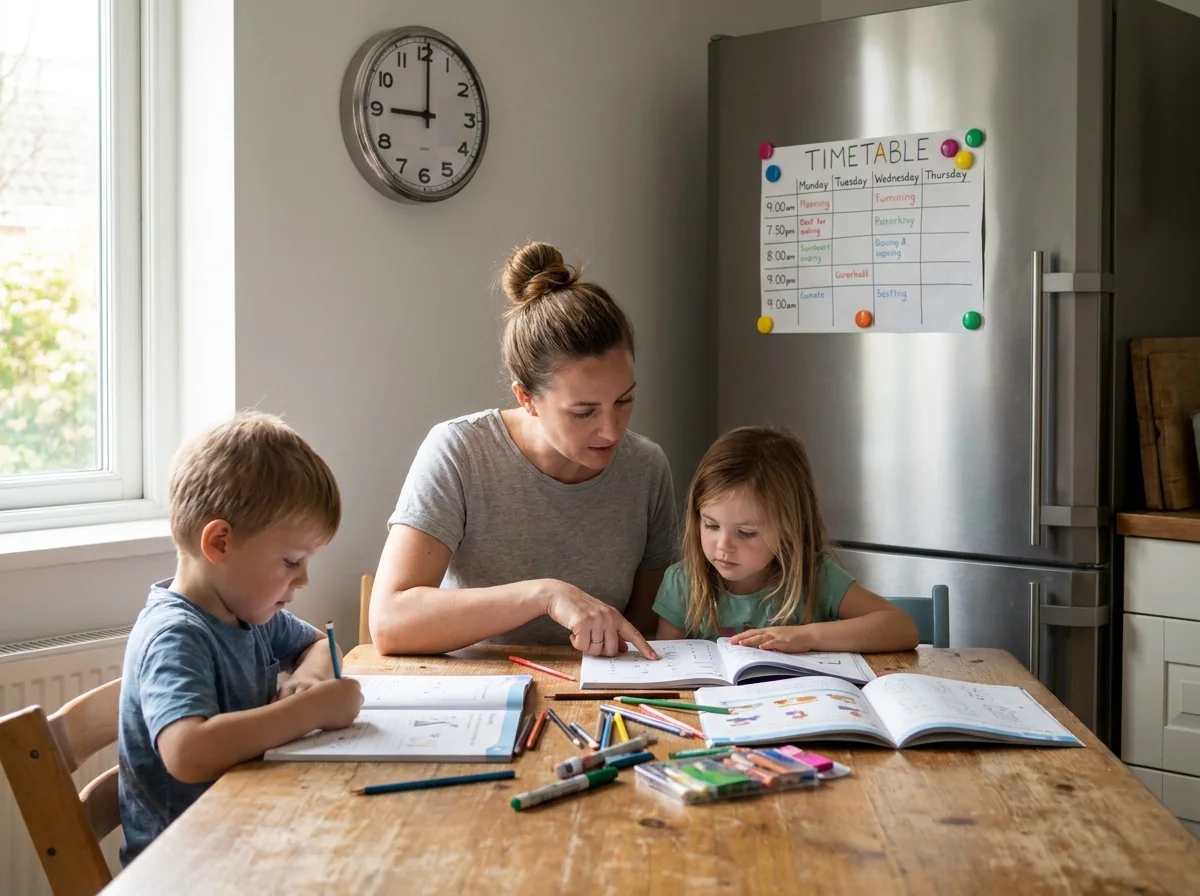
How many hours a day to homeschool, by grade
Less than most parents expect. For kindergarten through 3rd grade, the sit-down, focused part of a homeschool day usually takes between half an hour and two hours. Here is a typical range for each grade:
| Grade | Typical age | Focused lessons a day | Plus |
|---|---|---|---|
| Kindergarten | 5–6 | 30–60 minutes | Read-alouds, play, outdoor time |
| 1st grade | 6–7 | 45–90 minutes | 15–20 minutes of reading |
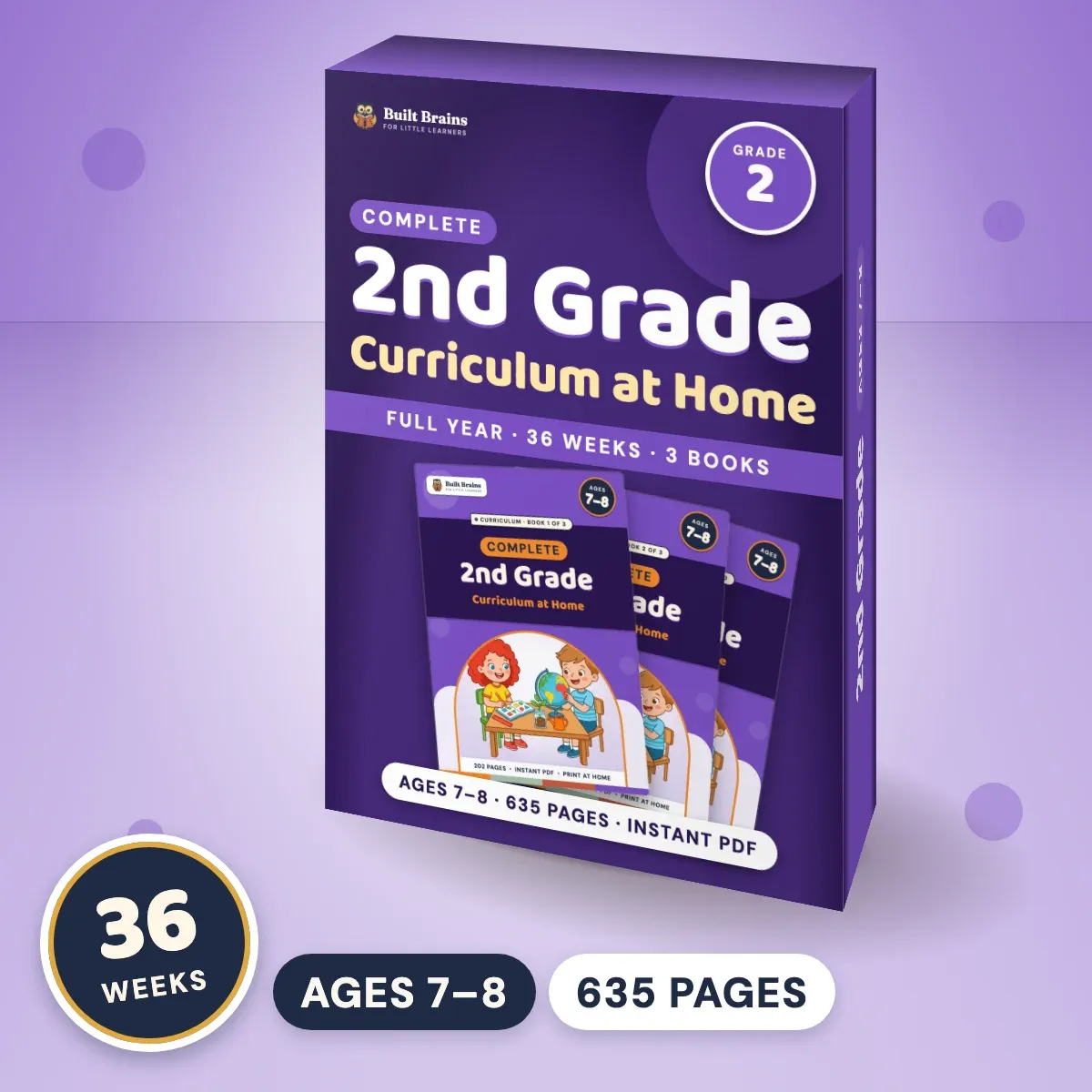
| 2nd grade | 7–8 | 1–2 hours | 15–20 minutes of independent reading |
| 3rd grade | 8–9 | 1–2 hours | 20–30 minutes of independent reading |
These are ranges, not targets. A focused five year old may finish kindergarten work in 25 minutes; a third grader writing a long story might work for two and a half hours one day and an hour the next. The question to ask is not "Did we do enough hours?" but "Is my child making steady progress, and are they still willing to learn tomorrow?"
"Focused" means lessons where you teach or your child practices a skill: phonics, reading, spelling, writing and math. Everything else in a good homeschool day (picture books on the couch, building a block tower, baking, a walk to look at bugs) still counts as learning. It just doesn't need a timer.
Why a homeschool day is shorter than a school day
Public schools in most states run about 180 days a year, and states that set a minimum school day for the early grades often put it somewhere around 4 to 6 hours of instruction (NCES). It's natural to compare and worry that one hour at home is not enough. But a classroom day is shared by 20 or more children, and a lot of it is spent on things a home day doesn't need:
- Arriving, unpacking, lining up and moving between rooms
- Waiting for a turn, waiting for help, waiting for others to finish
- Re-teaching the same idea to small groups at different levels
- Managing behavior across a whole room
- Lunch, recess and specials built into the schedule
At home, your child gets your full attention. You notice straight away when a sound is confused or a number is reversed, fix it, and move on. If they already know something, you skip it. That's why 15 minutes of phonics at the kitchen table can cover what takes much longer in a group.
Young children also learn a great deal through play, which pediatricians describe as essential to development, building language, thinking and social skills (American Academy of Pediatrics, HealthyChildren.org). A short lesson day leaves room for exactly that.
Sample homeschool schedules for K–3
Use these as starting points. Move blocks around to suit your family; many children do their best work right after breakfast.
Kindergarten (about 30–45 minutes of lessons)
- Warm-up (5 minutes): the day, the weather, a letter and a number.
- Phonics (10–15 minutes): a sound, blending practice, a few sight words.
- Movement break (10 minutes).
- Math (10–15 minutes): counters or snacks first, then a short page.
- Read-aloud and theme (15–20 minutes): picture books and a simple activity.
Afternoon: free play, outdoor time, a craft. Our Kindergarten at Home Curriculum is planned for about 30 minutes a day across 36 weeks, and the how to homeschool kindergarten guide walks through the whole first year.
1st grade (about 45–75 minutes of lessons)
- Phonics and spelling (15 minutes): the week's pattern and a word sort.
- Reading (15 minutes): a short passage read aloud together, then questions.
- Snack and outside (15–20 minutes).
- Math (15–20 minutes): facts, place value, time or money.
- Writing (10 minutes): a sentence or two from a prompt.
Our 1st Grade at Home Curriculum plans for about 45 minutes a day, which many families split into two sittings.
2nd and 3rd grade (about 1–2 hours of lessons)
- Reading and comprehension (20–30 minutes): the week's story or article, then discussion or written answers.
- Spelling and word study (10–15 minutes).
- Break (15–20 minutes).
- Math (20–30 minutes): teach the new idea together, then let your child practice while you stay nearby.
- Grammar and writing (15–20 minutes).
- Independent reading (15–30 minutes): often in the afternoon.
By 3rd grade, many children can read their own directions and start a page alone, so your time shifts from teaching every step to checking in. The 2nd grade and 3rd grade curriculum guides include sample weeks with times for each day.
How long should each lesson be?
A rough guide for how long a single sitting on one subject can last before attention drops off:
- Ages 5–6: 10 to 15 minutes per lesson
- Ages 6–7: 15 to 20 minutes
- Ages 7–9: 20 to 30 minutes
Every child is different, and the same child varies from day to day. Short lessons with a break in between nearly always beat one long session. A four-day week with a lighter fifth day for library trips, projects or review also works well for many families.
Signs it's too much (or too little)
Signs to cut back
- Tears, stalling or "I hate school" most days, not just occasionally
- Work gets sloppier the longer the lesson goes
- Your child guesses instead of thinking, just to be finished
- You're both dreading the start of lessons
If you see these, shorten lessons, add a movement break, or slow the pace and spend two weeks on a skill instead of one. Five calm minutes beat twenty frustrated ones.
Signs to add a little
- Your child finishes quickly and gets everything right, every day
- They ask for more, or start "doing school" on their own
- They seem bored rather than tired
In that case, add depth before you add hours: a harder book, a real-life math challenge (measuring for a recipe, counting change), or a longer writing piece. Moving ahead in the curriculum is fine when the basics are secure.
What does the law say about homeschool hours?
Homeschool rules are set by each state, and they vary a lot. Some states have no requirements for days or hours. Others ask homeschoolers to teach for a set number of days or hours, cover certain subjects, keep attendance or portfolio records, or test at certain grades. A few count instruction in hours across the year rather than per day.
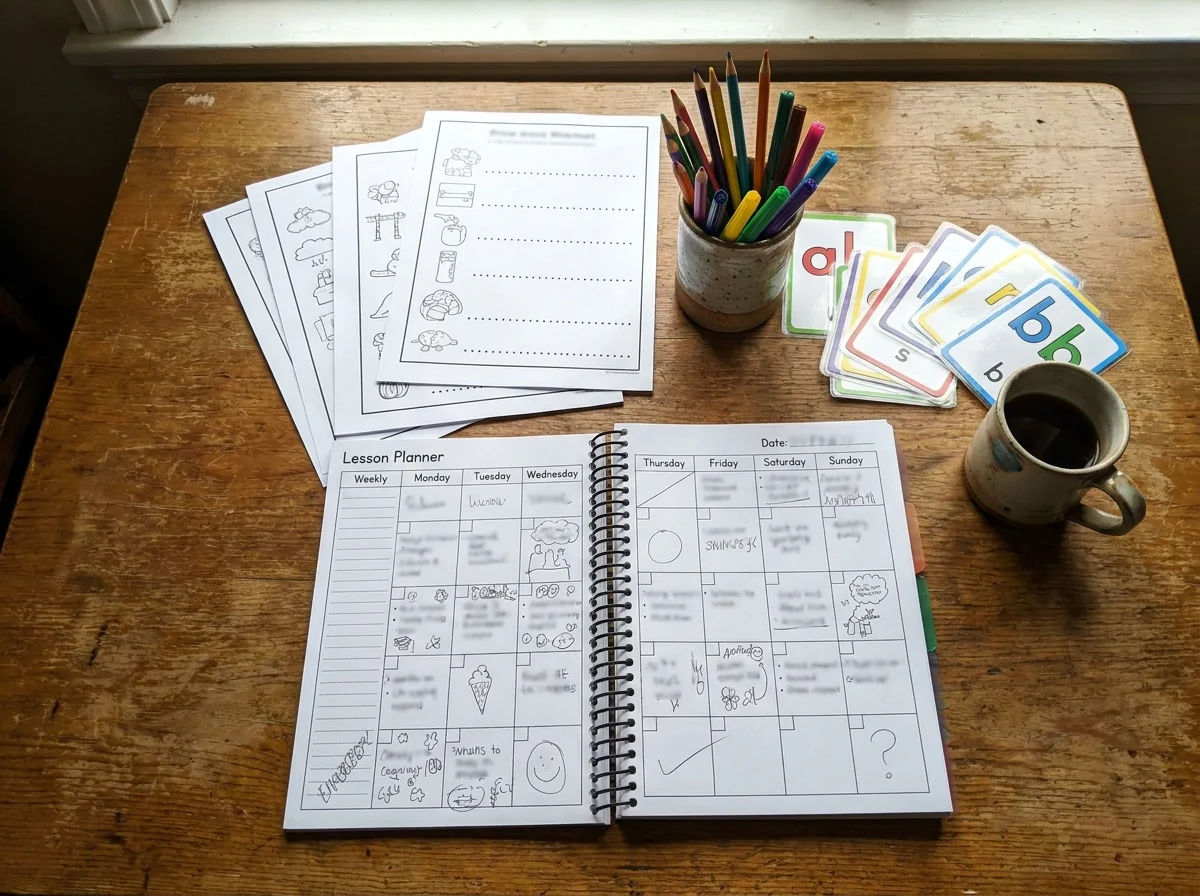
Because the rules change and differ so much, don't rely on a general number. Look up your state on the HSLDA state homeschool law map, which explains notice requirements, required subjects, testing and record keeping. If your state does count days or hours, a simple attendance log or a weekly planner page is usually all you need. The kindergarten guide's section on state requirements has a checklist for getting started.
Choosing a curriculum that fits the time you have
A curriculum written for a classroom often assumes long lessons and lots of teacher prep. For a short homeschool day, look for:
- Daily lessons you can finish in the time above. If one lesson takes an hour, it was not written for a kitchen table.
- A weekly plan you can open and use, so you spend minutes, not evenings, getting ready.
- Clear order: phonics, spelling and math that build week by week.
- Room for real books and play around the lessons.
Each of our grade curricula from kindergarten to 3rd grade has 36 weekly plans, so a full year fits a normal school calendar with room for breaks. If you're deciding between formats, see printable vs boxed homeschool curriculum.
 New
Ages 6–7 · 635 pages
Complete 1st Grade Curriculum at Home36 weeks of phonics, reading, writing, spelling and math — planned for you
 New
Ages 8–9 · 635 pages
Complete 3rd Grade Curriculum at Home36 weeks of reading, word study, grammar, writing and math — planned for you
 New
Ages 5–6 · 687 pages
Complete Kindergarten Curriculum at Home36 weeks of phonics, reading, math and more — planned for you
Sources
- HSLDA – Homeschool Laws by State: state-by-state homeschool requirements, including subjects, testing and records.
- NCES – Number of instructional days and hours in the school year, by state: public school year length and minimum school-day hours by state.
- HealthyChildren.org (American Academy of Pediatrics) – The Power of Play: why play matters for young children's learning and development.
Questions parents ask
About 30 to 60 minutes of focused lessons is enough for most five and six year olds, split into short pieces of 10 to 15 minutes for phonics, math and handwriting. Read-alouds, play, outdoor time and hands-on projects fill the rest of the day and count as learning too.
Most first graders do well with about 45 to 90 minutes of focused work: phonics and reading, spelling, a little writing and math. Splitting it into a morning block and a short afternoon block after lunch or outdoor time helps six year olds stay fresh. Add independent or shared reading on top.
For most third graders, one to two hours of focused lessons covers reading, word study, writing and math well, with 20 to 30 minutes of independent reading added. Projects, science, history and art can run longer on some days. What matters is steady progress, not hours logged, unless your state sets its own requirement.
It depends on your state. Some states have no hour or day requirements for homeschoolers, while others set a number of days, hours or subjects, or ask for records or testing. Check your state's page on HSLDA's state law map and follow the current rules where you live.
If the work is accurate and your child understands it, that is fine, especially in kindergarten. One-on-one lessons move fast. Fill the rest of the day with reading aloud, building, drawing, cooking, nature walks and free play. If the work is rushed and sloppy, slow down rather than add more pages.
Reviewed by
Early Childhood Educator & Curriculum Specialist
Maya Caldwell, M.Ed., is a veteran kindergarten teacher and instructional coach who specializes in structured literacy and purposeful play. With over a decade of classroom experience, she designs hands-on, inclusive learning environments that turn emerging readers into confident lifelong learners.
More about Maya →