
What do kids learn in 1st grade? The quick answer
First grade is the year reading clicks. Most children arrive blending three-letter words and leave able to read a simple book with little help. Math takes the same leap, from counting objects to working with numbers in their heads.
Here is the short version of what to teach in 1st grade:
- Phonics: review short vowels, then digraphs (sh, ch, th, wh, ck), blends (st, fl, tr), silent e, vowel teams (ai, ee, oa), r-controlled vowels (ar, or, er) and endings like -ed and -ing.
- Reading: decodable books moving toward early chapter books, plus about 100 to 150 high-frequency words over the year, and talking about characters, setting, main idea and facts in nonfiction.
- Writing: from one good sentence to three to five sentences on one topic, with capitals, periods and spelling that matches the phonics they have learned.
- Math: facts to 20, place value to 120, adding and subtracting two-digit numbers in simple cases, measuring, time, graphs, shapes and halves and fourths.
- Science and social studies: plants and animals, light and sound, the sun, moon and seasons, maps, family history, rules and community helpers.
This follows the general shape of US standards: many states use or adapt the Common Core for reading and math and the Next Generation Science Standards for science. Check your own state's homeschool rules, since some require specific subjects or yearly assessments.
What's inside the 1st Grade at Home Curriculum
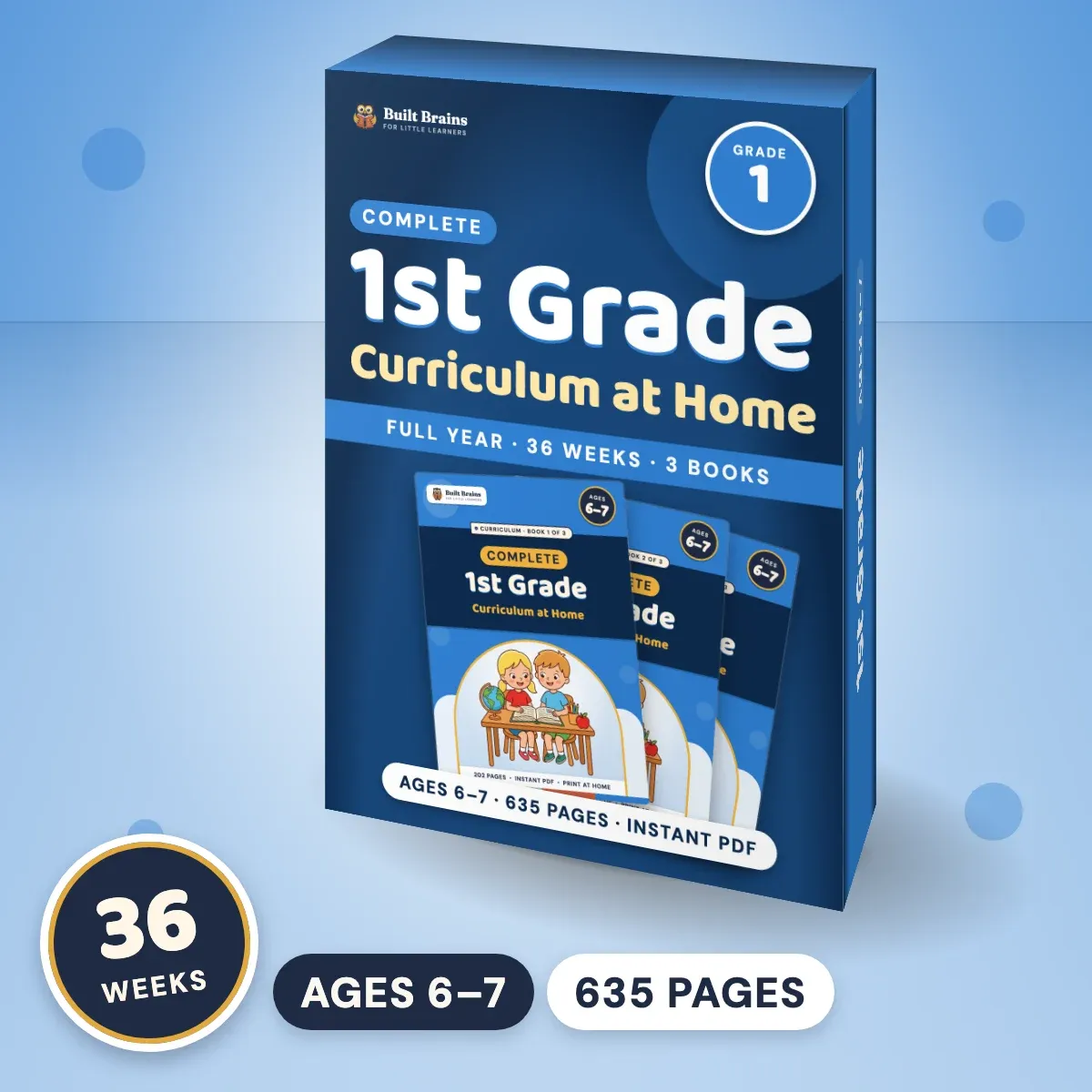
If you would rather open a plan each week than build one, our 1st Grade at Home Curriculum covers this scope in about 45 minutes a day across 36 weeks. It is 635 pages: three books (weeks 1 to 12, 13 to 24 and 25 to 36) plus a 19-page Parents' Guide, with 60 reading pages, 48 math pages, 36 spelling pages, 12 phonics, 12 grammar and 12 writing pages, plan pages and read-together pages. Every week has a spelling list and check, a phonics sort, a grammar mini-lesson, a reading passage with questions and writing prompts. Math runs from facts to 20 through place value to 120, two-digit adding and subtracting, time, money, fractions and graphs. It is an instant PDF download, black and white, prints on US Letter or A4, and has a 14-day money-back guarantee.
1st grade scope and sequence, month by month
Use this as a map, not a timetable. If your child needs three weeks on silent e, take them. A 36-week year fits into nine months of about four weeks each.
| Month | Phonics | Reading | Writing | Math | Science / social studies |
|---|---|---|---|---|---|
| Sept | Review letter sounds and short vowels, CVC words | Decodable sentences, first 20 to 30 high-frequency words | One complete sentence with a capital and period | Counting to 120, adding and subtracting within 10 | Rules, family, being a good citizen |
| Oct | Digraphs sh, ch, th, wh, ck | Short decodable stories, retelling beginning, middle, end | Labels and a sentence about a picture | Addition strategies: count on, doubles, make 10 | Plant parts, how plants grow |
| Nov | Beginning and ending blends (st, fl, tr, -nd, -mp) | Characters and setting | Two or three sentences in order using first, next, last | Subtraction within 20, fact families | Animals and their young |
| Dec | Silent e (a_e, i_e, o_e, u_e) | Reading with expression, rereading for fluency | A short personal story | Tens and ones, numbers to 120 | Holidays and traditions around the world |
| Jan | Vowel teams ai, ay, ee, ea | Nonfiction: headings, facts, main topic | A "how to" piece with steps | Comparing numbers with greater than and less than | Light and shadows |
| Feb | Vowel teams oa, ow, igh, y as a vowel | Asking and answering who, what, where, why | Opinion writing: "I like... because..." | Adding a two-digit and a one-digit number, adding tens | Sound and vibration |
| Mar | R-controlled vowels ar, or, er, ir, ur | Comparing two stories or two characters | Facts about a topic, three to five sentences | Measuring length, time to the hour and half hour | Sun, moon and day and night |
| Apr | Endings -ed, -ing, -s, -es, two-syllable words | Early chapter books with support | Friendly letter, capitalizing names and dates | Graphs and data, coins (often 2nd grade standard) | Maps, globes, land and water |
| May | Review all patterns, diphthongs ou, ow, oi, oy | Independent reading, answering with evidence from the text | Edit own writing for capitals, periods and spelling | Shapes, halves and fourths, review of facts | Seasons, then and now in your community |
How to teach 1st grade reading and phonics at home
Reading and phonics deserve the most time, and work best as one lesson: teach a pattern, read words with it, then read a passage that uses it.
A 25-minute reading lesson
- Warm up (3 minutes). Flash the sounds learned so far. Your child says the sound, not the letter name.
- New pattern (5 minutes). Write the new spelling on a whiteboard. Say: "These two letters, s and h, work together. They say /sh/. Ship. Fish."
- Word reading (5 minutes). Read 8 to 10 words with the pattern, then a few mixed with older patterns so your child has to look carefully.
- Connected text (8 minutes). A short decodable passage. Let your child read it twice: once to decode, once to sound like talking.
- Talk (4 minutes). Ask one or two questions: "Who was in the story? What problem did they have?"
If your child is unsure of letter sounds or blending, start there. Our guide to phonics phases shows how the stages fit together and where a child might need to step back.
Keep reading aloud every day too. Longer chapter books read to your child build the vocabulary their own decodable books cannot give them yet.
1st grade writing and spelling: what to expect
A typical 1st grader starts the year writing one sentence with invented spelling and ends it writing a short, readable paragraph. The bridge is short daily writing tied to phonics.
- Spelling: teach one pattern a week, the same pattern they are reading. A list of 8 to 12 words is enough. Test on Friday by saying each word in a sentence.
- Grammar: capitals at the start of sentences and for names, periods and question marks, nouns and verbs, and adding -s for more than one.
- Writing types: true stories, "how to" pieces, opinions and short fact pieces.
Accept phonetic spelling for untaught words ("becuz") but expect correct spelling for patterns already learned.
What 1st grade math looks like at home
First grade math is about number sense. Children should understand why 8 + 5 = 13, not just memorize it.
The big ideas
- Facts to 20. Strategies first: counting on, doubles (6 + 6), near doubles (6 + 7), and making 10 (8 + 5 = 8 + 2 + 3). Speed comes later, from short daily practice.
- Place value. 34 is 3 tens and 4 ones. Use bundles of 10 craft sticks or drawn sticks and dots until it is obvious.
- Adding and subtracting with bigger numbers. Adding 10 or 20 to a number, adding a two-digit and one-digit number, and simple two-digit sums.
- Measurement, time and data. Compare lengths, measure with paper clips, read clocks to the hour and half hour, and make tally charts and bar graphs from family surveys.
- Geometry and fractions. Name and build shapes, and cut paper shapes and food into halves and fourths.
A daily math lesson of 15 to 20 minutes works well: quick facts, the new idea with objects, then a page of practice. If a page is a struggle, go back to objects. Most 1st grade math frustration comes from moving to written sums too soon.
 Save $20
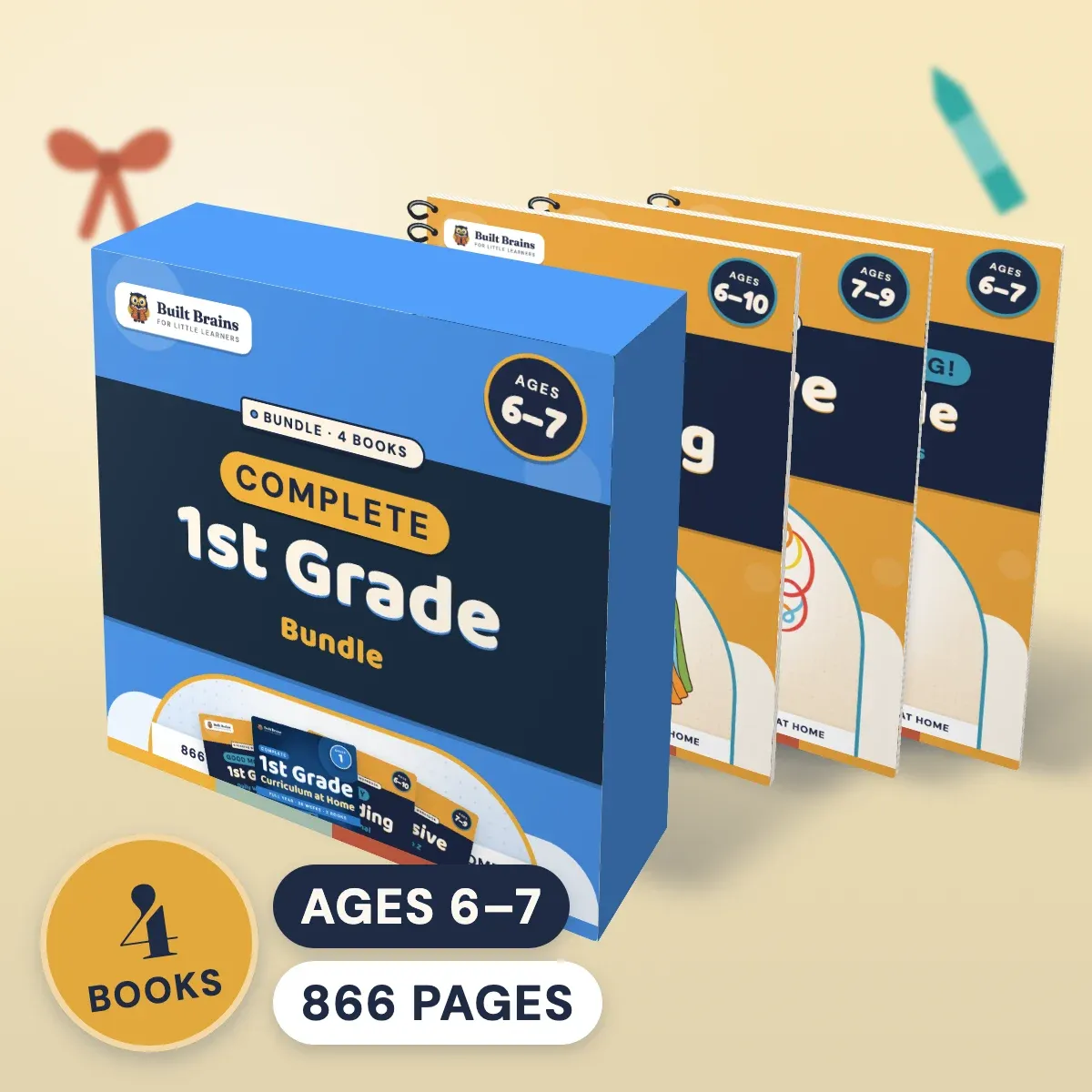
4 books · 866 pages
The Complete 1st Grade BundleCurriculum, warm-ups, reading journal and cursive
1st grade skills checklist for the end of the year
Use this as a guide in May or June, not a test. Children vary, and a child who meets most of these is ready for 2nd grade.
Reading and writing
- Reads words with short and long vowels, digraphs, blends and common vowel teams
- Reads simple books smoothly, rereading to fix mistakes
- Retells a story with beginning, middle and end
- Finds facts in a short nonfiction text
- Writes three to five sentences on one topic
- Uses capitals and end punctuation most of the time
Math
- Adds and subtracts within 20, with facts within 10 quick and accurate
- Counts, reads and writes numbers to 120
- Explains tens and ones in a two-digit number
- Tells time to the hour and half hour
- Reads and makes a simple graph
- Splits shapes into halves and fourths
If your child is well behind in reading by midyear, talk with your pediatrician or a reading specialist. It is better to check early than to wait.
How to plan a 1st grade homeschool week
A simple week that most families can keep up:
- Monday to Thursday: reading and phonics (25 minutes), math (20 minutes), writing or spelling (10 to 15 minutes).
- Two afternoons: science or social studies theme (20 to 30 minutes).
- Friday: spelling check, review games and a library trip.
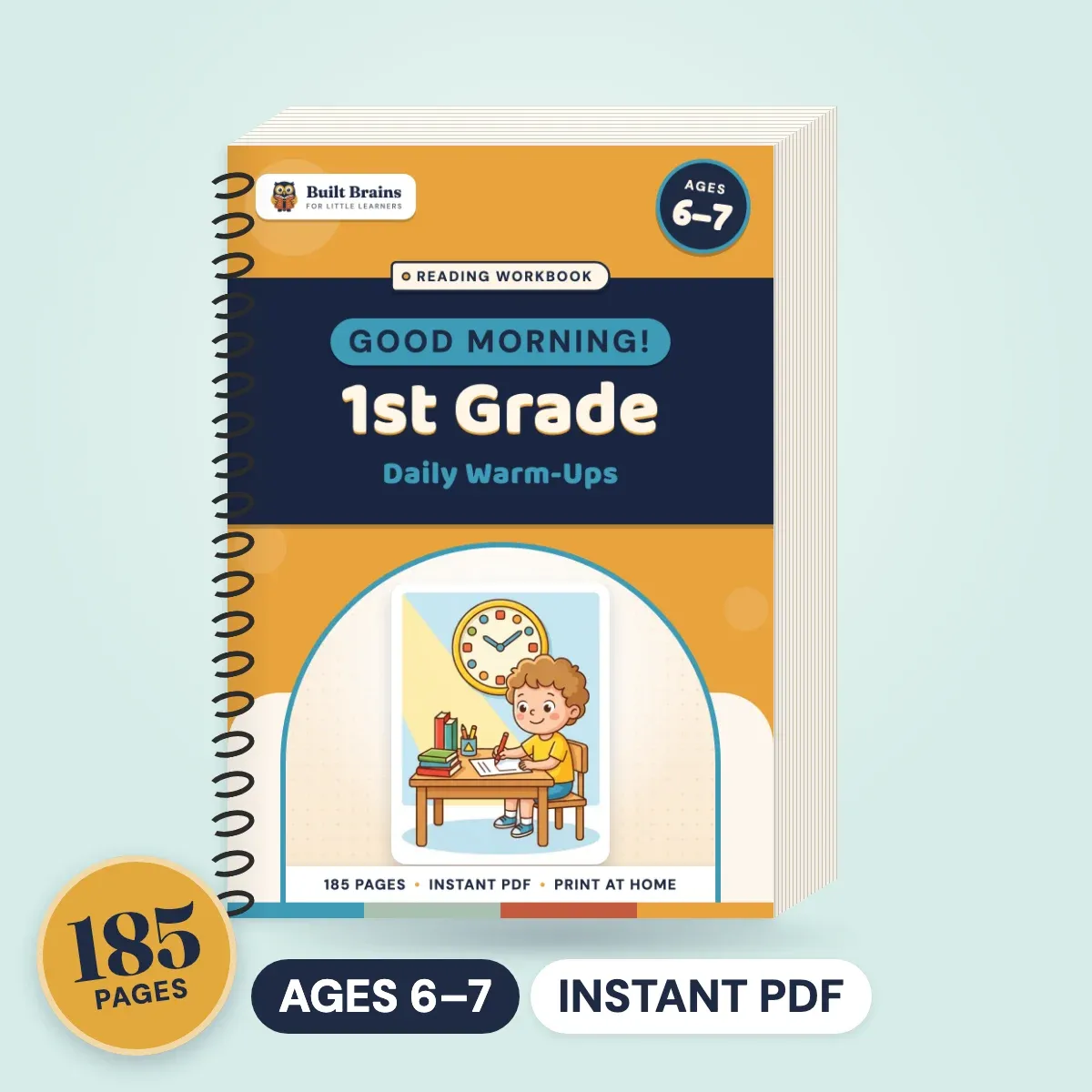
A five-minute morning page helps the day start on time, such as our 1st Grade Warm-Ups: date, weather, a fix-it sentence, math of the day and a quick write.
The first month overlaps with the end of kindergarten on purpose. Our guide to what to teach in kindergarten at home shows what your child should already have in place, and our 1st grade homeschool curriculum guide compares the ways to cover the year.
The easiest way to cover all of 1st grade
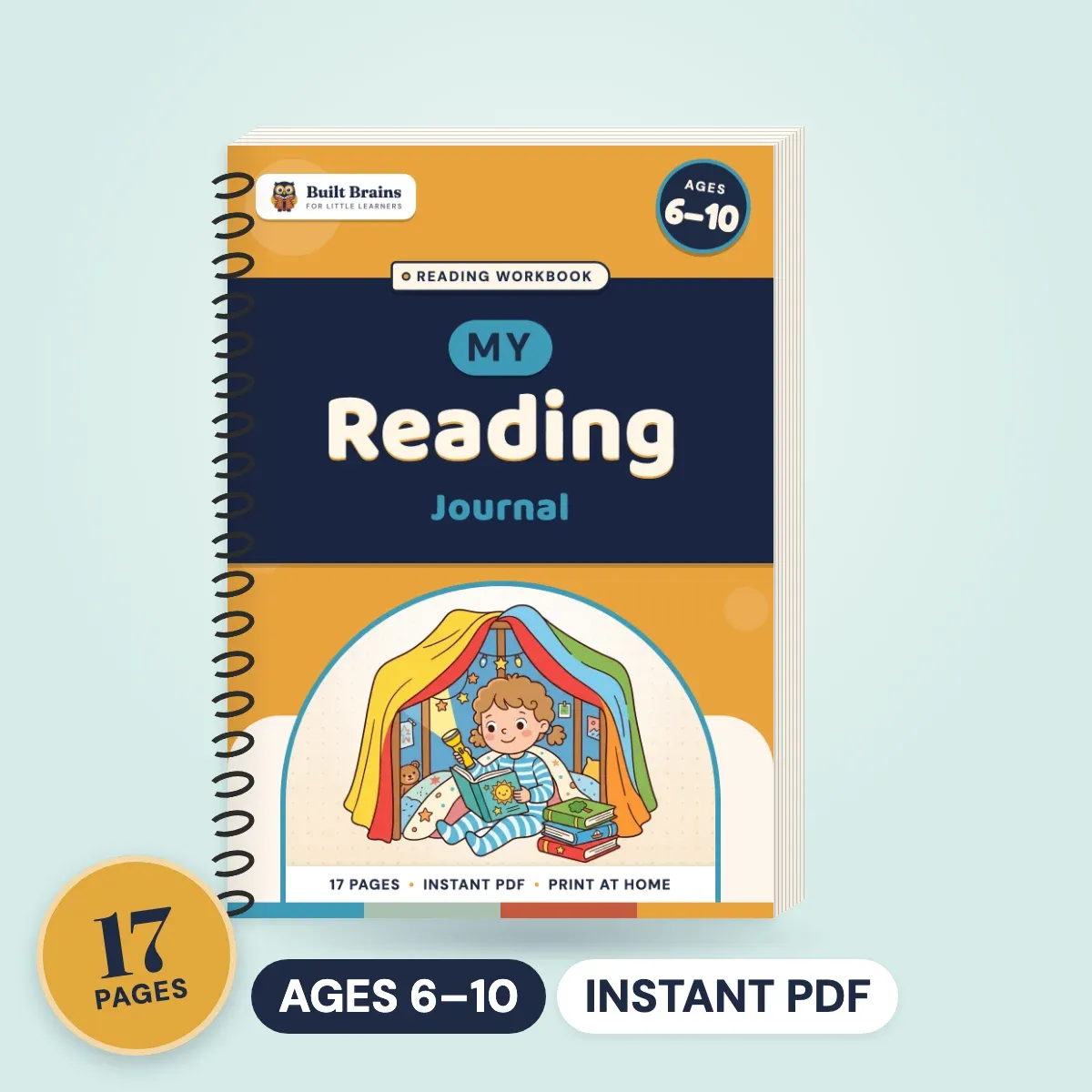
You can build 1st grade yourself from this map and a library card. If you would like the planning done, the Complete 1st Grade Bundle includes the 36-week curriculum plus 52 morning warm-ups, My Reading Journal for tracking books, and Cursive A to Z for an early start on joined writing. The curriculum on its own is shown below.
Not sure yet? Try our free printable book first to see how your child responds. Every Built Brains product is an instant black-and-white PDF that prints on US Letter or A4, with a 14-day money-back guarantee.
Questions parents ask
Most children finishing 1st grade can read simple chapter-style books with short sentences, decode words with digraphs, blends, silent e and common vowel teams, write several sentences on one topic with capitals and periods, know addition and subtraction facts within 20, understand tens and ones, and tell time to the half hour. Children vary, so look at steady progress rather than one deadline.
About one to two hours of focused work is plenty for most six and seven year olds, split into short blocks. Reading and phonics take the biggest share, about 20 to 30 minutes, then math for 15 to 20 minutes, writing for 10 to 15, and a short science or social studies topic a few times a week. Reading aloud adds more but feels like a treat.
At the start of 1st grade many children read short decodable sentences, and by the end most read simple early chapter books with some support. Instead of chasing a level number, check that your child can read a page of grade-level text fairly smoothly, with few guesses, and tell you what happened. If they guess a lot, go back to phonics.
The core 1st grade math goals in most US standards are adding and subtracting within 20, knowing facts within 10 quickly, counting and writing numbers to 120, understanding tens and ones, adding a two-digit number and a one-digit number, comparing lengths, telling time to the hour and half hour, reading simple graphs, and splitting shapes into halves and fourths.
Not strictly. Many families piece together phonics, library books and math practice. The hard part of 1st grade is sequence: phonics and math skills build week on week, and gaps show up later. A curriculum with weekly plans keeps that order for you so you spend your time teaching rather than planning.