What is systematic synthetic phonics?
Systematic synthetic phonics (often shortened to SSP) is the way reading is taught in state primary schools in England. The name sounds technical, but the idea is simple:
- Phonics: children learn which sounds (phonemes) go with which letters or letter groups (graphemes).
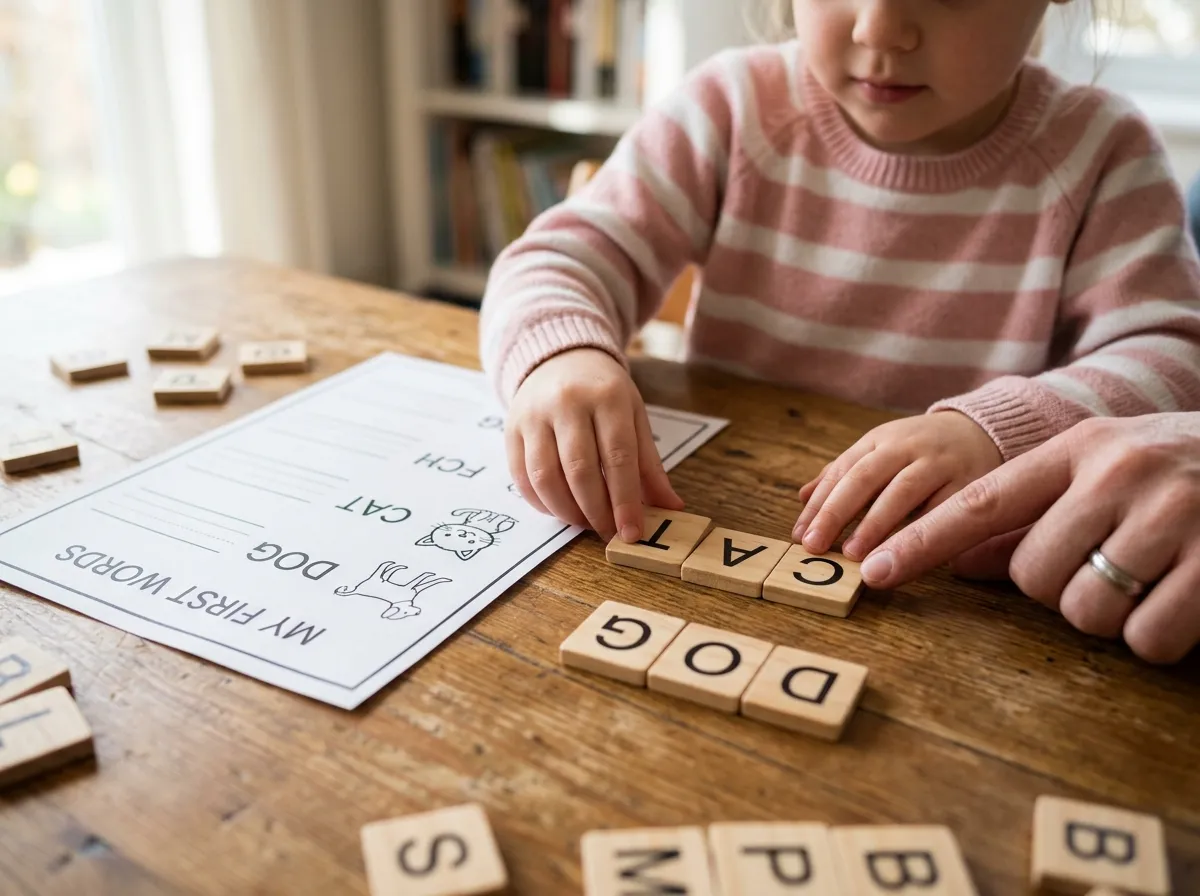
- Synthetic: they read a word by saying each sound in turn and synthesising (blending) them together: c-a-t, cat.
- Systematic: the sounds are taught in a planned order, a few at a time, with lots of practice before moving on.
Children also learn to do it backwards for spelling: hear a word, break it into its sounds (segmenting), and write a letter or letter group for each one.
Reading books sent home are usually decodable, meaning they only use sounds your child has already been taught. That is deliberate. It lets your child read a whole book using phonics rather than guessing from the pictures.
Letters and Sounds and today's validated programmes
The phases most parents have heard of come from Letters and Sounds, a free framework published by the government (then the Department for Education and Skills) in 2007. For well over a decade it was the backbone of phonics in many English schools, which is why you will still see "Phase 3 sounds" on so many websites and worksheets.
In 2021 the DfE updated its expectations for phonics teaching and set up a list of validated SSP programmes: complete schemes with teaching materials, training and matching decodable books. The original 2007 Letters and Sounds document was removed from that list in 2022, because it was never a full programme on its own.
Schools now typically use one of the validated programmes. Some keep the phase names (Little Wandle Letters and Sounds Revised is one example), while others use their own labels. Read Write Inc. Phonics, for instance, talks about Set 1, 2 and 3 sounds. The order of teaching is broadly similar across schemes, but the exact sequence, pace and names differ.
Phonics phases 1–6 at a glance
This table follows the classic Letters and Sounds framework. Your child's school may move faster or group sounds differently.
| Phase | Usual year group | What's taught | Example words | Example tricky words |
|---|---|---|---|---|
| 1 | Nursery, continuing in Reception | Listening, rhythm, rhyme, oral blending | (spoken only) c-a-t | none |
| 2 | Reception, autumn term | 19 letter sounds plus ff, ll, ss, ck; first blending | sat, pin, dog, bell | the, to, I, no, go, into |
| 3 | Reception | The rest of the alphabet, digraphs and trigraphs | ship, rain, night, farm | he, she, we, was, you, they |
| 4 | Reception, summer term | No new sounds; words with adjacent consonants | frog, tent, crisp | said, have, like, some, come |
| 5 | Year 1 | New graphemes, alternative spellings and pronunciations | play, cake, phone, blew | oh, their, people, could |
| 6 | Year 2 | Spelling rules, suffixes, reading fluency | jumped, happily, running | common exception words |
Phonics phase 1: listening and sound games
Phase 1 has no letters at all. It builds the listening skills children need before they can link sounds to print, and usually starts at nursery or preschool, then carries on through Reception alongside the later phases.
Letters and Sounds splits it into seven aspects:
- Environmental sounds: listening walks, guessing everyday sounds.
- Instrumental sounds: loud, quiet, fast and slow with shakers and drums.
- Body percussion: clapping, stamping, copying rhythms.
- Rhythm and rhyme: nursery rhymes, spotting rhyming words.
- Alliteration: words that start with the same sound ("silly snake slithers").
- Voice sounds: making different sounds with the voice, like mmm and sss.
- Oral blending and segmenting: "Touch your h-ea-d." "Can you find the c-u-p?"
At home, this is singing, rhyming, sound I Spy and playing with words. Our rhyming activities for preschoolers are all Phase 1-style games.
Phonics phase 2 sounds: first letters and blending
Phase 2 usually begins early in the Reception year. In Letters and Sounds, children learn sounds in five small sets:
- Set 1: s, a, t, p
- Set 2: i, n, m, d
- Set 3: g, o, c, k
- Set 4: ck, e, u, r
- Set 5: h, b, f, ff, l, ll, ss
After the first set, children start blending right away: at, sat, pat, tap. By the end of the phase many children can read and spell simple words such as it, up, cat, dog, run, bell and kiss.
Tricky words in Phase 2: the, to, I, no, go, into.
This is also the point to make sure your child hears pure sounds. Say "mmm", not "muh"; "sss", not "suh". For short sounds such as t, p and b, keep them clipped with no "uh" on the end. Pure sounds make blending far easier: "mmm-a-t" becomes mat, whereas "muh-a-tuh" never quite does. For more on this, see how to teach letter sounds.
The ABC Tracing Adventure includes a big letter with its picture, step-by-step tracing and a beginning-sounds hunt for every letter.
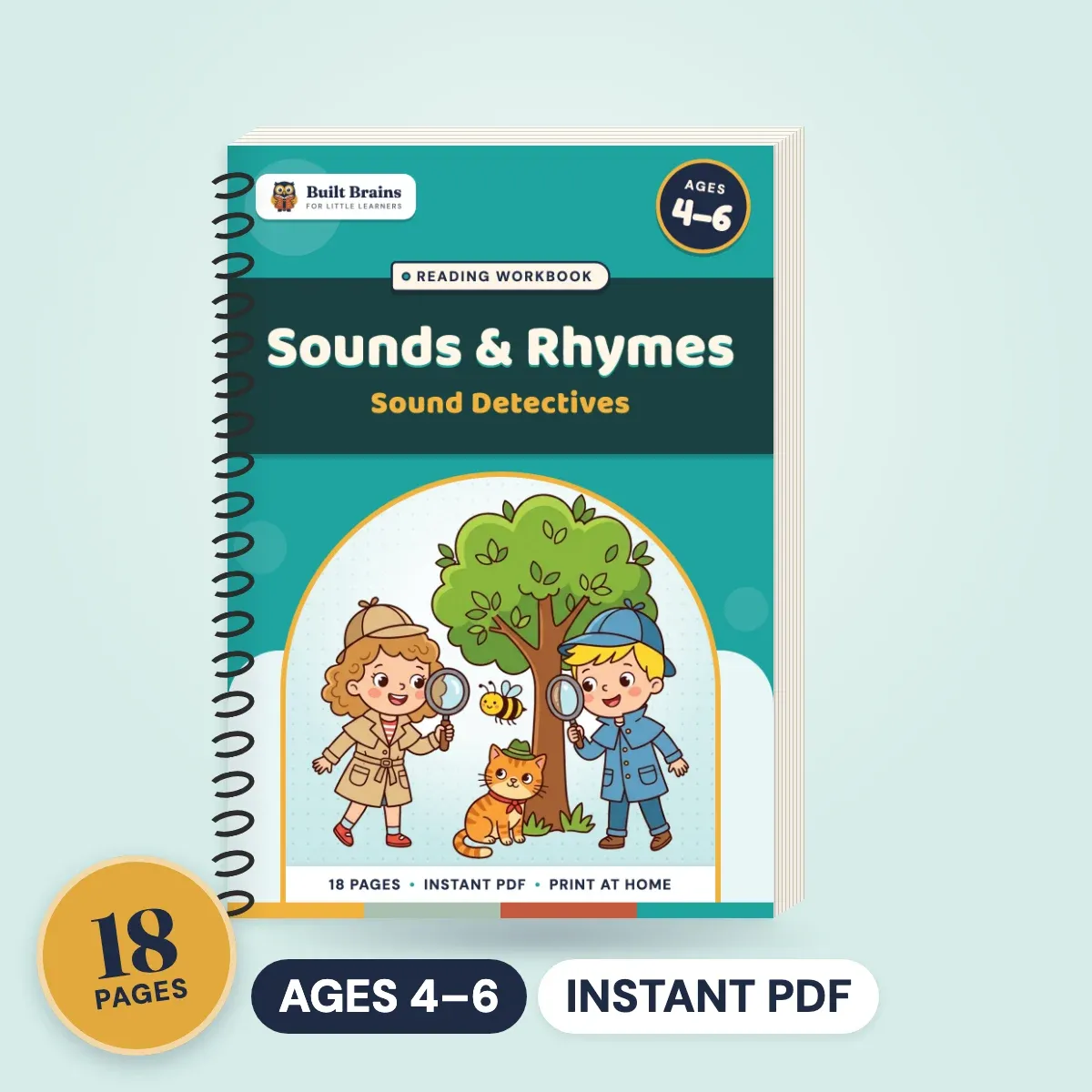
Ages 4–6 · 18 pages
Sound Detectives: Sounds & RhymesHear it, say it, circle it — the step before reading

Ages 3–5 · 60 pages
ABC Tracing Adventure: A to ZLearn every letter the right way — trace, find, color
Phonics phase 3: digraphs, trigraphs and letter names
Phase 3 runs through much of Reception. Children finish the alphabet and learn sounds spelled with more than one letter.
- Remaining letters: j, v, w, x, y, z, zz, qu
- Consonant digraphs: ch, sh, th, ng (two letters, one sound: chip, shop, thin, ring)
- Vowel digraphs and trigraphs: ai, ee, igh, oa, oo, ar, or, ur, ow, oi, ear, air, ure, er (rain, feet, night, boat, moon, book, farm, fork, hurt, cow, coin, near, hair, pure, letter)
Children also learn the letter names in Phase 3, often through an alphabet song, and read captions and short sentences such as "a fish in a net".
Tricky words in Phase 3: he, she, we, me, be, was, you, they, all, are, my, her.
Many schools teach a phrase for digraphs, such as "two letters, one sound". Some schemes use their own terms, so use your school's words at home.
Phonics phase 4, 5 and 6
Phase 4: blends and longer words (end of Reception)
No new sounds are taught. Instead, children practise words with adjacent consonants, where two or three consonants sit side by side and each keeps its own sound: frog, stop, tent, milk, crisp, string. The key is to still say every sound (f-r-o-g), not treat "fr" as a single new sound.
Tricky words: said, have, like, so, do, some, come, were, there, little, one, when, out, what.
Phase 5: new ways to spell sounds (Year 1)
Phase 5 is the longest, usually covering most of Year 1. Children learn:
- New graphemes: ay, ou, ie, ea, oy, ir, ue, aw, wh, ph, ew, oe, au, plus split digraphs a-e, e-e, i-e, o-e, u-e (make, these, like, home, cube)
- Alternative pronunciations: the same letters can make different sounds, such as ow in cow and snow, or ea in sea and head.
- Alternative spellings: the same sound can be written in different ways, such as the long a sound in rain, day and make.
Tricky words: oh, their, people, Mr, Mrs, looked, called, asked, could.
Phase 6: spelling and fluency (Year 2)
By Phase 6 most children can read many words automatically. The focus moves to spelling: past tense (-ed), suffixes such as -ing, -er, -est, -ful, -ly, -ment and -ness, and rules such as doubling a letter (running) or dropping an e (making). Reading shifts from decoding every word to reading with fluency and understanding. Many newer programmes finish their core phonics in Year 1 and move to a separate spelling scheme in Year 2.
The Year 1 phonics screening check
In England, children take the phonics screening check in June of Year 1. What to know:
- It is short and one-to-one. Your child reads 40 words aloud to a teacher they know, usually in a few minutes.
- Half are pseudo-words. These nonsense words (such as made-up alien names, usually shown with a picture of an alien) check that your child can decode rather than recognise words from memory.
- The threshold is confirmed each year after the check, but it has been 32 out of 40 every year since 2012.
- If a child doesn't reach it, they get extra support and take the check again at the end of Year 2.
- You will be told the result, usually in the end-of-year report.
The check applies in England. Scotland, Wales and Northern Ireland teach and assess early reading differently.
How to support phonics at home (without teaching a different method)
- Use the school's sounds. Ask for the sound mat or parent video and copy exactly how they say each sound and form each letter.
- Read the decodable book every night. Five to ten minutes. Let your child sound out; don't jump in with the word straight away.
- Say "sound it out, then say it fast." If they get stuck, point to each letter, say the sounds together, then blend.
- Read to your child too. Richer stories you read aloud build vocabulary and a love of books that decodable books can't.
- Play sound games. Sound I Spy, "what rhymes with..." and oral blending ("pass me the s-o-ck") keep Phase 1 skills going.
- Practise tricky words little and often. Write them on sticky notes around the house.
- Don't teach ahead with a different system. Drilling letter names instead of sounds, or "sounding out" with an "uh" on every letter, can clash with what school is doing.
Printable practice works well alongside school. The Sound Detectives workbook covers beginning sounds, rhymes and simple words, and CVC Word Quest gives first blending practice with three-letter words, which matches Phases 2 and 3 well.
A note for US and other readers: phases vs phonics and sight words
US schools don't use phases. Phonics is taught through a "scope and sequence" that follows a similar path: letter sounds, short-vowel words like cat (called CVC words), digraphs such as sh and ch, blends, silent e, then vowel teams. As a rough guide, Reception is similar to US pre-K, Year 1 to kindergarten and Year 2 to first grade.
Tricky words are close to what US teachers call sight words or "heart words", though sight word lists also include many words that can be sounded out. Our guide to kindergarten sight words explains how US schools approach them.
Questions parents ask
In Letters and Sounds: Phase 1 is listening and sound games; Phase 2 teaches the first 19 letter sounds and simple blending; Phase 3 adds the rest of the alphabet and sounds written with two or three letters, like sh and igh; Phase 4 practises words with consonant clusters; Phase 5 teaches alternative spellings; Phase 6 covers spelling rules and fluency.
In the classic Letters and Sounds order, children work through Phases 2, 3 and 4 in Reception, with Phase 1 listening games carrying on alongside. Many validated programmes aim to finish their Reception sounds by the summer term. Children move at different speeds, so ask your child's teacher where they are and what is coming next.
In Letters and Sounds, Phase 2 teaches s, a, t, p, then i, n, m, d, then g, o, c, k, then ck, e, u, r, and finally h, b, f, ff, l, ll and ss. Children blend these into simple words such as sat, pin, dog and bell. Your child's school programme may teach them in a slightly different order.
The threshold is confirmed each year after the check, but it has been 32 out of 40 every year since the check began in 2012. Children who do not reach it get extra support and take the check again at the end of Year 2. It is a check to find children who need help, not an exam to revise for.
Tricky words are common words children need early that contain a spelling they haven't been taught yet, or an unusual one, such as the, said and was. Children still sound out the parts they can and learn the tricky bit. Some schemes call them common exception words or harder-to-read words.