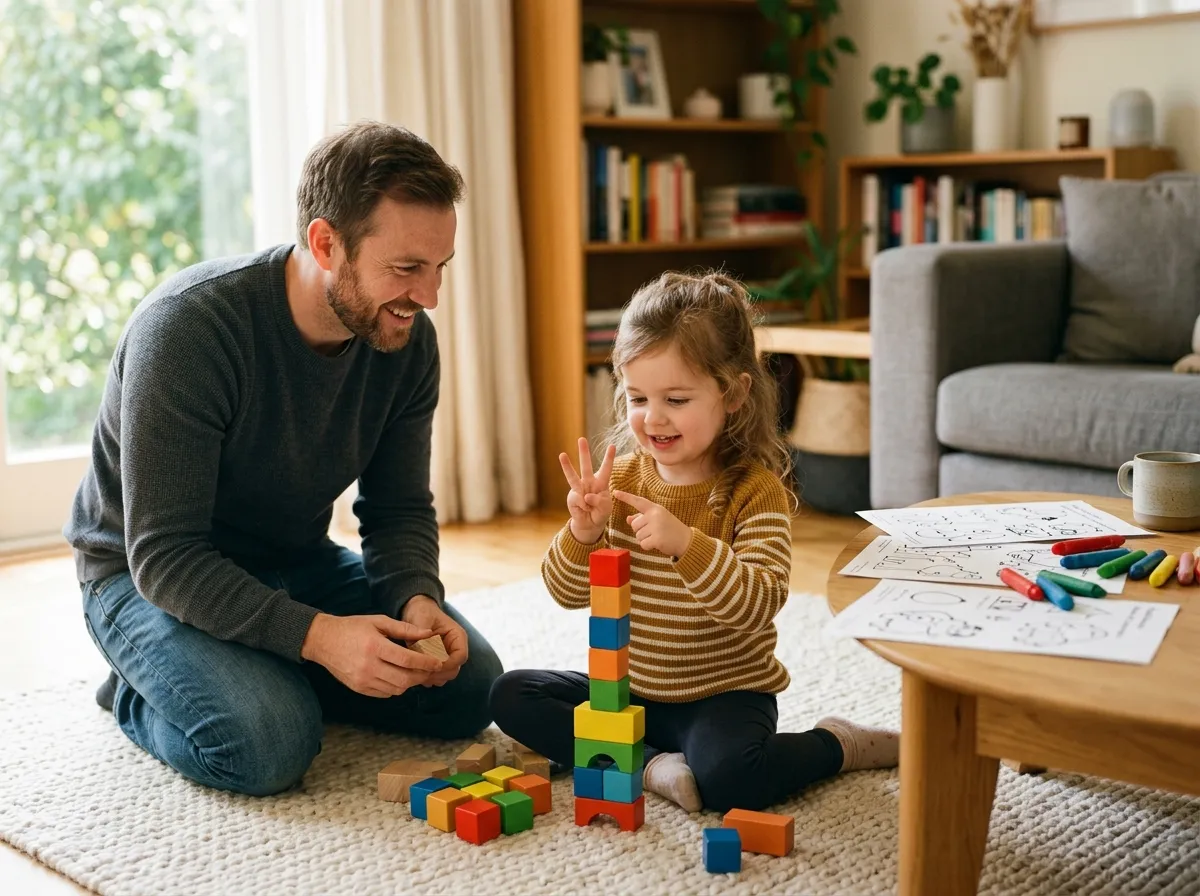
What should a 3 year old know academically? The short answer
At 3, “academic” learning looks a lot like play. The skills that later turn into reading, writing and math are being built through talking, listening to stories, handling small objects and sorting things into piles. So when you ask what a 3 year old should know, the honest answer is less about facts and more about foundations.
Most children during the year they are 3 are working on:
- Language: talking in short sentences, asking lots of “why” and “what” questions, following simple directions.
- Early literacy: loving books, turning pages, joining in with familiar lines, noticing that print means something.
- Early math: saying some numbers in order, counting two or three objects, matching and sorting by color, shape and size.
- Fine motor: stringing large beads, holding a crayon to scribble and copy a circle.
- Social and emotional: playing near and then with other children, starting to take turns with help, naming a few feelings.
- Self-care: using a fork, pulling on loose clothes, washing hands with help.
What is not expected yet: reading words, writing letters, knowing every letter sound, counting to 20 or sitting still for long lessons. If your 3 year old does some of these, lovely. If not, they are right on track.
An honest age-3 checklist
This table draws on the CDC’s milestone checklists, the Head Start Early Learning Outcomes Framework (ELOF) used across US preschool programs, and the UK’s Development Matters guidance for the EYFS. The CDC updated its checklists in 2022 so that each milestone is something most children, roughly three in four or more, can do by that age. That means the left column is a floor, not a target, and the right column is where many children are heading by 4.
| Area | Most children during age 3 | Working toward by 4 (not expected yet) |
|---|---|---|
| Language | Short sentences, back-and-forth talk, says first name, asks who/what/where/why questions, mostly understood by others | Sentences of four or more words, tells you something that happened today |
| Early literacy | Enjoys being read to, turns pages, points to pictures, fills in words in familiar books, knows print is different from pictures | Recognizes several letters, especially in their name, spots some rhymes |
| Early math | Says some numbers in order, counts 2–3 objects, matches and sorts by color or size, understands “one” and “more” | Counts about 5 objects correctly, names a few colors and shapes |
| Fine motor | Strings large beads, scribbles, copies a circle when shown, builds a small block tower | Holds a crayon between fingers and thumb, not a fist; first snips with scissors |
| Social-emotional | Calms within about 10 minutes after you leave, notices and joins other children, pretend play | Takes turns with fewer reminders, comforts a friend, likes to be a helper |
| Self-care | Uses a fork, pulls on loose clothes, helps wash hands, toilet learning in progress | Pours water or serves food with supervision, undoes some buttons |
How to read this table
- Children vary a lot. A child who turned 3 last week and one about to turn 4 are in very different places. Summer birthdays and premature babies may sit toward the younger end.
- Uneven is normal. Plenty of 3 year olds talk like little professors but can’t cut paper yet, or count happily but go quiet in groups.
- Look for progress, not ticks. Is your child doing a bit more than three months ago? That matters more than any single item.
What should a 3 year old know before preschool?
If your child is starting preschool, nursery or a playgroup this year, teachers are not checking for letters. They are hoping your child can:
- Say their name and respond when it is called.
- Ask for help with words or gestures: “I need the toilet,” “I want water.”
- Manage a goodbye. Some tears are normal. Most children settle within minutes once you have gone.
- Sit for a short story of three to five minutes, even if they wriggle.
- Try self-care: wash hands, pull on a coat, eat a snack independently.
- Play near other children without always needing an adult to referee.
You can practice these at home in a relaxed way. Rehearse the goodbye with a short, predictable script: “I’m going to the store. I’ll be back after snack. Love you, see you soon.” Then leave, and come back when you said you would. That reliability is what helps a child settle.
How to practice through play, 10 to 15 minutes a day
A 3 year old’s attention for an adult-led activity is short, often five to ten minutes at a stretch. So keep the focused part small and let everyday life do the rest. Here is a simple weekly rhythm.
A sample week
- Monday: talk and stories. Read one picture book twice. The second time, pause before a familiar word and let your child fill it in.
- Tuesday: counting with real things. Count three spoons into a bowl, touching each one. Then ask, “How many spoons?” If they count again, that is normal. Say, “Three! The last number tells us how many.”
- Wednesday: color and shape sorting. Tip out a handful of blocks or lids and sort them into two groups: red and not red, big and small.
- Thursday: busy hands. Thread pasta onto a shoelace, squash play-dough, tear paper for a collage, or trace big wavy lines with a finger then a chunky crayon.
- Friday: pretend and move. Set up a teddy picnic, count the plates, serve “one for you, one for you.” Then march, hop and freeze to music.
Scripts that help
- To build vocabulary: “Your tower is tall. Mine is short. Can you make yours even taller?”
- To encourage sentences: If your child says “Juice,” reply with a slightly longer version: “More juice, please? Here’s more juice.”
- To end on a good note: “That was great counting. Let’s do one more and then go outside.”
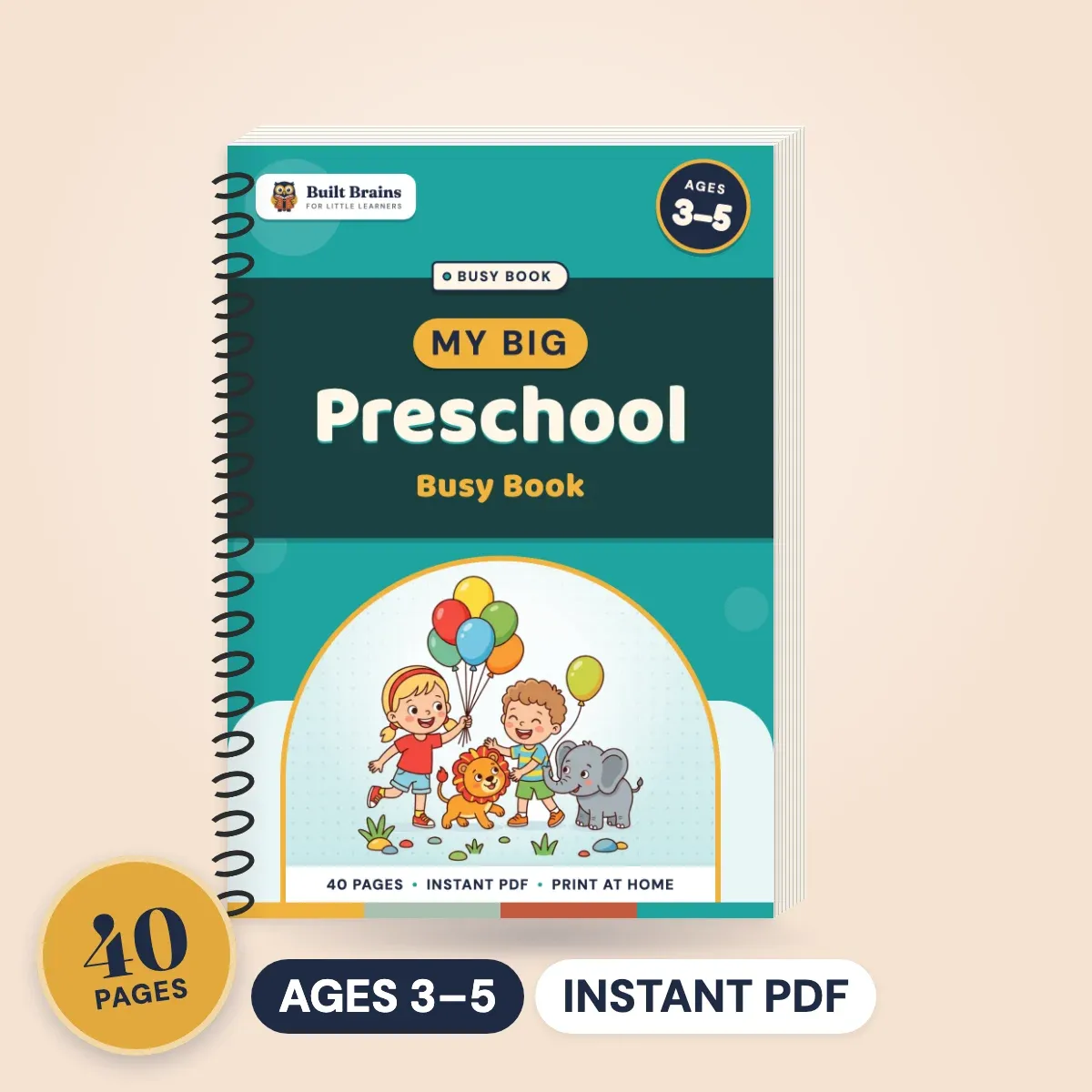
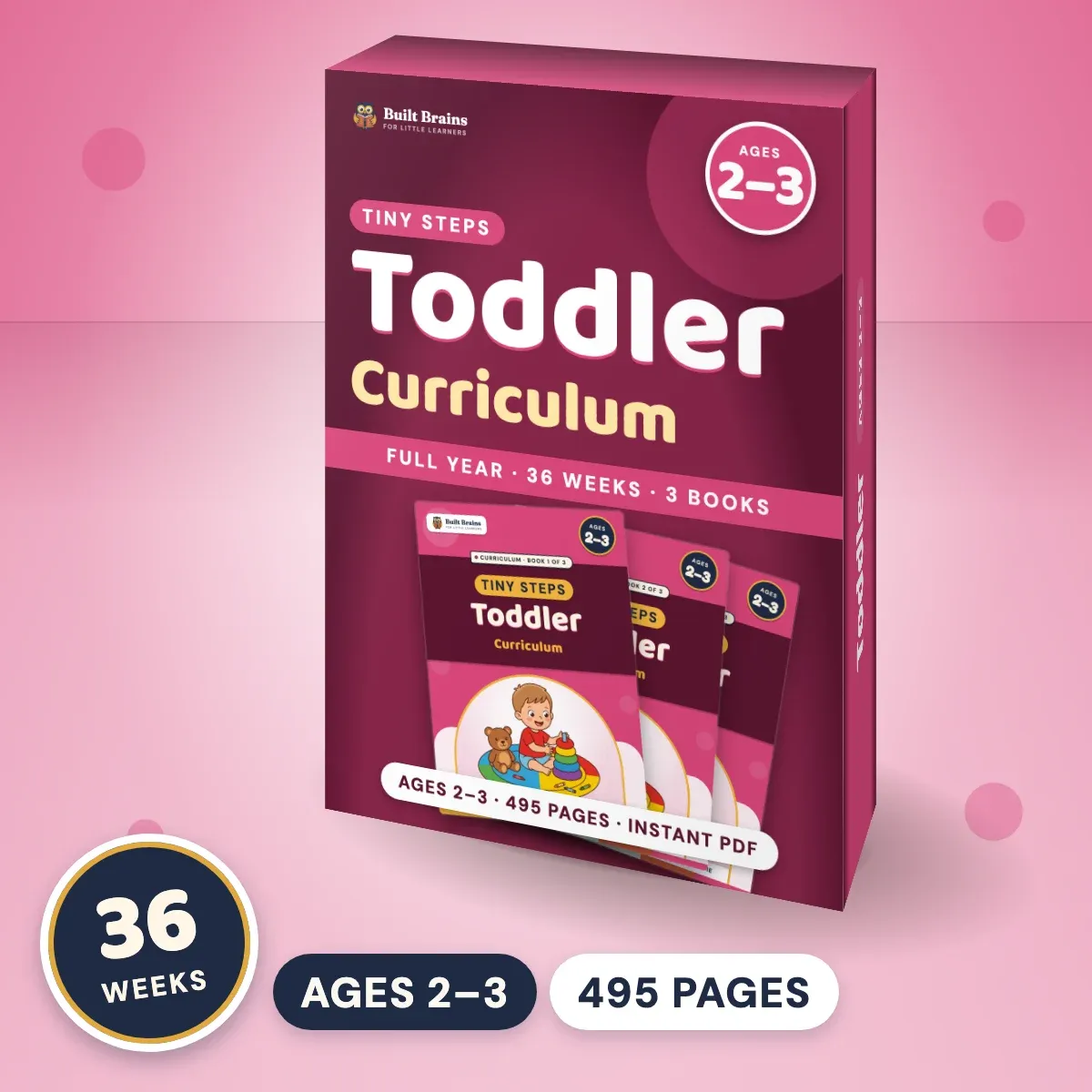
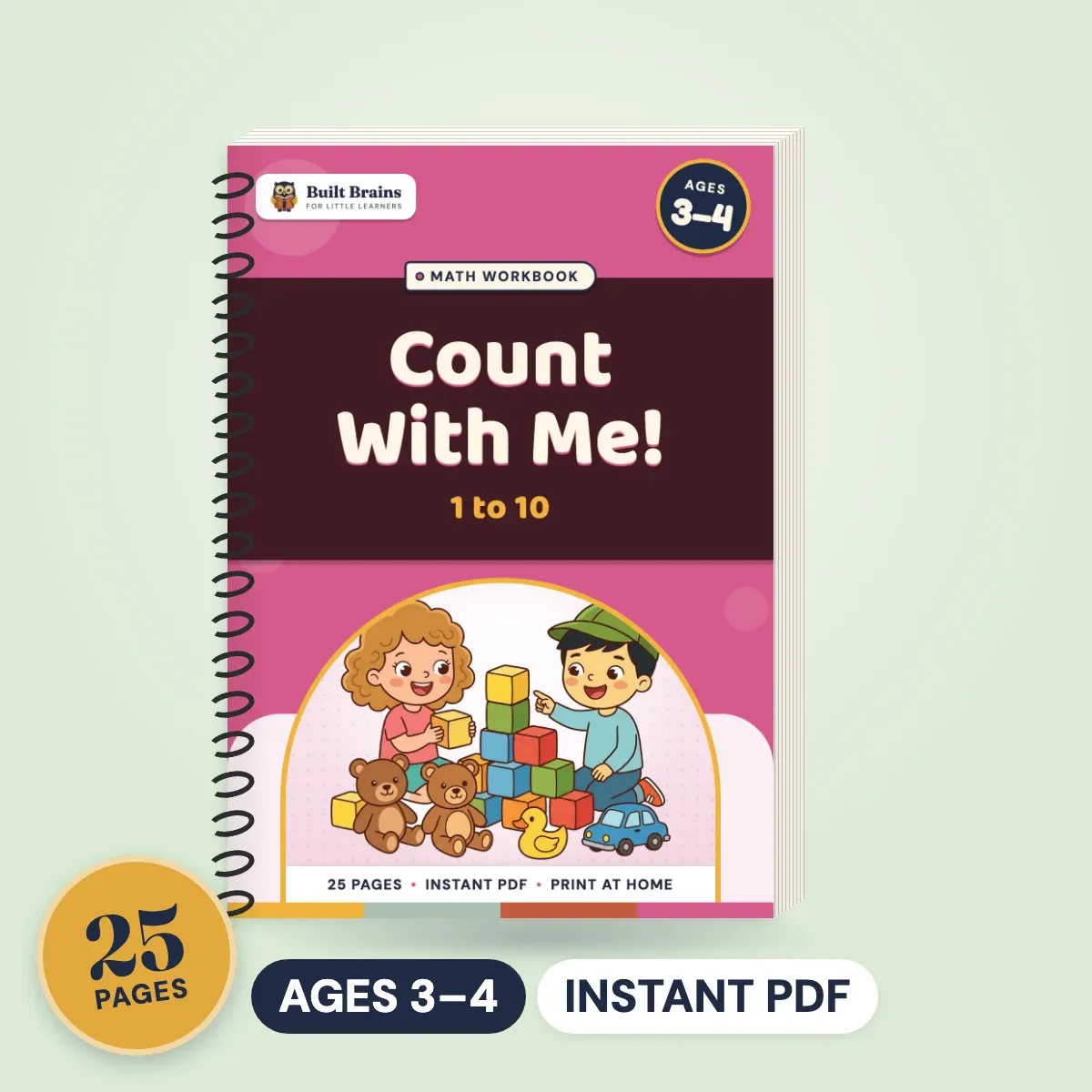
If you prefer pages ready to go, gentle printables can help structure the 10 minutes. The Tiny Steps Toddler Curriculum is designed for 2 and 3 year olds, with a color, a shape, a number and a theme each week and big simple pages to color, dot-dab, trace and match. For first counting, Count With Me! 1 to 10 uses toys your child already knows.
 New
NewAges 2–3 · 495 pages
Tiny Steps Toddler Curriculum36 playful weeks of colors, shapes, numbers and first words

Early literacy at 3: what it really looks like
Reading starts long before letters. At 3, these are the skills that matter most:
- Hearing lots of words. Children who are talked with, not just talked at, build bigger vocabularies. Narrate what you are doing while you cook or shop.
- Enjoying books. Two or three stories a day, including the same favorite over and over, is exactly right.
- Playing with sounds. Nursery rhymes, clapping songs and silly rhymes (“cat, hat, zat!”) tune the ear for later phonics.
- Noticing print. Point to the words as you read a title. Show them their name on their cup or coat hook.
If your child shows interest in letters, follow it. Start with the letters in their name, and play “find the S” on cereal boxes and road signs. There is no need to drill the whole alphabet. Learning every letter and its sound fits comfortably into the pre-K year.
Early math at 3: counting, sorting and comparing
Math at this age is mostly about quantity and comparison, not numerals on a page.
- Rote counting: saying “one, two, three, four, five” in order. Songs help.
- One-to-one counting: touching one object per number. Start with two or three objects.
- Comparing: more and less, big and small, long and short, full and empty.
- Sorting and matching: socks into pairs, toys into bins, cutlery into the drawer.
- Shapes in the world: “The plate is a circle. The window is a rectangle.”
Bath time is a natural math lab: pour, fill, empty, count ducks. So is a snack plate: “You have two crackers. I’ll give you one more. How many now?”
Fine motor, self-care and feelings
Fine motor
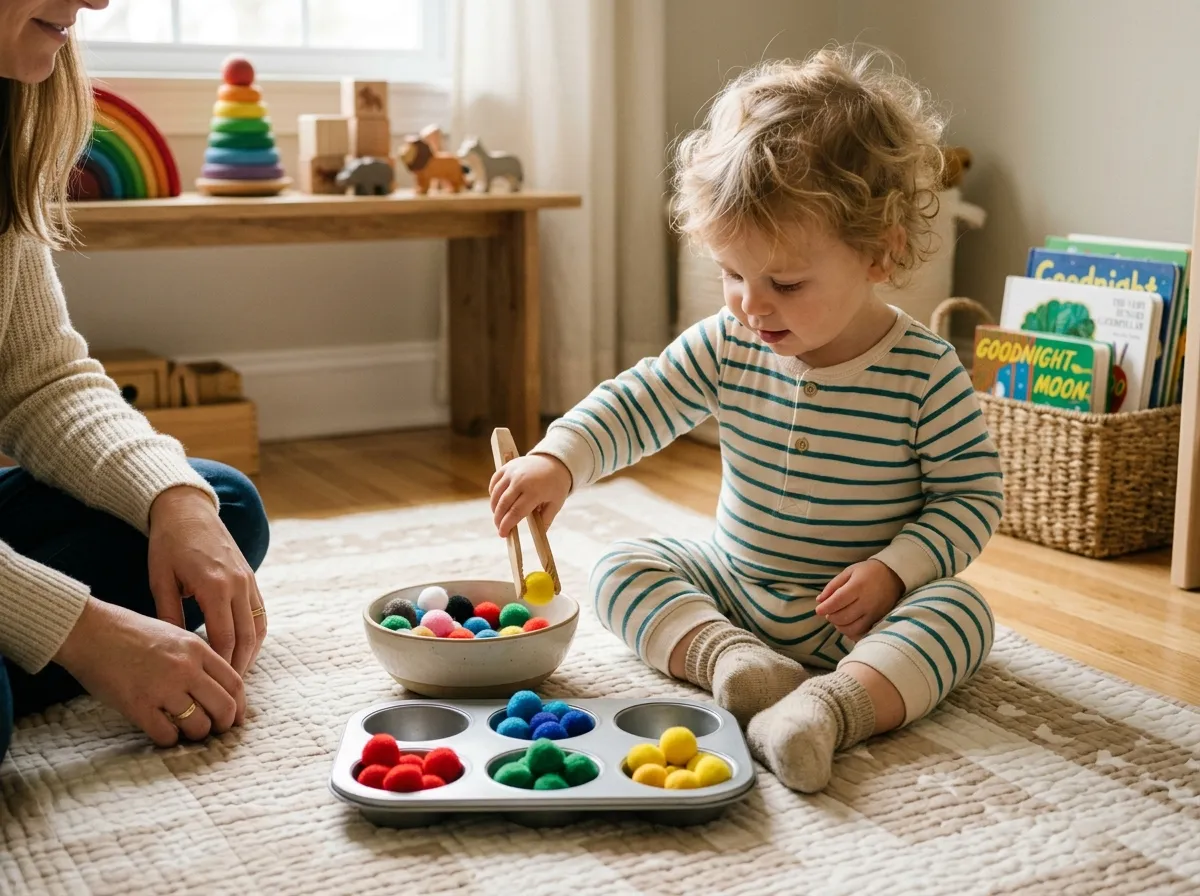
Strong, careful hands come before writing. Play-dough, stickers, peg puzzles, pouring water, tearing paper and picking up pompoms with tongs all build the small muscles your child will later use to hold a pencil. Our fine motor activities guide has dozens of cheap ideas.
Self-care
Give your child real jobs with extra time built in: pulling on socks, carrying their plate, wiping the table, putting shoes by the door. Independence feels good, and it is one of the things preschool teachers notice most.
Feelings and play
Name feelings when you see them: “You’re frustrated because the tower fell.” Offer a way through: “Let’s take a big breath and build it again.” Arrange short playdates or park time so your child can practice sharing and waiting with other children, which no worksheet can teach.
When to talk to your pediatrician or health visitor
The CDC’s advice is simple: don’t wait. If your child is not meeting one or more milestones, has lost skills they once had, or you have a nagging worry, raise it early. Checking costs nothing, and support is most effective when it starts young.
Signs worth mentioning at a check-up include:
- Very few words or no short sentences, or speech that even family find hard to understand
- Not understanding simple instructions
- Little interest in other children or in pretend play
- Frequent falls or real difficulty with stairs
- Losing words or skills they used to have
In the US, your pediatrician can do a developmental screening. From age 3, evaluations for extra help are usually arranged through your local public school district, even if your child is not in school. In the UK, speak to your health visitor, GP or your child’s nursery keyworker, who can refer on to speech and language therapy or other services.
Keep it light and keep going
A 3 year old who is talked to, read to, allowed to play and given small jobs is learning everything they need right now. Ten happy minutes a day is plenty.
If you want a gentle plan, browse our printables for preschool ages 3–4, or look at the Complete Preschool Curriculum at Home, a 36-week plan for ages 3 to 5 in about 20 minutes a day. To try the format first, download the free printable book. And when you want to see what comes next, read what a 4 year old should know.
Questions parents ask
Not necessarily. Many 3 year olds can sing the alphabet song, but singing it is not the same as recognizing letters. Recognizing a handful of letters, often the ones in their own name, is typical. Knowing all 26 letters and their sounds is usually a goal for the end of pre-K, when children are closer to 5.
Many 3 year olds can say the numbers to 5 or 10 in order, often skipping one. Counting objects correctly is harder: most can count two or three things by touching each one, and are still learning that the last number tells you how many. Counting reliably to 10 usually comes during the year they turn 4.
Most 3 year olds can match and sort by color, and many can name a few colors. The CDC’s checklists place naming a few colors at around age 4, so a 3 year old who mixes up color names is well within the normal range. Keep naming colors in everyday talk and it will come.
By 3, most children talk in short sentences and can be understood by people outside the family most of the time. If your child uses mostly single words, is very hard to understand, or has stopped using words they once used, talk to your pediatrician or health visitor. A hearing check and speech assessment are simple first steps.
Preschool teachers are not expecting letters or numbers. It helps if your child can say their name, tell an adult they need something, manage short separations with a little comfort, sit for a short story, and try basic self-care like washing hands and pulling on a coat. Toilet learning is often still in progress, so ask the setting about their policy.