The five senses, in the words preschoolers need
Teach the sense and its body part as a pair, with a gesture:
| Sense | Body part | Gesture | What it does |
|---|---|---|---|
| Sight | Eyes | Point to eyes | Sees colors, shapes, near and far |
| Hearing | Ears | Cup ears | Hears loud and quiet, high and low |
| Smell | Nose | Tap nose | Smells sweet, stinky, fresh |
| Taste | Tongue | Stick out tongue | Tastes sweet, salty, sour, bitter |
| Touch | Skin, especially hands | Wiggle fingers | Feels rough, smooth, hot, cold, soft |
A few facts that are true and small enough to stick:
- Your eyes let in light through the black circle in the middle, the pupil, which gets bigger in the dark and smaller in bright light (KidsHealth – Your Eyes). Try it with a flashlight and a mirror.
- Your ears catch sounds and send them to your brain. The part you can see is only the outside; the important bits are hidden inside your head (KidsHealth – Your Ears).
- Your tongue is covered in tiny bumps that hold your taste buds, and taste and smell work as a team, which is why food tastes dull when your nose is blocked (KidsHealth – Your Tongue).
- Your skin is your biggest organ and feels touch, pressure, heat, cold and pain all over your body (KidsHealth – Your Skin).
35 five senses activities for preschool, by sense
Sight (eyes)
- I-spy color walk. "I spy something red." Then let your child lead. Builds color words and careful looking.
- Magnifying-glass table. A leaf, a coin, a shell, a piece of fabric. What can you see up close that you could not see before?
- Pupil flashlight test. Look in a mirror in a dim room, shine a flashlight (not directly into the eye) nearby, and watch the pupil shrink.
- Spot the difference tray. Six objects on a tray; child closes eyes; remove one. What is missing?
- Color-mixing bags. Two primary-color paint blobs in a zip bag; squish and watch the new color appear.
- Blindfold walk across the room holding your hand, then talk about what eyes do for us.
- Shadow shapes. Hands in front of a lamp. Big, small, near, far.
Hearing (ears)
- Listening walk. Walk in silence for two minutes, then list every sound you heard. Read The Listening Walk first.
- Sound shakers. Fill pairs of film canisters or small jars with rice, beans, bells and buttons. Shake and match the pairs by sound alone.
- Loud and quiet. Whisper a word, say it, shout it. Then play it on a drum.
- Guess the sound. Behind a screen: crumple paper, pour water, jingle keys, clap. Child guesses.
- Homemade instruments. A rubber-band guitar over a tissue box, a pot-lid cymbal, a rice shaker.
- High and low. Tap glasses with different amounts of water. Which sounds highest?
- Animal sound match. Make the sound, child finds the toy animal.
Smell (nose)
- Smell jars. Cotton balls dabbed with vanilla, lemon, cinnamon, coffee, mint and vinegar in lidded jars with holes. Sniff and guess, then match to pictures.
- Scented play dough. Add cinnamon or cocoa to a basic dough. Smell and squeeze at the same time.
- Kitchen smell hunt. Smell an onion, a banana, bread, an orange peel. Sort into "like" and "do not like."
- Flower and herb walk. Rub a mint or rosemary leaf between fingers and smell.
- Smelly painting. Mix a drop of extract into paint and make a picture you can smell when it dries.
- The nose knows. Taste apple and pear with nose held, then unheld. Smell and taste work together.
Taste (tongue)
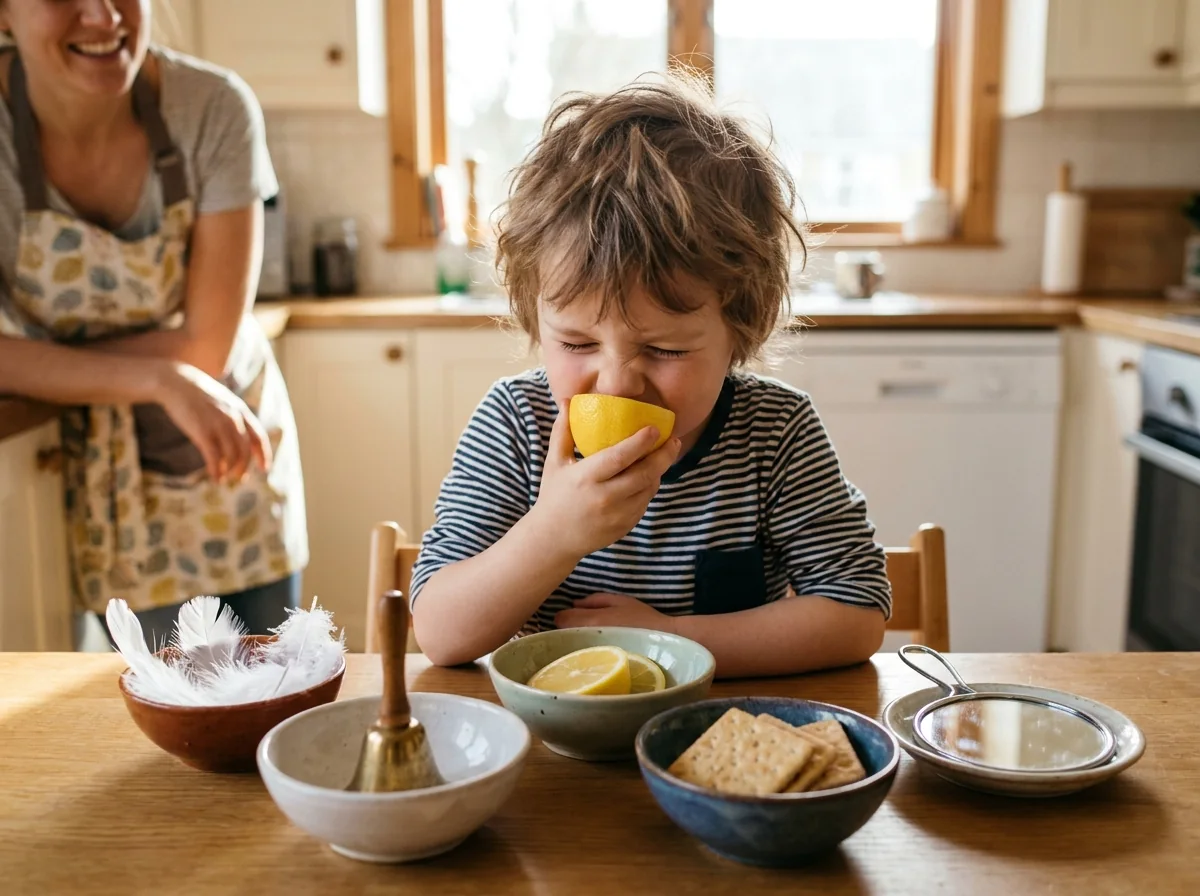
- Sweet, salty, sour, bitter. Banana, pretzel, lemon, and a tiny bit of unsweetened cocoa. One at a time, make the face, name the taste.
- Rainbow taste plate. One fruit or vegetable of each color; taste and vote with stickers.
- Mirror tongue look. Stick out your tongue in a mirror and look for the bumps that hold the taste buds.
- Crunchy or soft? Crackers, cucumber, cheese, bread. Listen and feel as you chew.
- Make a taste graph. "Our favorite fruit" with stickers in columns.
Touch (skin)
- Mystery touch bag. A pillowcase with a pine cone, a sponge, a spoon, a toy car, a cotton ball. Reach in, describe, guess.
- Texture cards. Glue sandpaper, foil, felt, bubble wrap and cotton to cards. Sort rough and smooth, then match pairs with eyes closed.
- Warm and cold bowls. Warm water, cold water, room temperature. Which is which?
- Barefoot path. Grass, a towel, a cushion, a tray of dry oats, a cool tile.
- Finger-paint textures. Add sand to one paint and salt to another and compare on paper.
- Sensory bin. Dry oats or pasta with scoops and hidden objects. Our sensory bin ideas for toddlers has safe fillers by age.
All five together
- Popcorn senses. Hear it pop, smell it, see it change, feel it, taste it. One snack, five senses.
- Orange investigation. Look, smell the peel, feel the bumps, hear the peel tear, taste a segment.
- Five senses outdoors. On a walk, find one thing for each sense and draw them on a five-box sheet.
- Senses song. To "Head, Shoulders, Knees and Toes": "Eyes see, ears hear, nose smells, tongue tastes, skin feels" with the gestures above.
A 5-day five senses lesson plan
One sense a day is the classic shape and it works. Each day: the gesture and body part, one book, one experiment, one table activity.
| Day | Sense | Book | Hands-on | Table time |
|---|---|---|---|---|
| Monday | Sight | Brown Bear, Brown Bear, What Do You See? | I-spy color walk, pupil flashlight test | Trace the word eyes, color-matching page |
| Tuesday | Hearing | The Listening Walk | Listening walk, sound shakers | Trace ears, loud-and-quiet sort |
| Wednesday | Smell | My Five Senses (smell pages) | Smell jars, scented play dough | Trace nose, like/do-not-like sort |
| Thursday | Taste | Eating the Alphabet | Sweet-salty-sour test, the nose knows | Trace tongue, favorite-fruit graph |
| Friday | Touch and review | Pat the Bunny or My Five Senses | Mystery touch bag, popcorn senses | Trace skin, senses song, certificate |
Keep each block to 15 to 20 minutes for 3 year olds and up to 30 for 5 year olds. If you run a second week, take the whole plan outdoors and swap the books. For where a short unit like this sits in a wider week, see our preschool at home schedule.
Picture books about the five senses
- My Five Senses by Aliki, the classic, with a page or two per sense
- The Listening Walk by Paul Showers
- Brown Bear, Brown Bear, What Do You See? by Bill Martin Jr. and Eric Carle
- Polar Bear, Polar Bear, What Do You Hear? by Bill Martin Jr. and Eric Carle
- Pat the Bunny by Dorothy Kunhardt (touch-and-feel, best for the youngest)
- Eating the Alphabet by Lois Ehlert
- Hello Ocean by Pam Muñoz Ryan, a day at the beach through all five senses
- The Black Book of Colors by Menena Cottin, colors described without sight
Sensory-sensitive children: offer choices, never force
Some children love a mystery bag and refuse a lemon; some cover their ears at the sound shakers; some will not put a hand into oats. All of this is normal variation, and a five senses week is a good time to work with it rather than against it.
- Watching counts. Let your child watch you or a sibling do the activity first. Many will join in on the second day.
- Give a tool. Tongs, a spoon or a paintbrush let a child explore a texture without touching it. The learning is the same.
- Tasting is always optional. Pediatricians advise offering new foods repeatedly without pressure; forcing a taste tends to backfire and makes a child less willing next time (healthychildren.org – Picky Eaters). Smelling, licking or just putting a food on the plate are all fine steps.
- Lower the volume. For noise-sensitive children, do the sound activities with soft shakers first, let them control the loud ones, and offer ear defenders if you have them.
- Name feelings, not failures. "That one is too scratchy for you, so you can use the tongs" keeps the child in the activity.
- When to ask for advice. If strong reactions to textures, sounds, lights or clothing happen every day and get in the way of eating, dressing or play, mention it to your pediatrician. The American Academy of Pediatrics notes that sensory processing differences are common in young children and are sometimes part of a wider picture that is worth checking (healthychildren.org – Sensory Integration Therapy).
Safety notes for five senses activities
- Allergies first. Check every food and scent with any visitors' parents. Nut extracts are an easy one to miss.
- Small parts. Beans, buttons and bells in sound shakers must be sealed with tape or glue, and kept away from children under 3.
- Flashlights are shone near the face for the pupil test, never into the eyes.
- Smell jars: sniff from a hand's width away, never taste the cotton ball. Skip anything strong enough to sting, such as ammonia.
- Hot and cold bowls should be warm, never hot. Test with your own wrist.
What to print for a five senses unit
- My Five Senses Science Unit (ages 3–5, 18 pages): a read-aloud senses fact page, body-part words to trace, word cards, matching and sorting, counting, a maze and coloring. It provides the table-time activity for each day in the plan above.
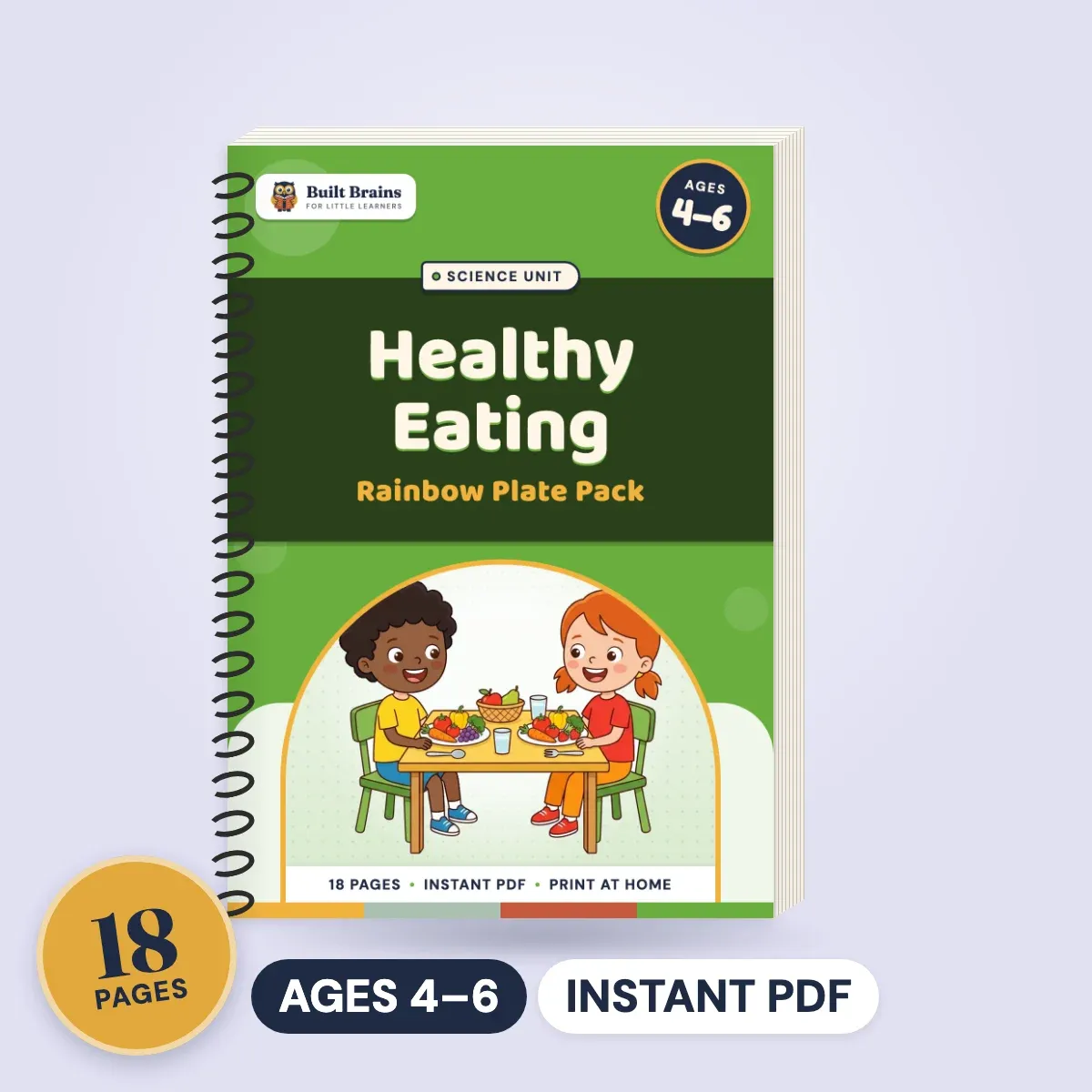
- Rainbow Plate Healthy Eating Pack (ages 4–6, 18 pages) for taste day: food words to trace, counting and a cut-and-sort of everyday foods and sometimes treats.
- My Big Preschool Busy Book (ages 3–5, 40 pages) for quiet time between senses: coloring, tracing, mazes and matching that need no setup.
- Science & Our World Bundle (ages 4–7) if you want the five senses alongside weather, life cycles, bugs and healthy eating for the rest of the year.
The tracing and cutting in these pages double as hand-strength work; see fine motor activities for preschoolers for more.
Sources
- KidsHealth – Your Eyes and Your Ears: child-level explanations of how the pupil responds to light and how the ear carries sound to the brain.
- KidsHealth – Your Tongue and Your Skin: taste buds on the tongue, taste and smell working together, and skin as the body's largest organ.
- healthychildren.org – Picky Eaters: offering new foods repeatedly without pressure.
- healthychildren.org – Sensory Integration Therapy: background on sensory processing differences in young children and when to seek advice.
Questions parents ask
Sight with the eyes, hearing with the ears, smell with the nose, taste with the tongue and touch with the skin, especially the hands. Teach the sense and its body part together, with a gesture for each: point to eyes, cup ears, tap nose, stick out tongue, wiggle fingers. Most preschoolers can name all five by the end of a week.
One sense a day, one body part, one simple game. Monday is eyes and an I-spy color walk, Tuesday is ears and a listening walk, and so on. Skip worksheets for threes and use real objects: a feather, a lemon, a bell. A short song with gestures ties it together, and repeating the five words at snack time is as effective as any lesson.
The "nose knows" taste test. Offer small pieces of apple and pear while your child holds their nose, then again without. Most children find the flavors hard to tell apart with the nose closed, which shows that smell and taste work together. Follow with a sweet, salty and sour test using banana, a pretzel and lemon.
That is fine, and fairly common. Offer the activity as a choice, let them watch first, and give a tool such as tongs or a spoon so hands stay clean. Never force a taste or a touch. If strong reactions to textures, sounds or clothing show up every day and get in the way of ordinary life, mention it to your pediatrician.
One week is the classic shape: one sense per day, Monday to Friday, with a quick "all five" review and a favorite activity repeated on the last day. Stretch it to two weeks by adding a second round of activities and a book per sense, or by moving the whole thing outdoors for the second week.

Reviewed by
Early Years SENCo (Special Educational Needs Coordinator)
Ben Mitchell is an Early Years SENCo specializing in early identification and inclusive classroom strategies for neurodivergent children.
More about B. Mitchell →