
How to use these number tracing worksheets
Aim for one number page a day, then use the three counting pages over the following days. Each page takes about 10 minutes.
- Find the number in real life. Before the page, hold up one spoon, then two, then three. Say the number as you count.
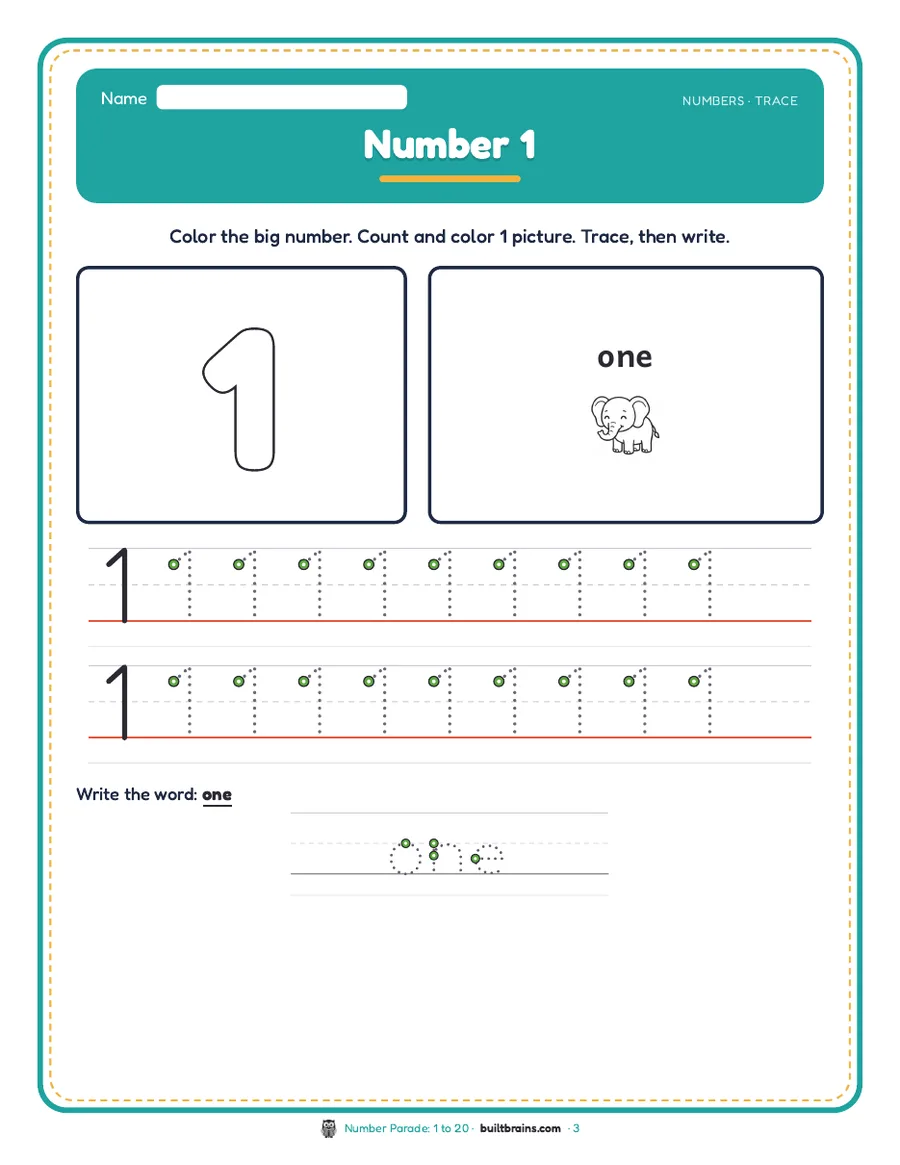
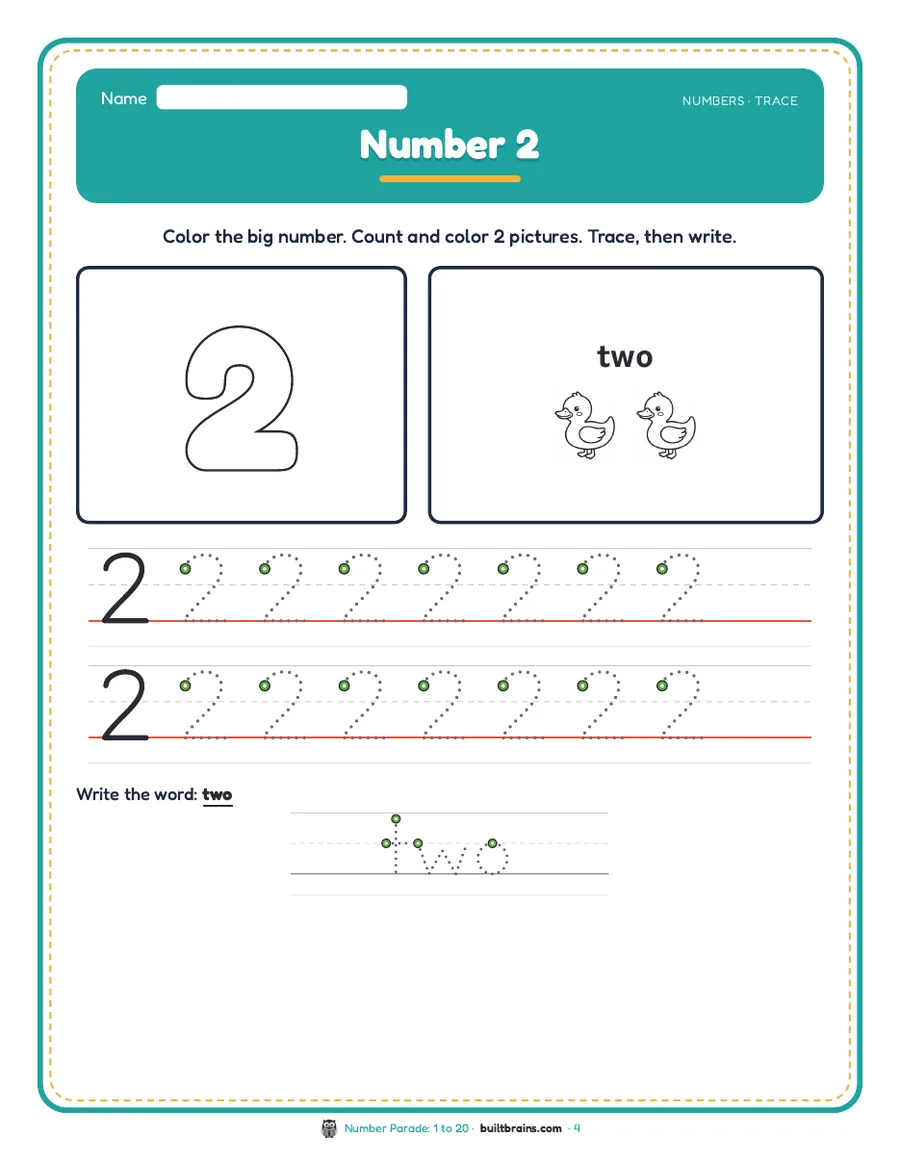
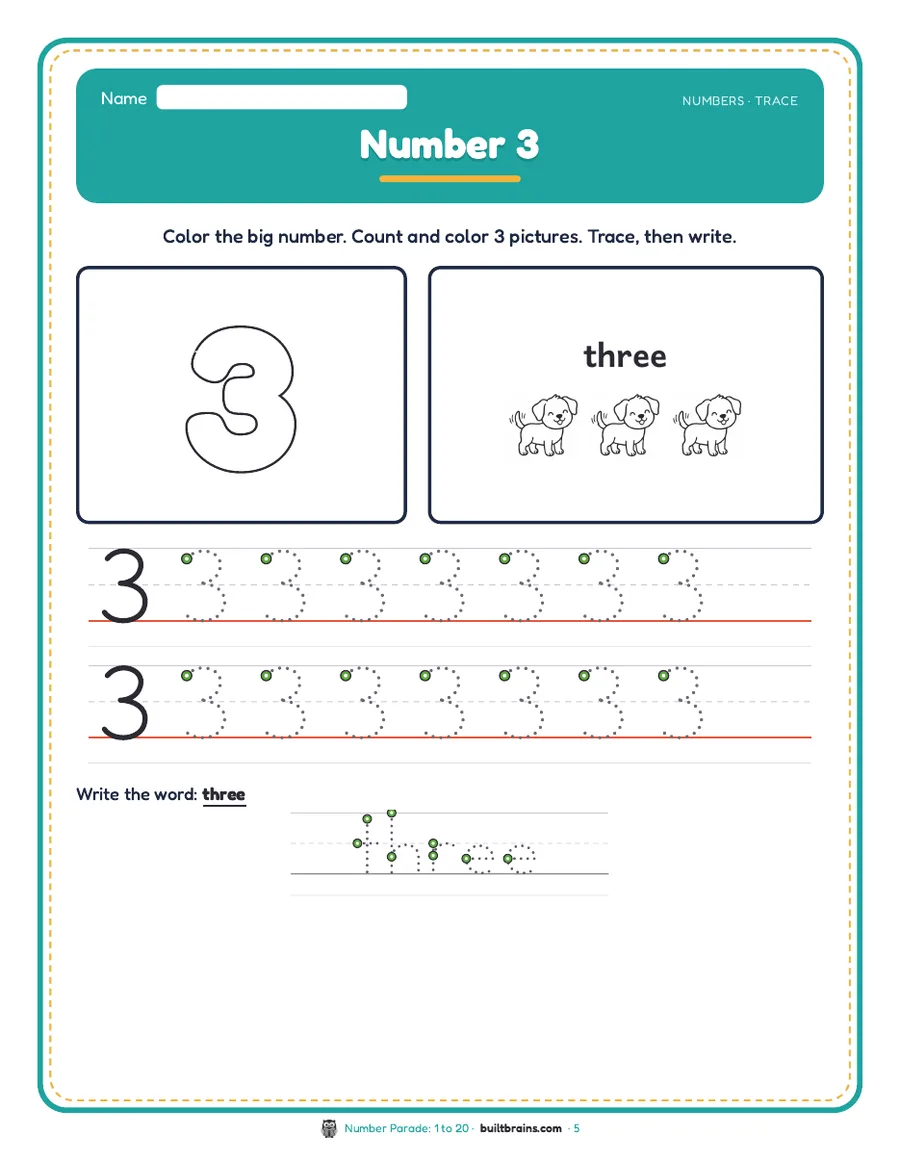
- Color the big number. This slows your child down so they notice the shape.
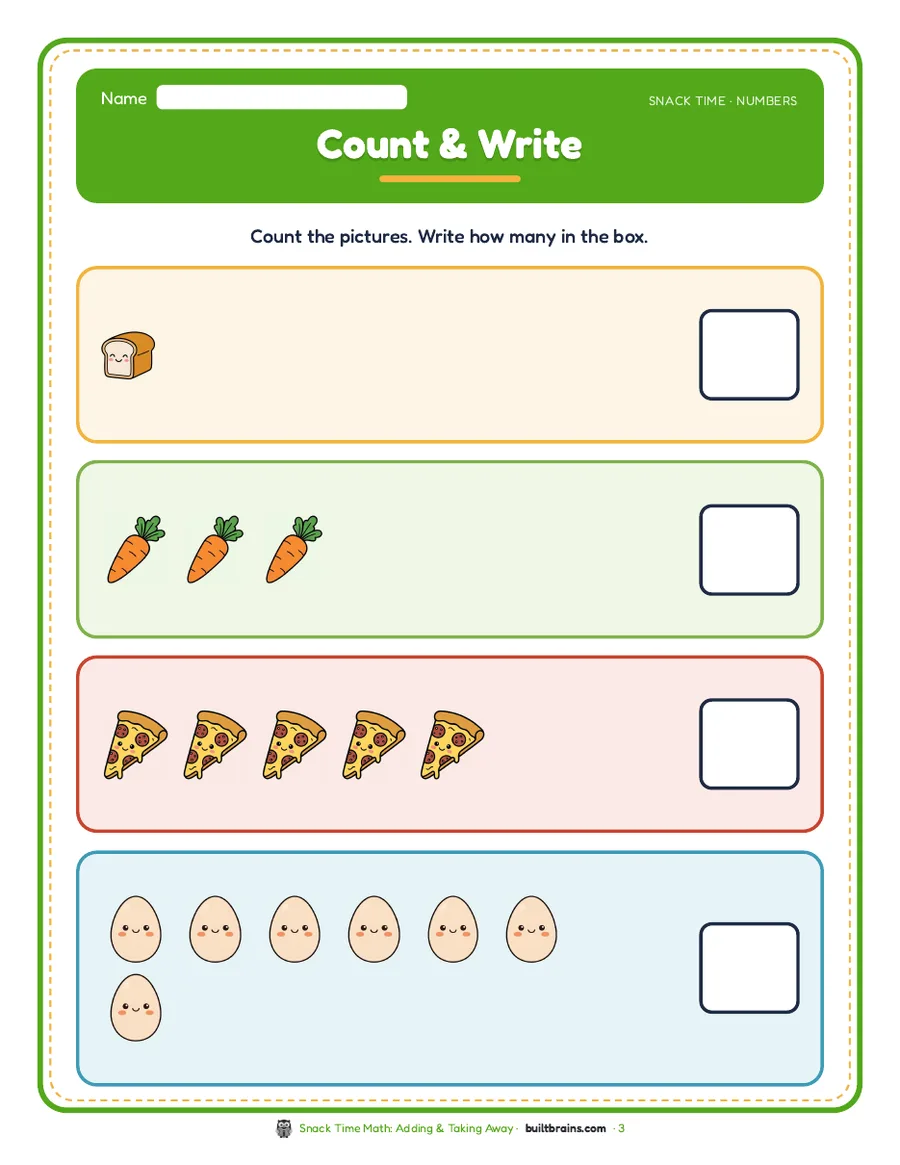
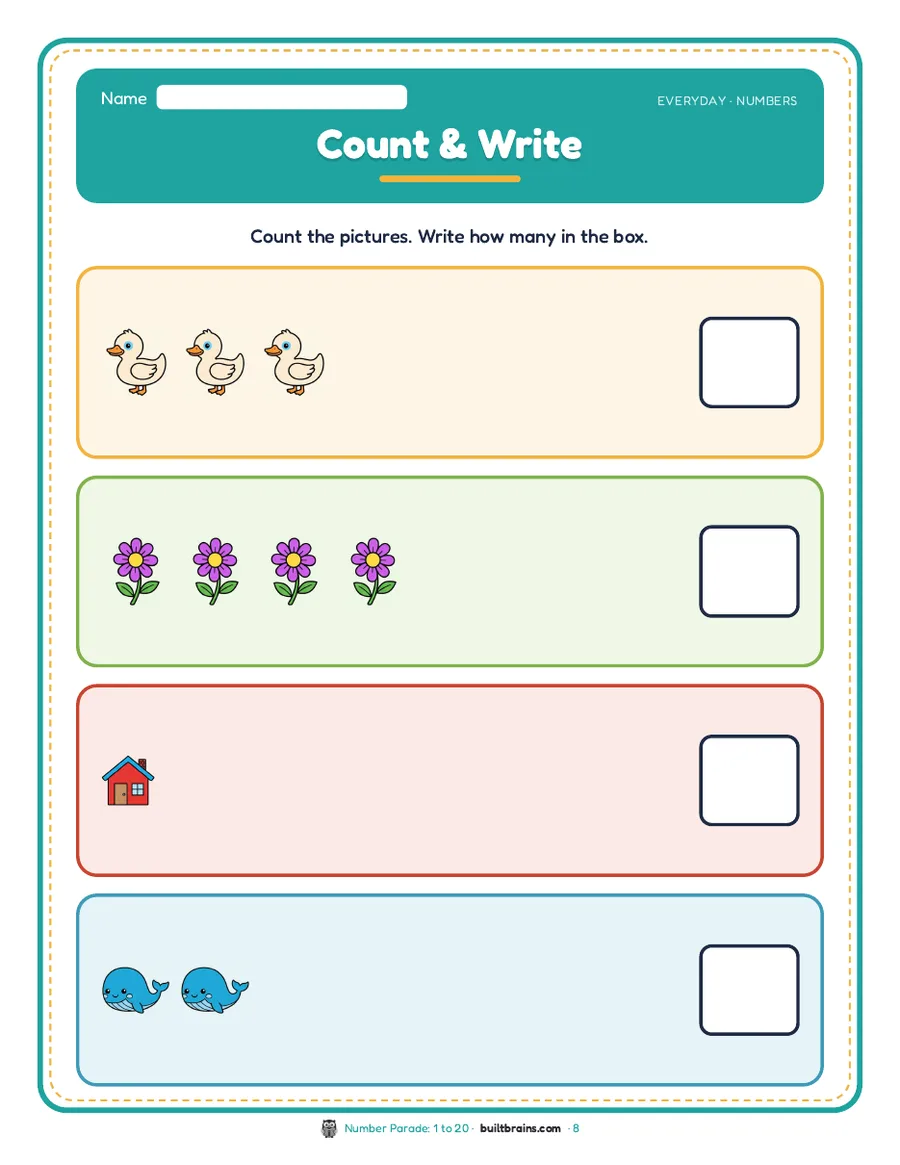
- Count the pictures. Touch each one and say one number per touch.
- Trace the digit. Start at the dot and follow the arrows. Trace with a finger first, then a crayon.
- Trace the word. For younger children, you can trace the word together, hand over hand.
You need a pencil or crayon, a few colors and about ten small objects, such as blocks, buttons or crackers, for counting. Our guide to number tracing 1 to 20 has formation rhymes for every digit and a 4-week plan if you want a schedule.
Tips by age
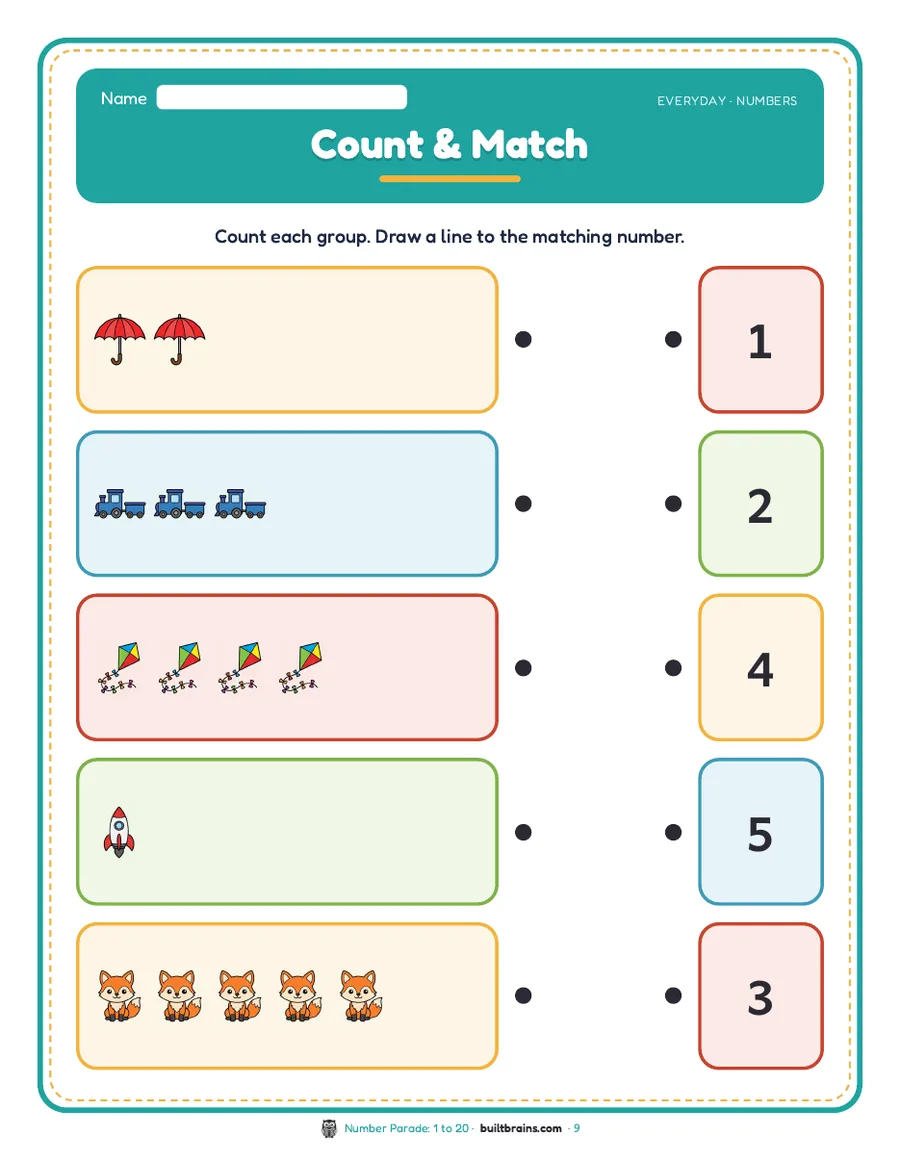
Age 3. Stick to the numbers 1 to 3 and lots of real objects. Finger trace, then crayon trace. Do the count-and-match page together, counting out loud as you point.
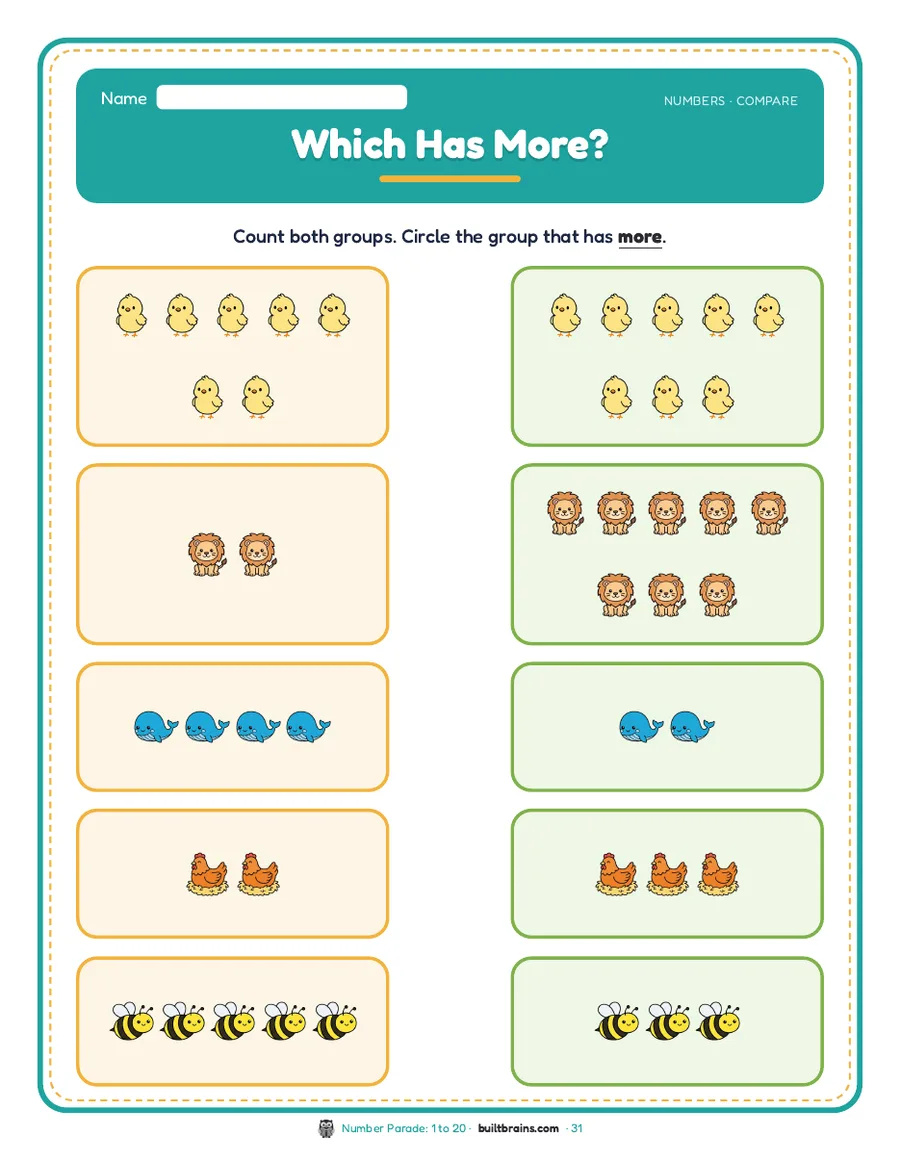
Age 4. Expect your child to trace the digit alone and count to 3 easily. Ask them to show you three fingers, three jumps and three claps. On the "which has more?" page, ask them how they know, not just which one.
Age 5. Go through the three tracing pages quickly and spend more time on comparing. Ask "how many more?" and let them count the difference. Try writing 1, 2 and 3 on blank paper with no dots.
Games to play with the pages
- Snack count. Put crackers on each picture of the counting pages, count them, then eat them one by one counting backward.
- Number hop. Lay the three tracing pages on the floor. Call out a number and your child hops to it, then hops that many times.
- More or less hunt. After the "which has more?" page, set up two piles of toys and let your child decide which has more, then check by lining them up.
- Hide and count. Hide 1, 2 or 3 small toys under a cup. Lift it, count and point to the matching number page.
- Number of the day. Pin up today's page and spot that number on clocks, doors and car plates on a walk.
For more ideas across counting, shapes and patterns, see our list of math activities for preschoolers.
When your child is ready for more
When 1 to 3 feel easy, carry on to 4 and 5, then pause for a review before 6. Grouping numbers in fives keeps practice manageable and lets your child see progress quickly. Numbers 11 to 20 are trickier because the names don't match the digits, so give them a little more time.
The full Number Parade: 1 to 20 follows exactly this order. It has 20 number tracing pages, 8 counting and number pages, 2 compare and order pages, count-and-clip cards, dot-to-dots and review pages after every five numbers, with a certificate of completion at the end.
Questions parents ask
Most children start number tracing between 3 and 5. A 3 year old can color the big number and trace with a finger. By 4, most can trace the digit with a crayon and count small groups. Five year olds often trace the number word too and move quickly through the counting pages.
Yes. The 6 pages are free to download and print as often as you like for home or class use. No email or account is needed. Pick Colourful or Black & White and US Letter or A4, and the file downloads instantly.
Tracing teaches what a number looks like, but children also need to know how many it means. The count-and-write, count-and-match and "which has more?" pages connect each numeral to a real quantity, which is the part that turns tracing into number sense.
Reversals such as a backward 2 or 3 are very common up to about age 6 or 7 and usually fade with practice. Keep tracing from the start dot, say a little formation rhyme as you go, and gently point out the right direction without making a big deal of it.
Number Parade: 1 to 20 has 37 pages: 20 number tracing pages, 8 counting and number pages, 2 compare and order pages, 2 pages of count-and-clip cards and 2 dot-to-dots, with review pages after every five numbers and a certificate of completion.