
How to use these kindergarten addition worksheets
Each page takes 5 to 10 minutes. You need a pencil, crayons and, if you like, a small bowl of real snacks such as crackers, raisins or cereal.
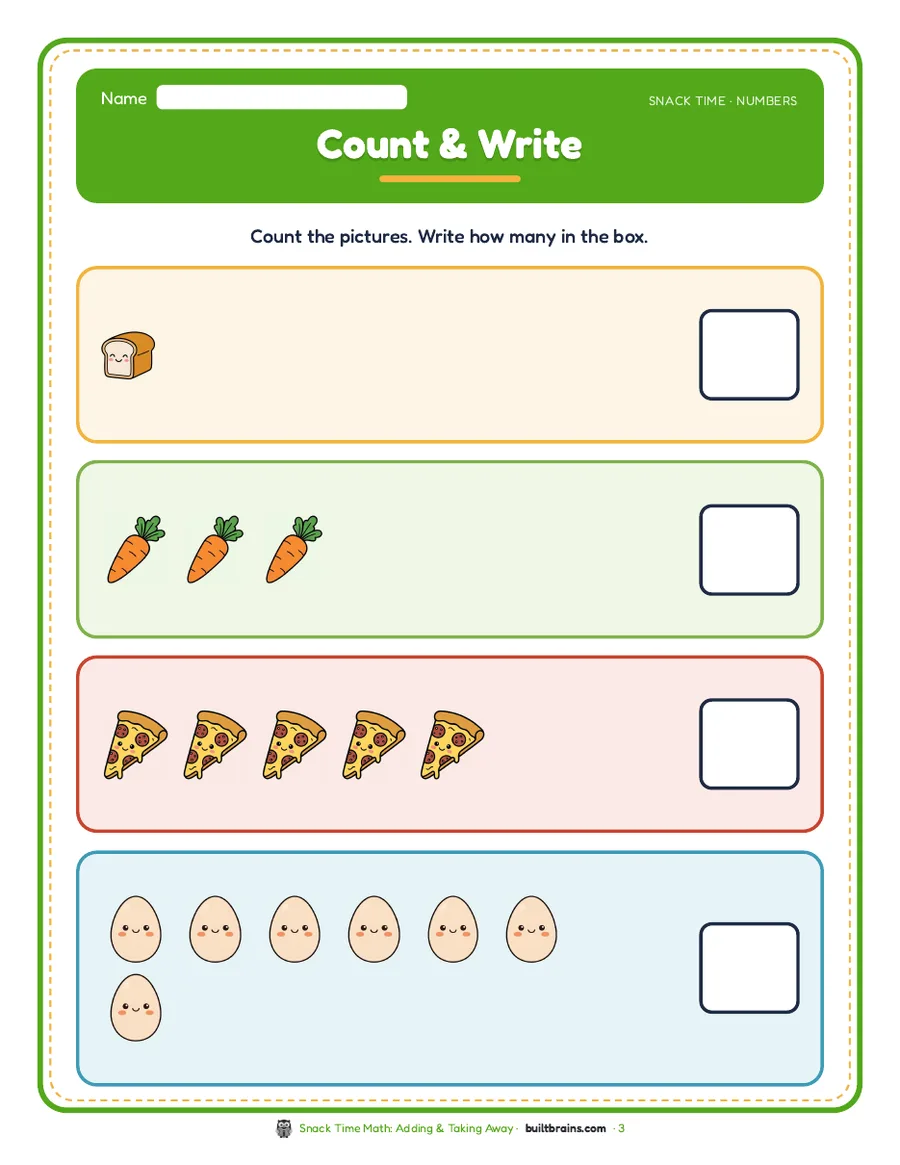
- Warm up with counting. On the count-and-write page, your child touches each picture as they count, then writes the number. Touching keeps the count honest.
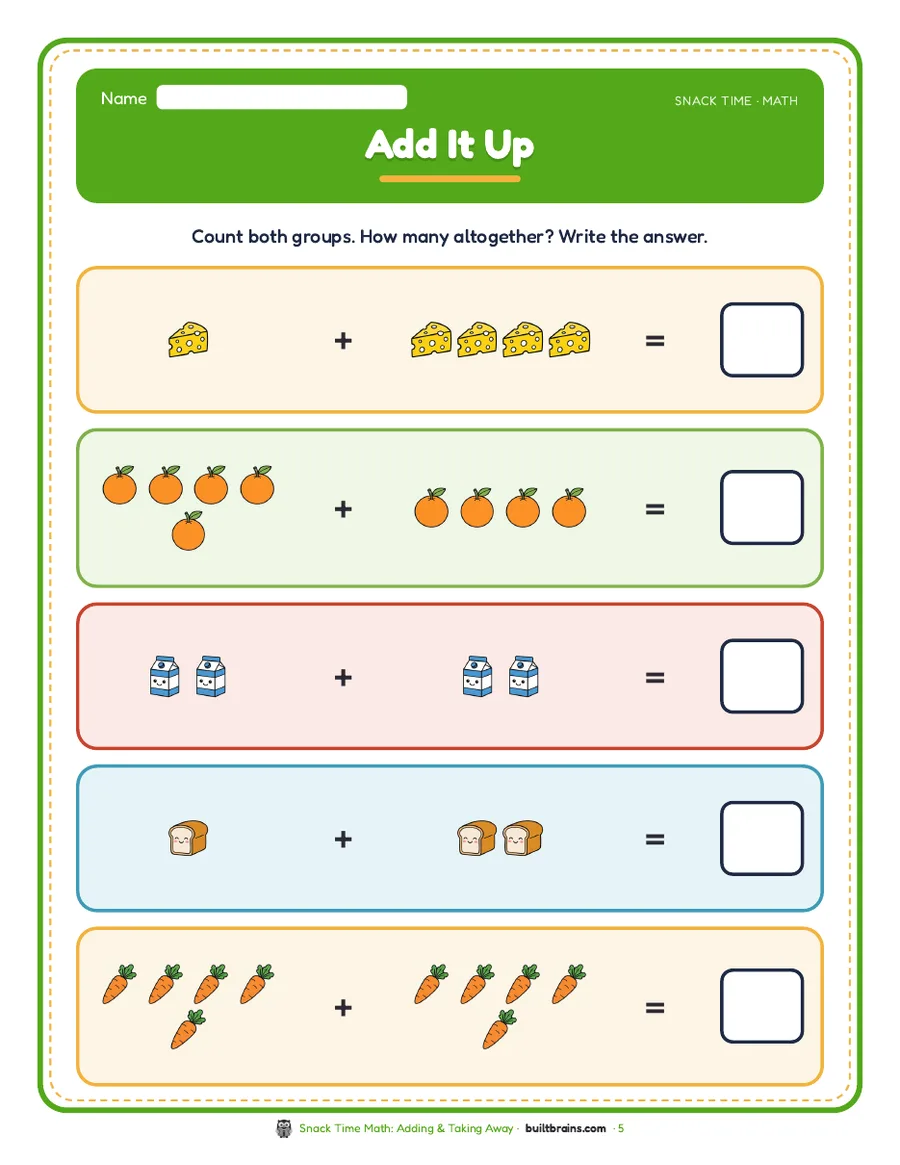
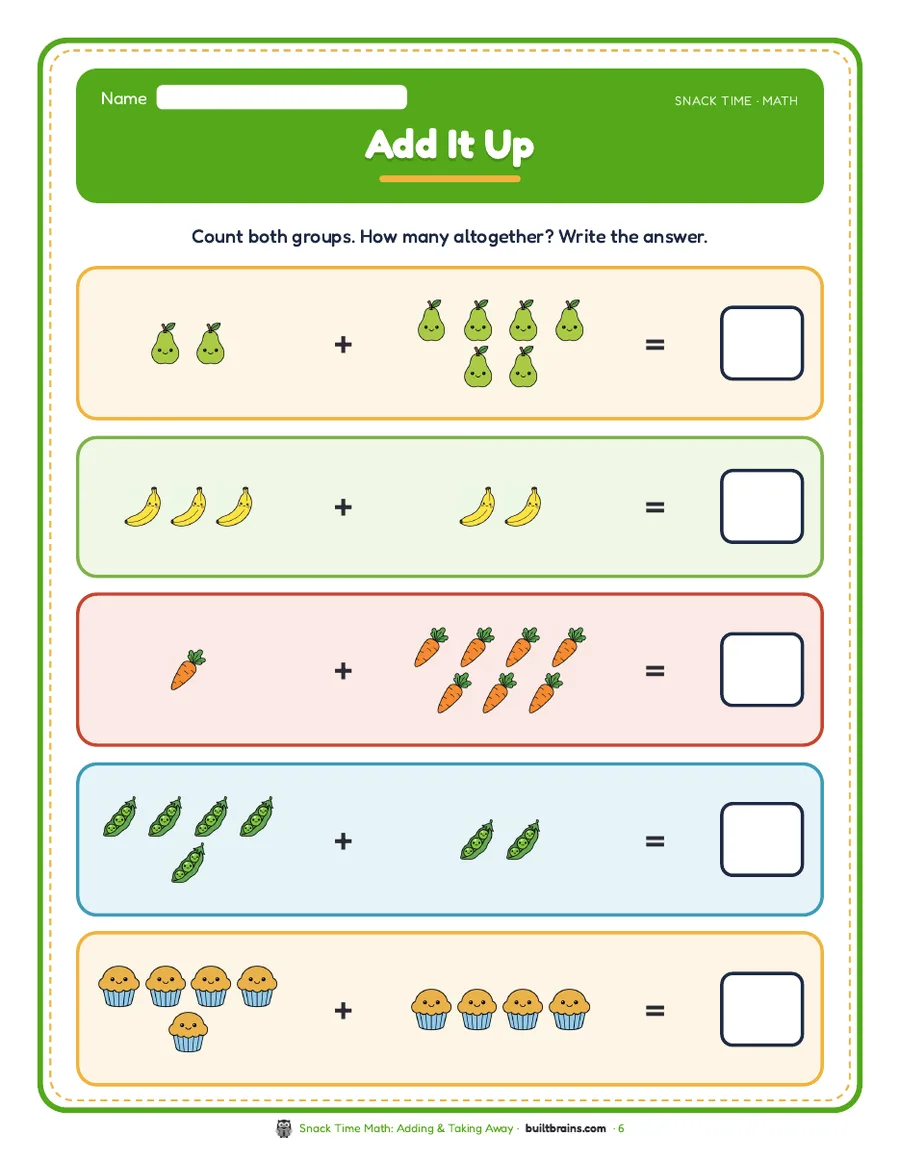
- Add it up. Count the first group, count the second, then count them all together and write the answer. Read the sum out loud: "three plus two equals five."
- Do the second add-it-up page another day. Repeating the same kind of page builds confidence. This time, see if your child can count on from the first group.
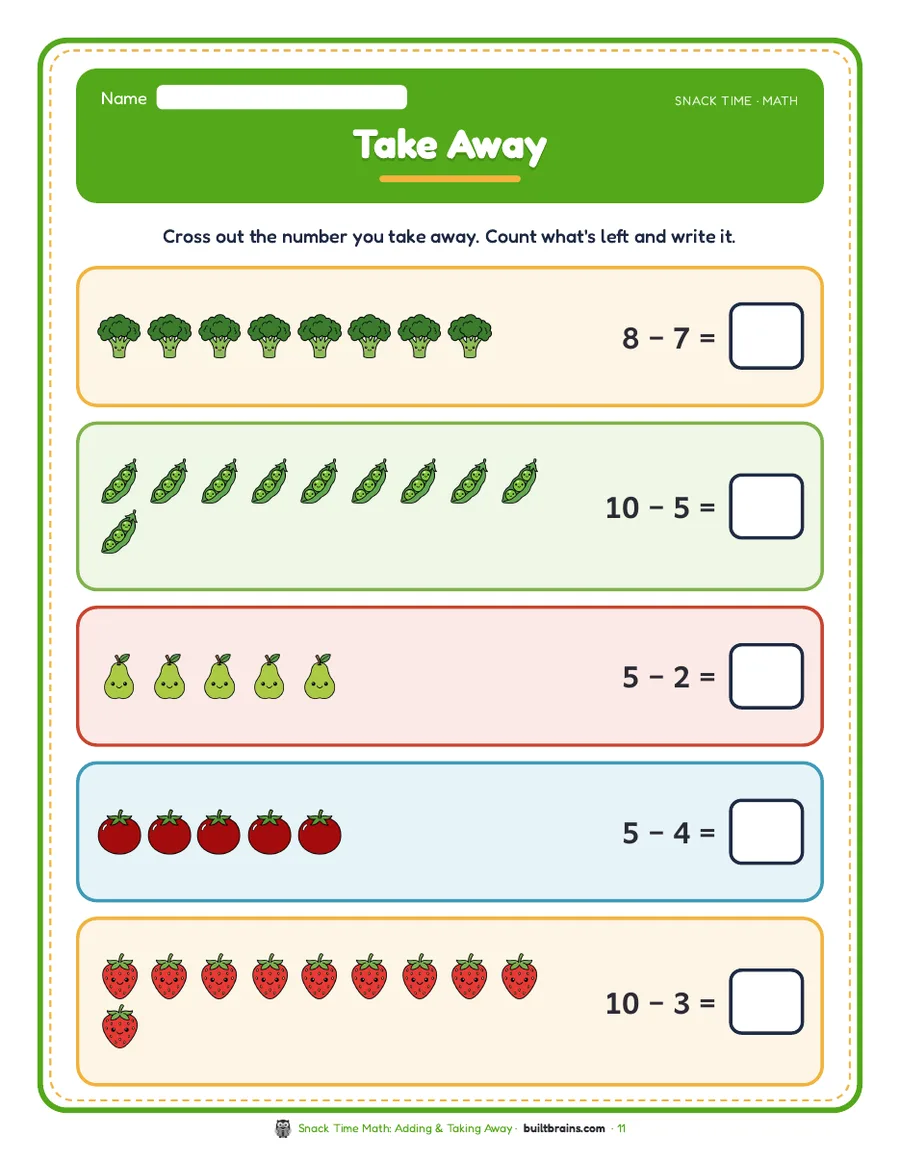
- Take away. Count the pictures, cross out the number being taken away, and count what is left. Act it out first with real snacks: put out 8, eat 7, how many are left?
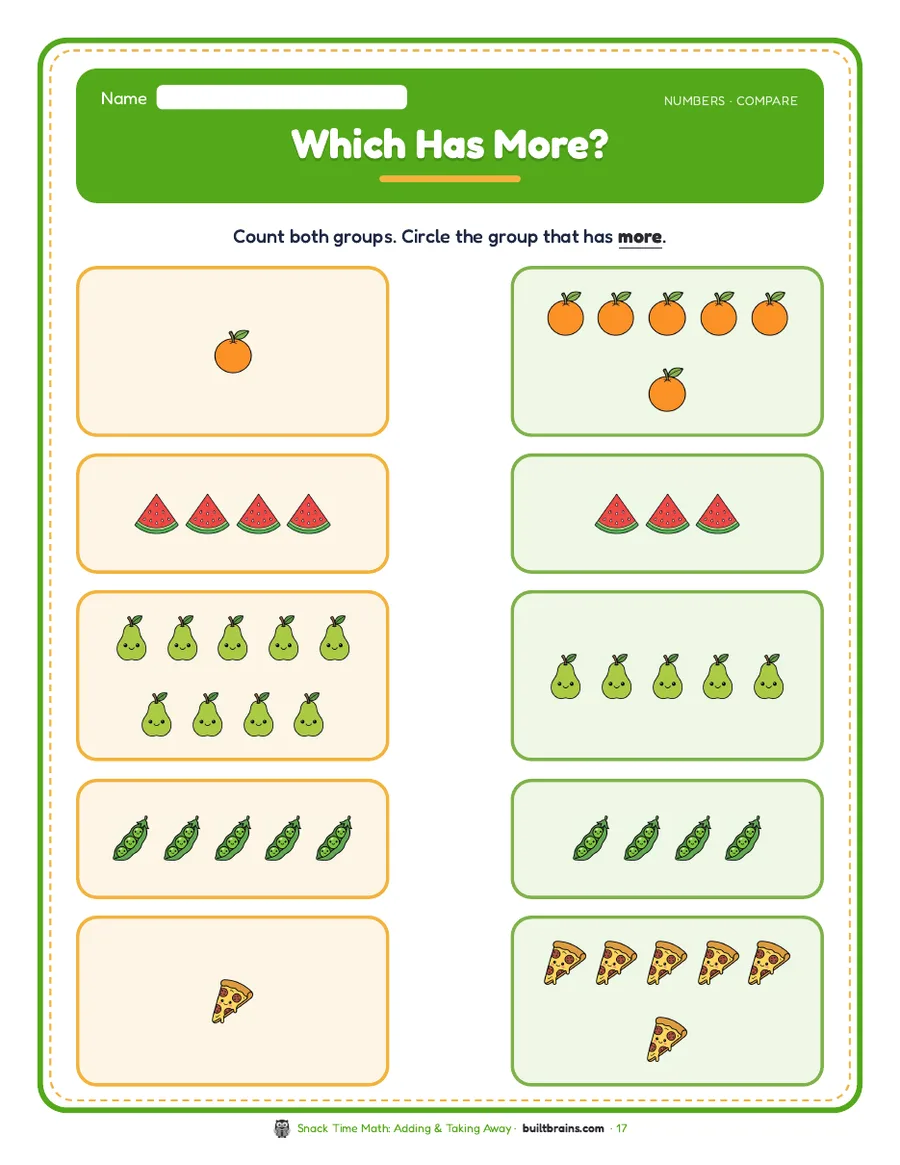
- Which has more? Count both groups and circle the bigger one. Ask "how many more?" for a stretch.
For more ways to build number sense away from paper, our post on math activities for preschoolers has ideas for counting, patterns and early adding with snacks.
Tips by age
Just turned 5. Use real objects on top of the pictures, one cracker per picture. Write the answer for them if writing numbers is slow, and let them trace over it.
Older 5s and 6s. Cover the pictures with a sticky note after counting the first group, and ask them to count on from that number.
Ready for a challenge. After each sum, ask for the turnaround fact: if 3 plus 2 is 5, what is 2 plus 3?
Games to play with the pages
- Snack sums. Use the add-it-up pages as a placemat. Put real snacks on each picture, add, and eat the answer.
- Make your own. On the back of a page, draw two groups of anything (dots, hearts, cars) and swap with a grown-up to solve.
- More or less dice. Roll two dice. Whoever has more wins the round. It turns the which-has-more page into a game.
- Story problems. Turn any sum into a story: "Five ducks were in the pond. Two swam away. How many are left?"
- Count the day. Count things around the house to 10 in a big group, a nice link if your class does a 100th day of school celebration later in the year.
When your child is ready for more
Once picture sums to 10 feel easy, the next steps are knowing pairs that make 10 (like 6 and 4), counting on without pictures, and seeing that adding and taking away are linked: if 7 plus 3 is 10, then 10 take away 3 is 7.
Snack Time Math: Adding & Taking Away builds that step by step over 23 pages: 12 adding and taking-away pages, more-or-less and matching, counting and graphing, and count-and-clip cards to cut out. It keeps the same friendly snack pictures throughout, so math still feels like snack time.
Questions parents ask
Most children are ready to add with pictures once they can count a group of up to 10 objects accurately, touching each one once. That is usually around 5. Start with real objects or pictures like these before moving to sums written only in numbers, which come later in the year.
Yes. Choose Colourful or Black & White and US Letter or A4, and the download starts immediately, with no email and no account. These five pages are taken straight from our Snack Time Math book, so you can try the style with your child before deciding on the full book.
Start with counting, then adding, which is why the pages are in this order. Taking away usually clicks once your child has added for a week or two. The which-has-more page fits any time and is a nice easy win on a tired day.
Yes, counting everything from 1 is the normal first stage. Over time, show them how to "count on": start from the first number and keep going. Say "you have 4, so put 4 in your head and count on: 5, 6, 7." Most children pick it up with a little practice.
Snack Time Math: Adding & Taking Away has 23 pages: 12 adding and taking-away pages, more-or-less and matching pages, counting and graphing, and count-and-clip cards to cut out. Inside are 13 math pages, 3 counting and number pages, 2 compare and order pages and 2 cut-out card pages.